Describing Wave Motion
3 guided lessons · 27 checks · 3. Waves → Waves & The Electromagnetic Spectrum
Guided lessons for this note
Which concept don't you understand yet?
We'll explain it simply and check your understanding. Pick any lesson — any order works.
0 of 27 checks correct so far
Lesson 1 of 3
Wavefronts
Seen from above, a moving wave can be drawn as a set of parallel lines, each standing for one wave: the wavefronts. Their spacing does real work in diagrams, because crowded lines mean a short wavelength and widely spaced lines mean a long one. The arrow showing travel direction is called a ray.
What you know already
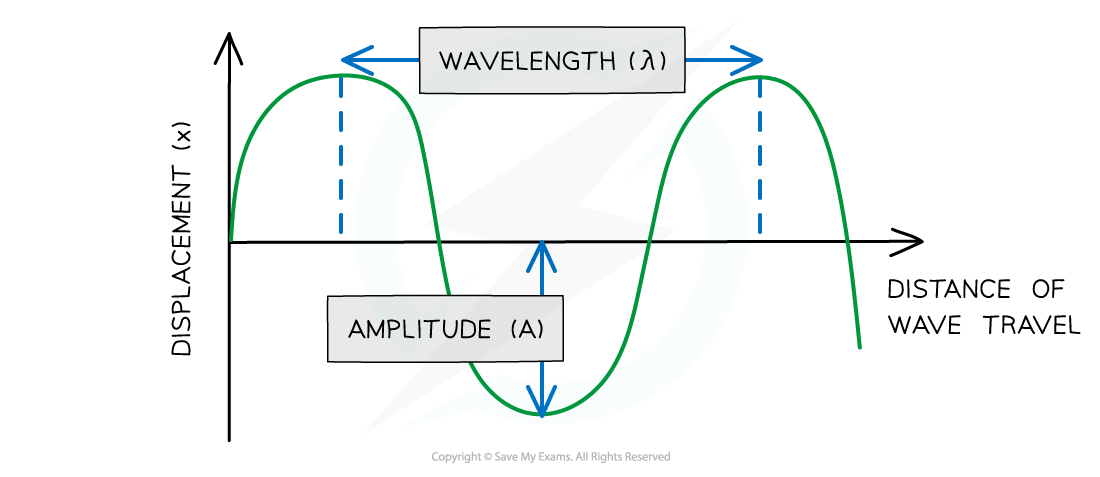
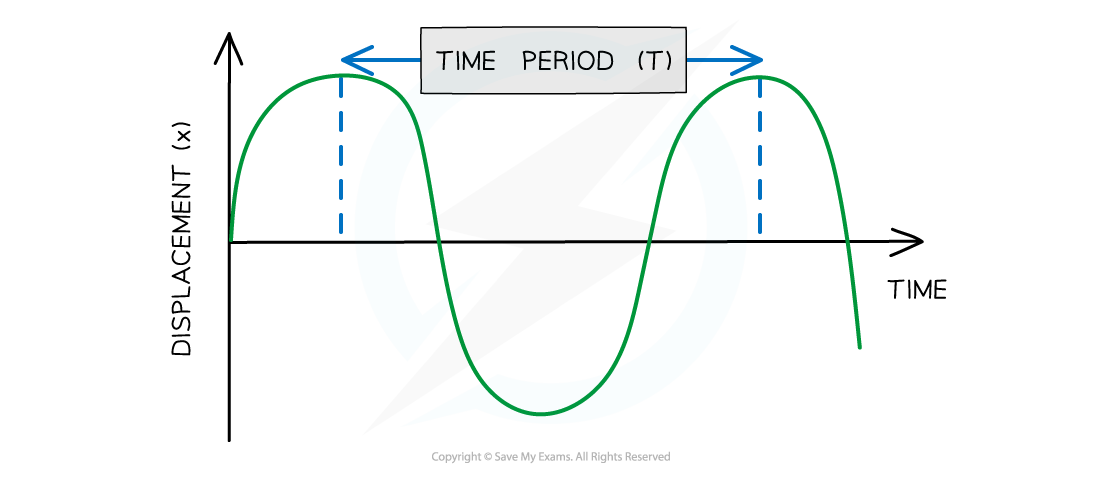
Waves only make sense once you can measure them. This lesson fixes the five measuring words of wave motion in place: the wavefront you draw from above, the amplitude of a swing, the wavelength between matching points, the frequency of passes per second and the period of a single pass. Every later wave calculation leans on these.
Key points of understanding
- Each wavefront line represents a single wave drawn as if viewed from above.
- The arrow showing the direction a wave moves is called a ray.
- The gap between neighbouring wavefronts represents the wavelength.
- Close-spaced wavefronts show a short wavelength; far-spaced ones show a long wavelength.
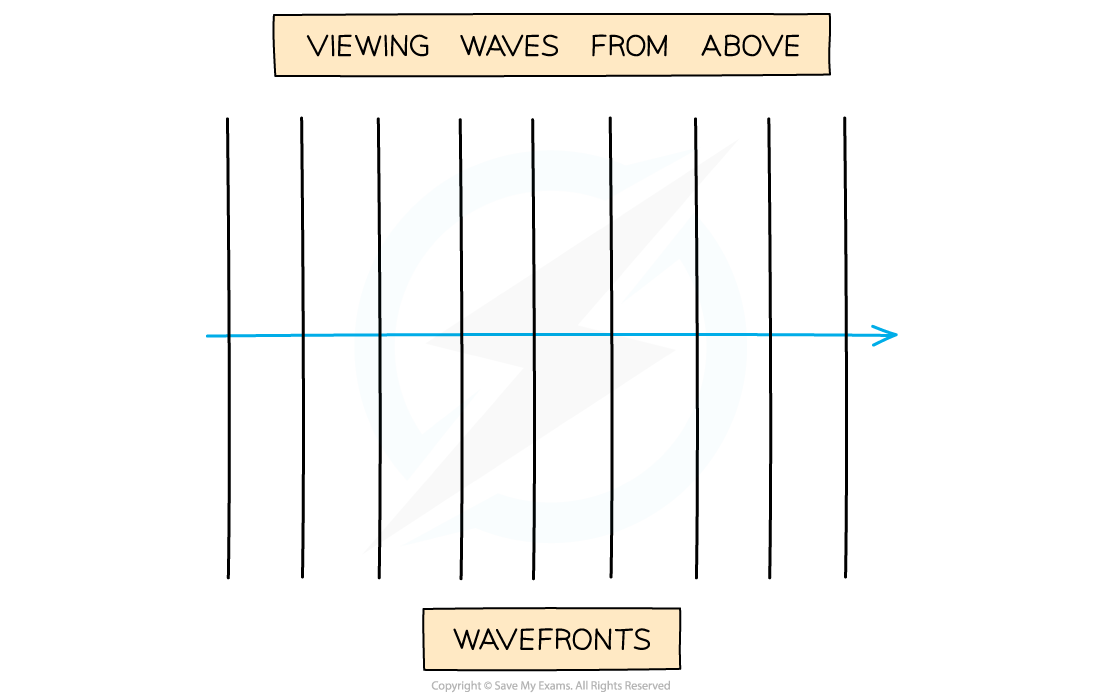
Diagram showing a wave moving to the right, drawn as a series of wavefronts
Choose a confidence level to continue.
Prefer to read it all at once? Show the full lesson as a page
1.Wavefronts
Seen from above, a moving wave can be drawn as a set of parallel lines, each standing for one wave: the wavefronts. Their spacing does real work in diagrams, because crowded lines mean a short wavelength and widely spaced lines mean a long one. The arrow showing travel direction is called a ray.
Diagram showing a wave moving to the right, drawn as a series of wavefronts
Key points
- Each wavefront line represents a single wave drawn as if viewed from above.
- The arrow showing the direction a wave moves is called a ray.
- The gap between neighbouring wavefronts represents the wavelength.
Guided content from the SME authoring corpus — note rn_TPSJT83Gh8nMCcVV, pinned at dad406f1ecd8 · promoted SyllabAI/syllabai-resources b3caaaa90c5e