Centre of Gravity
1 guided lesson · 9 checks · 1. Forces & Motion → Moments
Guided lessons for this note
Which concept don't you understand yet?
We'll explain it simply and check your understanding. Pick any lesson — any order works.
0 of 9 checks correct so far
Lesson 1 of 1
Centre of gravity
Every object has one special point at which its weight can be treated as acting — the centre of gravity. Knowing that point tells you exactly where to start the weight arrow in any force diagram. This lesson defines the point, places it for symmetrical shapes, and works through the hanging method used for irregular ones.
What you know already
You have just met moments — the turning effects that forces produce about a pivot. Whether a force turns an object depends on where that force is applied, which raises a natural question: where on a body does its weight actually act? This note answers that with a single special point, the centre of gravity, and shows how to find it.
Key points of understanding
- An object's centre of gravity is the single point through which its whole weight acts.
- A symmetrical object with uniform density carries its centre of gravity at the point of symmetry — a sphere's sits at the exact centre.
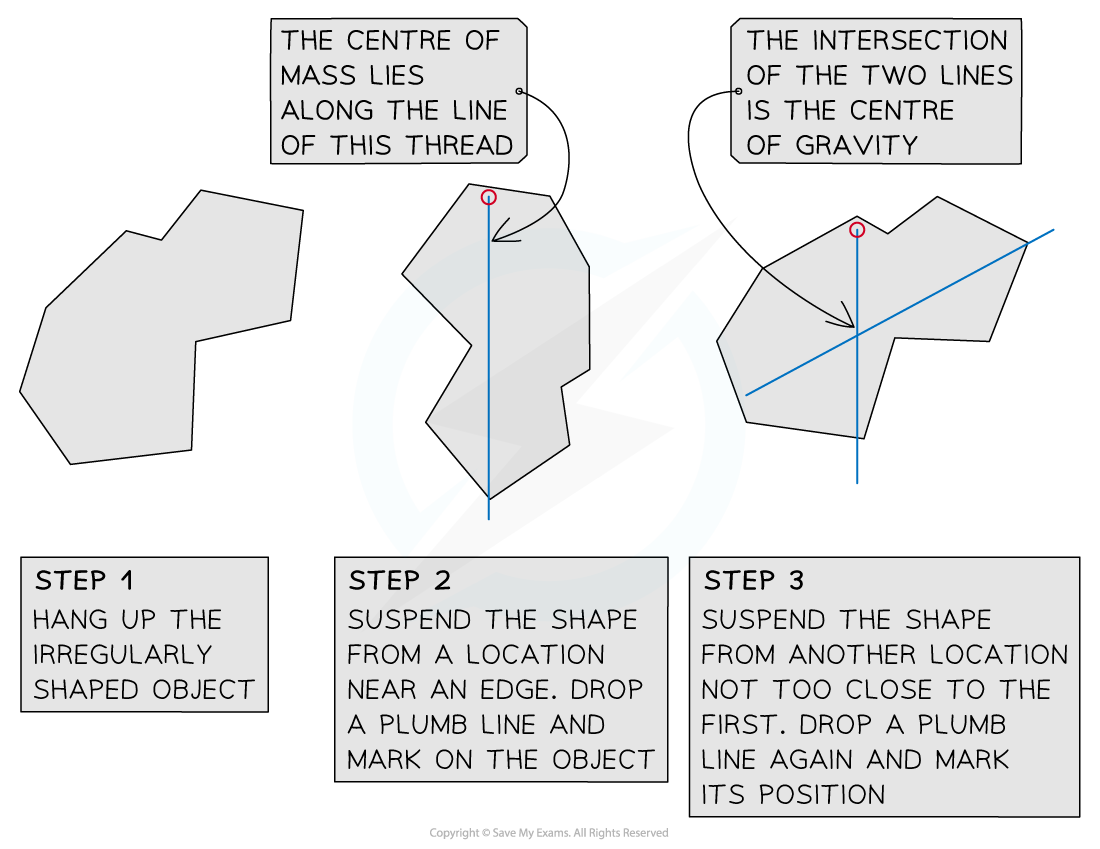
- An irregular object's centre of gravity is found by hanging the shape from a pivot.
- A plumb line hung beside the pivot marks a vertical line that must pass through the centre of gravity.
- Repeating the suspension from two further points, the centre of gravity appears where all the lines intersect.
- Because the point is hypothetical it can lie outside the body, yet force diagrams must still show weight acting from it.
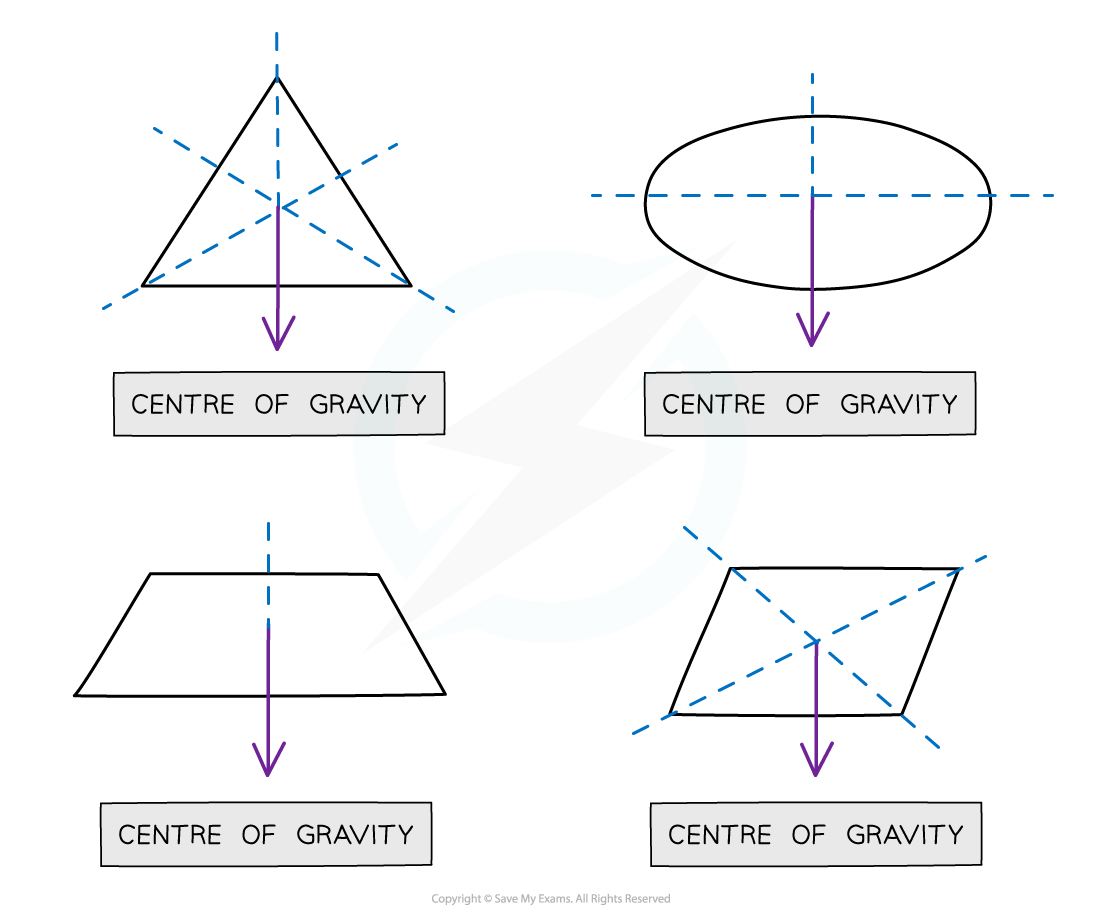
The centre of gravity of a regular shaped object can be found using symmetry
Choose a confidence level to continue.
Prefer to read it all at once? Show the full lesson as a page
1.Centre of gravity
Every object has one special point at which its weight can be treated as acting — the centre of gravity. Knowing that point tells you exactly where to start the weight arrow in any force diagram. This lesson defines the point, places it for symmetrical shapes, and works through the hanging method used for irregular ones.
The centre of gravity of a regular shaped object can be found using symmetry
Key points
- An object's centre of gravity is the single point through which its whole weight acts.
- A symmetrical object with uniform density carries its centre of gravity at the point of symmetry — a sphere's sits at the exact centre.
- An irregular object's centre of gravity is found by hanging the shape from a pivot.
- A plumb line hung beside the pivot marks a vertical line that must pass through the centre of gravity.
- Repeating the suspension from two further points, the centre of gravity appears where all the lines intersect.
- Because the point is hypothetical it can lie outside the body, yet force diagrams must still show weight acting from it.
First pass
The whole weight of a body can be drawn as one arrow acting through a single point, the centre of gravity.
Analogy — A shopping bag swings from one spot on your hand however unevenly it is packed — the bag behaves as if all its weight pulled from that spot.
Exam pointer — In any force diagram, start the weight arrow at the object's centre of gravity — examiners look for exactly that.
Going deeper
Symmetry locates the point for regular bodies — a uniform sphere's sits at its geometric centre — while irregular shapes need hanging, plumb lines and intersecting marks.
Analogy — Hang a picture frame from one nail and let it swing: it settles only when its heavy point hangs directly beneath the nail, which is the settling a plumb line records.
Exam pointer — The point is hypothetical — it can fall outside the body and slides as posture changes, yet diagrams still anchor the weight there.
Checks
0 of 9 attempted · 0 correct
Guided content from the SME authoring corpus — note rn_TPDdhwDYsrWgQB7R, pinned at 0cea83a78102 · promoted SyllabAI/syllabai-resources b3caaaa90c5e