Momentum & Safety Features
2 guided lessons · 18 checks · 1. Forces & Motion → Momentum
Guided lessons for this note
Which concept don't you understand yet?
We'll explain it simply and check your understanding. Pick any lesson — any order works.
0 of 18 checks correct so far
Lesson 1 of 2
Safety features in vehicles
When a car stops abruptly, its passengers keep moving — and the faster that momentum is brought to zero, the harder the hit. Every safety device in a vehicle works the same trick: stretching out the stopping time so the force shrinks. This lesson follows that idea through seat belts, airbags and crumple zones.
What you know already
You already know that every moving object carries momentum, and that a force acting over a time changes it. This lesson puts that idea to work: seat belts, airbags, crumple zones and crash mats all manipulate one quantity — the time a collision lasts — to cut the forces a body feels.
Key points of understanding
- Force equals the rate of change of momentum, so lengthening the collision time lowers the force the impact delivers.
- Contact time is how long the person stays in touch with whatever they have hit.
- Crumple zones, seat belts and airbags absorb impact energy by changing shape, stretching the duration of the force.
- A stretched seat belt gives the passenger's momentum longer to fall to zero, cutting the force felt.
- Airbags cushion passengers thrown forwards, and crumple zones crush deliberately at the front and rear to extend the stopping time.
- A heavy, fast vehicle carries huge momentum, so only an extended contact time can keep its impact force down.
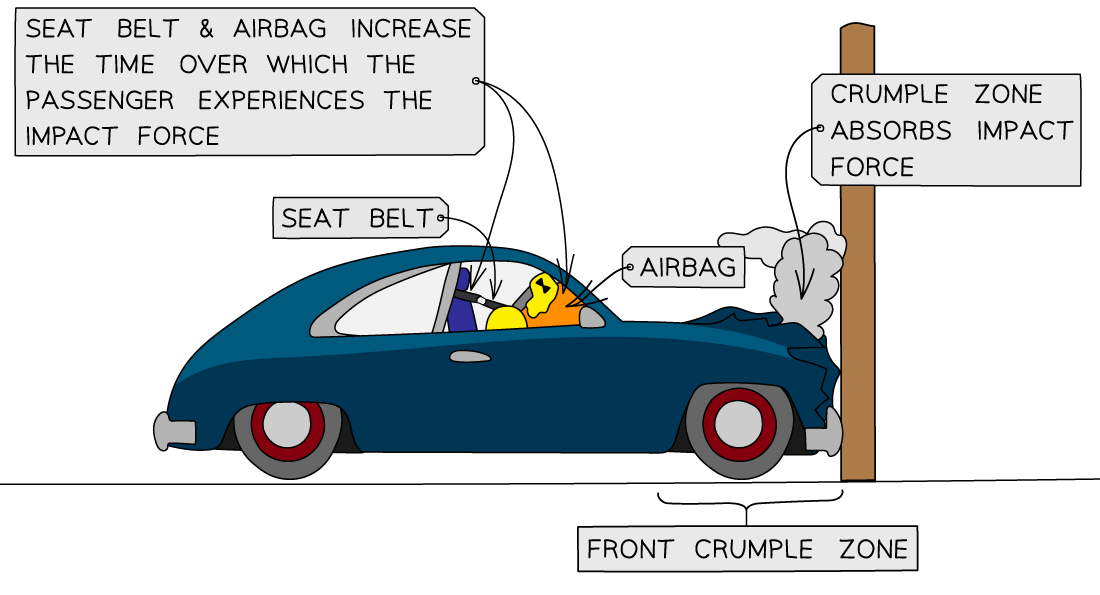
The seat belt, airbag and crumple zones help reduce the risk of injury on a passenger
Choose a confidence level to continue.
Prefer to read it all at once? Show the full lesson as a page
1.Safety features in vehicles
When a car stops abruptly, its passengers keep moving — and the faster that momentum is brought to zero, the harder the hit. Every safety device in a vehicle works the same trick: stretching out the stopping time so the force shrinks. This lesson follows that idea through seat belts, airbags and crumple zones.
The seat belt, airbag and crumple zones help reduce the risk of injury on a passenger
Key points
- Force equals the rate of change of momentum, so lengthening the collision time lowers the force the impact delivers.
- Contact time is how long the person stays in touch with whatever they have hit.
- Crumple zones, seat belts and airbags absorb impact energy by changing shape, stretching the duration of the force.
- A stretched seat belt gives the passenger's momentum longer to fall to zero, cutting the force felt.
- Airbags cushion passengers thrown forwards, and crumple zones crush deliberately at the front and rear to extend the stopping time.
- A heavy, fast vehicle carries huge momentum, so only an extended contact time can keep its impact force down.
First pass
Longer collision time means smaller force: that one trade is what every vehicle safety feature makes.
Analogy — Catching a ball by drawing your hands back as it arrives — the same catch spread over more time stings far less.
Exam pointer — Feature questions want the chain spelled out: contact time up, so force down, so injury risk down.
Going deeper
Because force is the rate of change of momentum, the same momentum change spread over a longer interval arrives as a gentler force — the shared design goal of crumple zones, belts and airbags.
Analogy — Picture the momentum change as a fixed volume of water and the contact time as the pipe's width: a wider pipe delivers the same water with a gentler push.
Exam pointer — Name the feature, state that it increases the contact time, then give the reduced force on the passenger — all three steps earn the marks.
Checks
0 of 9 attempted · 0 correct
2.Crash mats
Drop a ball on concrete and it stops in an instant; drop it on a cushion and the stop takes longer, so it feels gentler. Crash mats, playground floors and mats for light landings all apply that principle to falling bodies. This lesson shows how a soft surface buys a falling body extra contact time.
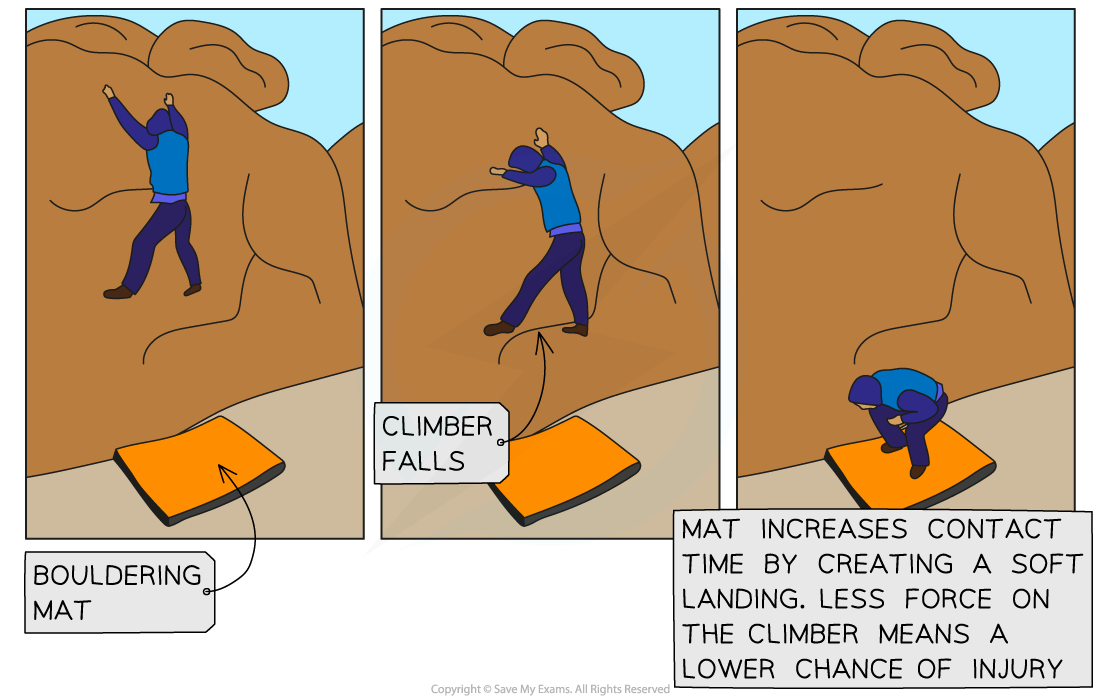
A bouldering mat is a type of crash mat used to reduce the chance of injury in falls whilst climbing
Key points
- Gymnasium crash mats are thick and soft to soak up the shock a landing body delivers.
- A soft landing keeps the body touching the mat for longer than a hard floor would.
- The extended contact time lowers the rate of momentum change, so the landing force and the injury risk both shrink.
- Playground cushioning works identically, lengthening the time a falling child spends in touch with the ground.
- Lighter children can manage with thinner mats, and low falls need less cushioning than high ones.
- Safety features lessen the chance of serious harm but cannot rule out injury altogether.
First pass
A soft mat stretches the landing out, and a longer landing means a smaller force.
Analogy — Jumping into water instead of onto paving — the water gives way, so the same stop takes longer and hurts less.
Exam pointer — Match the mat to the fall: heavier bodies and bigger drops call for thicker cushioning.
Going deeper
The mat cannot change how much momentum the falling body must lose — only how long losing it takes; force is that momentum change divided by the time, so more time means less force.
Analogy — Think of it as a payment plan: the same debt of momentum settled over more instalments takes smaller bites out of you.
Exam pointer — Justify mat thickness with both factors — the faller's mass and the speed at touchdown — not with one alone.
Checks
0 of 9 attempted · 0 correct
Guided content from the SME authoring corpus — note rn_RQK2MW3zRPNNzwtc, pinned at 0cea83a78102 · promoted SyllabAI/syllabai-resources b3caaaa90c5e