Resistors in Series
2 guided lessons · 18 checks · 2. Electricity → Components in Series & Parallel Circuits
Guided lessons for this note
Which concept don't you understand yet?
We'll explain it simply and check your understanding. Pick any lesson — any order works.
0 of 18 checks correct so far
Lesson 1 of 2
Resistors in series
Charge pushing through series resistors must run the whole obstacle course, so the oppositions stack. Add the resistances for the total, share the supply voltage across the chain, and one common current threads every component. This lesson turns that picture into three solvable equations.
What you know already
String resistors together in a row and their opposition to current simply adds up. This note states the series rule for resistance, shows why the supply voltage divides across the chain, and then summarises the full contrast between series and parallel behaviour so that any simple circuit can be solved step by step.
Key points of understanding
- Resistors in series add: the total resistance equals the sum of the individual resistances.
- For two resistors the rule reads R = R1 + R2.
- Each extra series resistor adds more opposition for the charge to push through.
- The supply voltage divides so that the individual voltages sum to the total.
- In series the current is common to every component, so one equation chain solves the circuit.
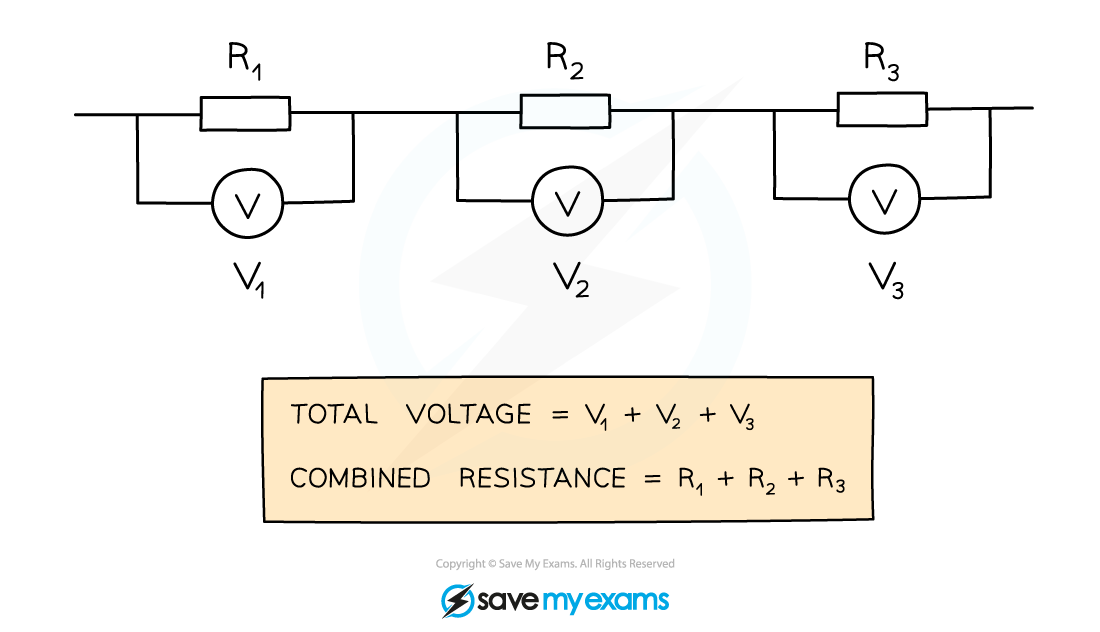
Three resistors connected in series. The total voltage is the sum of the individual voltages, and the total resistance is the sum of the three individual resistances

Choose a confidence level to continue.
Prefer to read it all at once? Show the full lesson as a page
1.Resistors in series
Charge pushing through series resistors must run the whole obstacle course, so the oppositions stack. Add the resistances for the total, share the supply voltage across the chain, and one common current threads every component. This lesson turns that picture into three solvable equations.
Three resistors connected in series. The total voltage is the sum of the individual voltages, and the total resistance is the sum of the three individual resistances
Guided content from the SME authoring corpus — note rn_PyxMmTd6S9pMDTt6, pinned at 275f3b535d78 · promoted SyllabAI/syllabai-resources b3caaaa90c5e