Snell's Law
1 guided lesson · 9 checks · 3. Waves → Reflection & Refraction
Guided lessons for this note
Which concept don't you understand yet?
We'll explain it simply and check your understanding. Pick any lesson — any order works.
0 of 9 checks correct so far
Lesson 1 of 1
Snell's law
Draw any ray hitting a boundary and two angles matter: one on the way in, one on the way out. Snell's law says the sines of those angles keep a fixed ratio, and that ratio is the material's refractive index. Because it compares two speeds, the index is a bare number — always above 1, larger for optically denser materials, and it works for every boundary light can cross.
What you know already
Refraction bends a light ray when it crosses into a new material, and Snell's law turns that bending into a calculation. One ratio — the refractive index — ties the sine of the incidence angle to the sine of the refraction angle. Rearranged, it predicts how sharply a ray bends at any boundary. This lesson defines the ratio, works the equation both ways and explains why every material lands above 1.
Key points of understanding
- Snell's law links the refractive index to the angles of incidence and refraction: n = sin i / sin r.
- The refractive index compares the speed of light in a vacuum with the slower speed of light inside the material.
- The refractive index is always larger than 1, differs between materials and has no units because it is a ratio.
- More optically dense materials have higher refractive indices: about 2.4 for diamond and about 1.5 for glass.
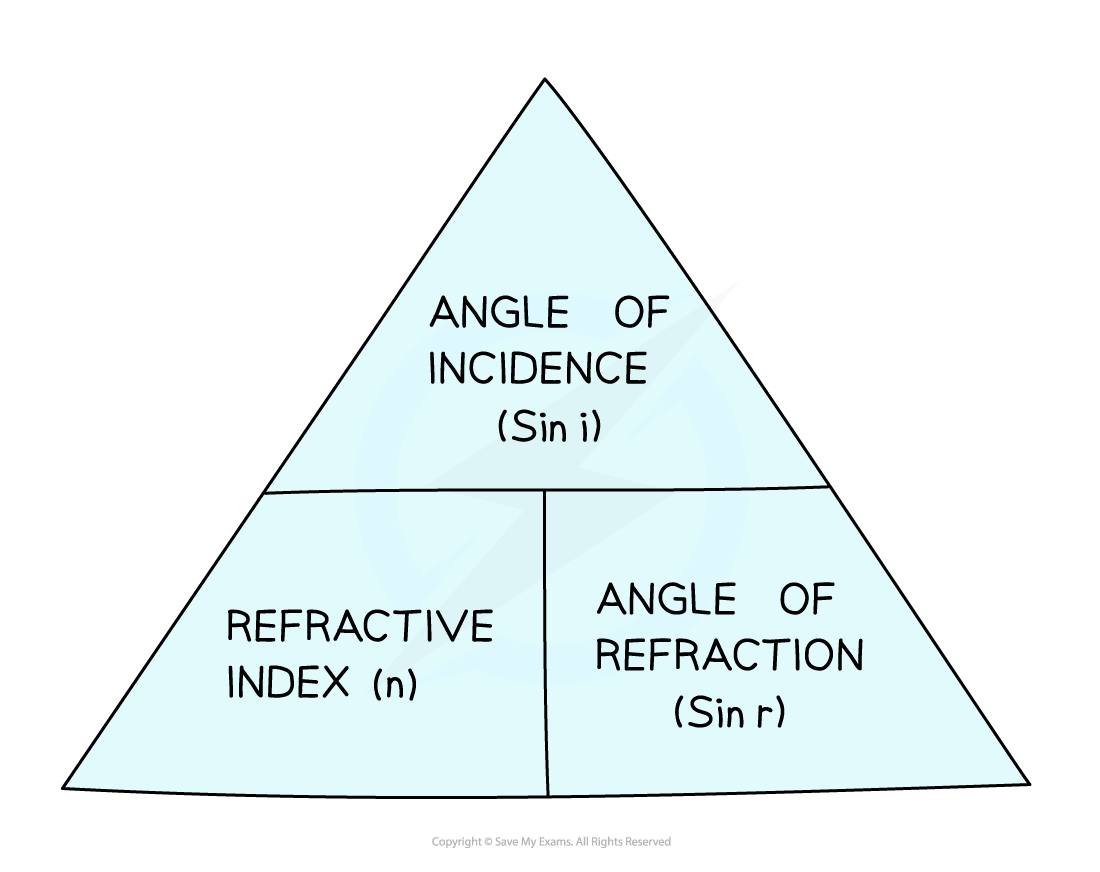
Snell's law formula triangle
Choose a confidence level to continue.
Prefer to read it all at once? Show the full lesson as a page
1.Snell's law
Draw any ray hitting a boundary and two angles matter: one on the way in, one on the way out. Snell's law says the sines of those angles keep a fixed ratio, and that ratio is the material's refractive index. Because it compares two speeds, the index is a bare number — always above 1, larger for optically denser materials, and it works for every boundary light can cross.
Snell's law formula triangle
Key points
- Snell's law links the refractive index to the angles of incidence and refraction: n = sin i / sin r.
- The refractive index compares the speed of light in a vacuum with the slower speed of light inside the material.
- The refractive index is always larger than 1, differs between materials and has no units because it is a ratio.
Guided content from the SME authoring corpus — note rn_J6rwHvcb9zhBpJCM, pinned at dad406f1ecd8 · promoted SyllabAI/syllabai-resources b3caaaa90c5e