Total Internal Reflection
3 guided lessons · 27 checks · 3. Waves → Reflection & Refraction
Guided lessons for this note
Which concept don't you understand yet?
We'll explain it simply and check your understanding. Pick any lesson — any order works.
0 of 27 checks correct so far
Lesson 1 of 3
Total internal reflection
Shine light from glass towards air at a shallow angle and it escapes, bent away from the normal. Increase the incidence angle and a threshold arrives: past it, nothing escapes — the whole ray snaps back inside the glass. Optical fibres ride that effect bounce after bounce to carry phone calls and see inside patients, while prisms use it in periscopes, binoculars and the reflectors that guard bicycles at night.
What you know already
A light ray crossing from glass into air usually refracts away from the normal — but push the incidence angle far enough and the ray never leaves at all: every bit of the light turns back inside the denser material. That sharp switch is total internal reflection, it has a threshold called the critical angle, and one small equation links that angle to the refractive index. Fibres, prisms and sparkling gemstones all run on it.
Key points of understanding
- Total internal reflection happens when light travels from a denser material towards a less dense one and the incidence angle exceeds the critical angle.
- Both conditions must hold: the incidence angle is greater than the critical angle and the first material is denser than the second.
- Optical fibres guide light by repeated total internal reflection, used for communications, endoscopes and decorative lamps.
- Prisms reflect light internally in periscopes, binoculars, telescopes and cameras.
- Safety reflectors for bicycles and cars, and posts marking road edges, also use prismatic reflection.
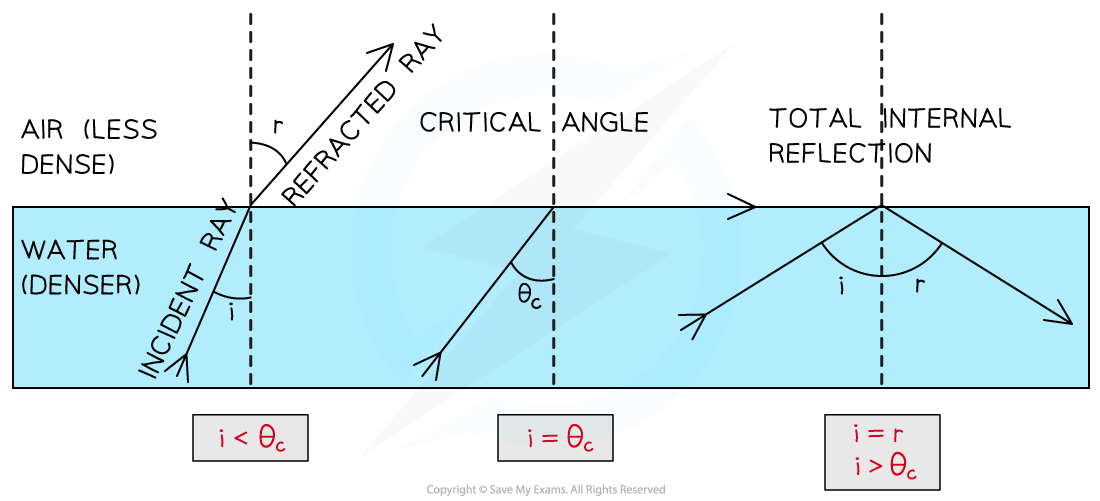
The critical angle is different for different materials. Refraction occurs when the angle of incidence is less than the critical angle, and total internal reflection occurs when it is greater
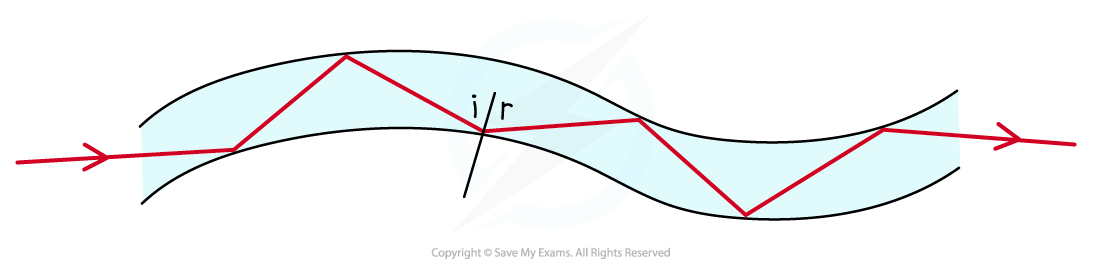
Optical fibres utilise total internal reflection for communications
Choose a confidence level to continue.
Prefer to read it all at once? Show the full lesson as a page
1.Total internal reflection
Shine light from glass towards air at a shallow angle and it escapes, bent away from the normal. Increase the incidence angle and a threshold arrives: past it, nothing escapes — the whole ray snaps back inside the glass. Optical fibres ride that effect bounce after bounce to carry phone calls and see inside patients, while prisms use it in periscopes, binoculars and the reflectors that guard bicycles at night.
The critical angle is different for different materials. Refraction occurs when the angle of incidence is less than the critical angle, and total internal reflection occurs when it is greater
Optical fibres utilise total internal reflection for communications
Key points
- Total internal reflection happens when light travels from a denser material towards a less dense one and the incidence angle exceeds the critical angle.
- Both conditions must hold: the incidence angle is greater than the critical angle and the first material is denser than the second.
- Optical fibres guide light by repeated total internal reflection, used for communications, endoscopes and decorative lamps.
- Prisms reflect light internally in periscopes, binoculars, telescopes and cameras.
- Safety reflectors for bicycles and cars, and posts marking road edges, also use prismatic reflection.
First pass
Past the critical angle, light going from a denser to a less dense material stops escaping and reflects completely inside the first material.
Analogy — A ball thrown at a net too softly passes through, but hit hard enough at the right angle it bounces straight back — except here the switch is exact, not gradual.
Exam pointer — Write the full name "total internal reflection" when asked for the phenomenon — "internal reflection" alone can drop the mark.
Going deeper
Two conditions together: the ray starts in the denser material and strikes beyond the critical angle; then none of the light is transmitted and the boundary behaves as a perfect mirror.
Analogy — A silent doorman: up to the threshold some light always slips through the boundary, past it the door shuts and everyone is turned back.
Exam pointer — Application questions want the object named first (a right-angled prism) and then the device (a periscope) — give both.
Checks
0 of 9 attempted · 0 correct
2.The critical angle
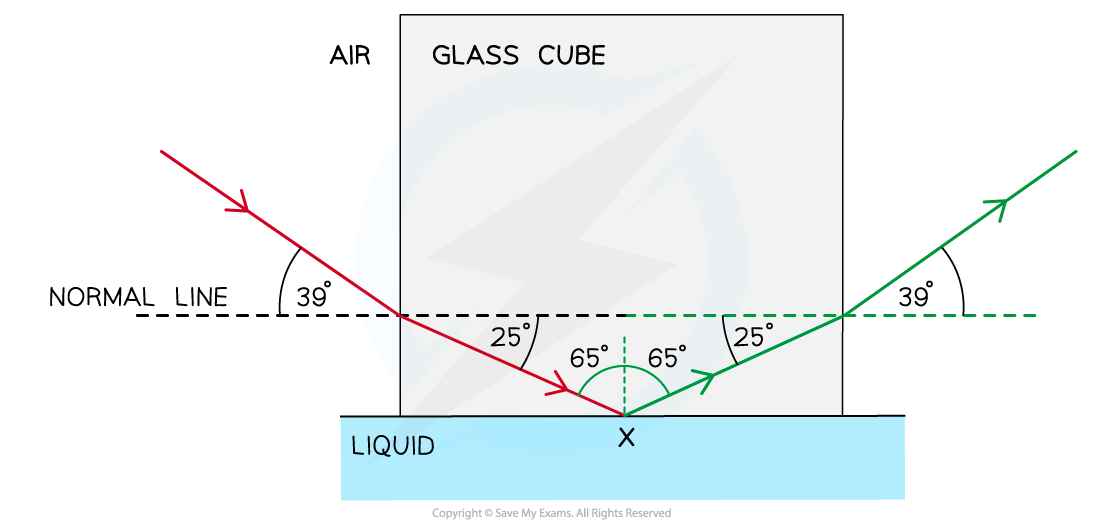
Raise the incidence angle step by step and the refracted ray walks away from the normal, closer and closer to the boundary itself. At one exact angle the refraction lies flat along the surface at 90° — that incidence angle is the critical angle. One degree more and the escaping ray is gone, replaced by a reflected one of equal strength.
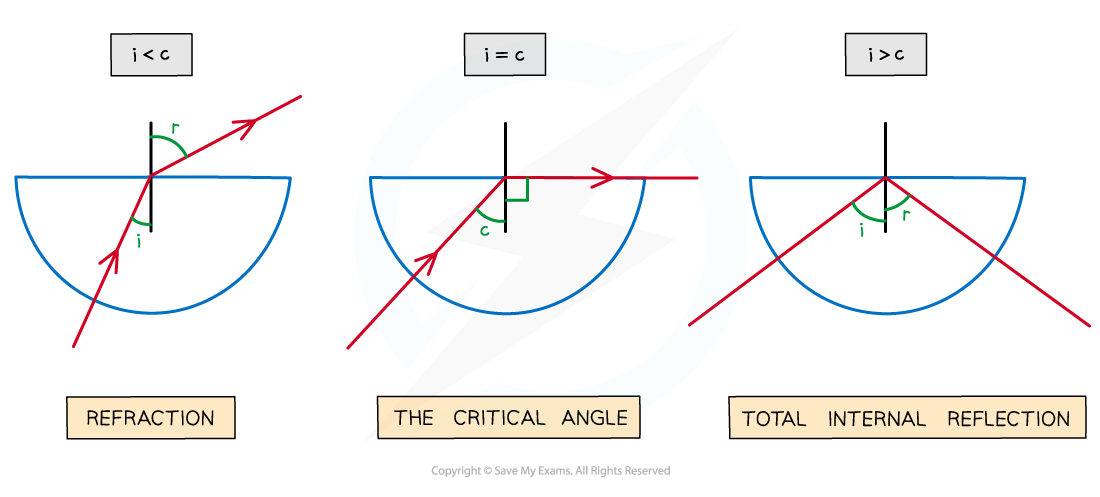
As the angle of incidence increases it will eventually surplus the critical angle and lead to total internal reflection of the light
Key points
- Raising the incidence angle raises the refraction angle towards 90°.
- At the critical angle the refracted ray skims exactly along the boundary at 90°.
- Beyond the critical angle the refracted ray is replaced by a totally internally reflected one.
- The switch from refraction to total internal reflection happens only going from a denser to a less dense material.
First pass
The critical angle is the incidence angle at which the refracted ray travels exactly along the boundary at 90° to the normal.
Analogy — A ramp that finally levels out: raise the entry angle and the exit ray flattens until, at the critical angle, it skims the floor.
Exam pointer — Definitions earn marks word-for-word: incidence angle in, refraction at 90° along the boundary.
Going deeper
As incidence grows the refraction angle grows too, until it reaches 90°; that incidence value is the critical angle, and past it the boundary reflects totally instead of transmitting.
Analogy — A door that swings shut: the escaping ray narrows to a slit along the frame, then vanishes altogether.
Exam pointer — Sketch the three-ray diagram (below, at, beyond the critical angle) — it earns explanation marks fast.
Checks
0 of 9 attempted · 0 correct
3.Calculating the critical angle
The critical angle is not a new measurement to memorise — it comes free with the refractive index. One line of algebra, sin c = 1 / n, converts a material's index into the angle beyond which light cannot escape. High-index materials pay twice: light slows more inside them, and their small critical angles trap rays over a much wider range, which is exactly why diamond glitters so fiercely.
Key points
- The critical angle and the refractive index are linked by sin c = 1 / n.
- Rearranged, the refractive index is n = 1 / sin c.
- A larger refractive index means a smaller critical angle.
- Light inside a high-refractive-index material is more likely to be totally internally reflected.
First pass
Divide 1 by the refractive index to get sin c, then apply the inverse sine to get the critical angle itself.
Analogy — One dial, two scales: the index and the critical angle are the same fact read in different units.
Exam pointer — Show the substitution — sin c = 1 / n with the numbers — before reaching for the inverse sine button.
Going deeper
Because sin c = 1 / n, a larger index shrinks the critical angle, so rays inside a dense material exceed it over a wider range of directions and reflect totally more often.
Analogy — A low doorway: the taller the material's optical density, the easier any ray bumps its head and gets turned back.
Exam pointer — Comparison questions want both angles calculated, then the trend named: bigger index, smaller c, more sparkle.
Checks
0 of 9 attempted · 0 correct
From the revision note
Diagrams on this note's page that are not tied to a specific lesson.
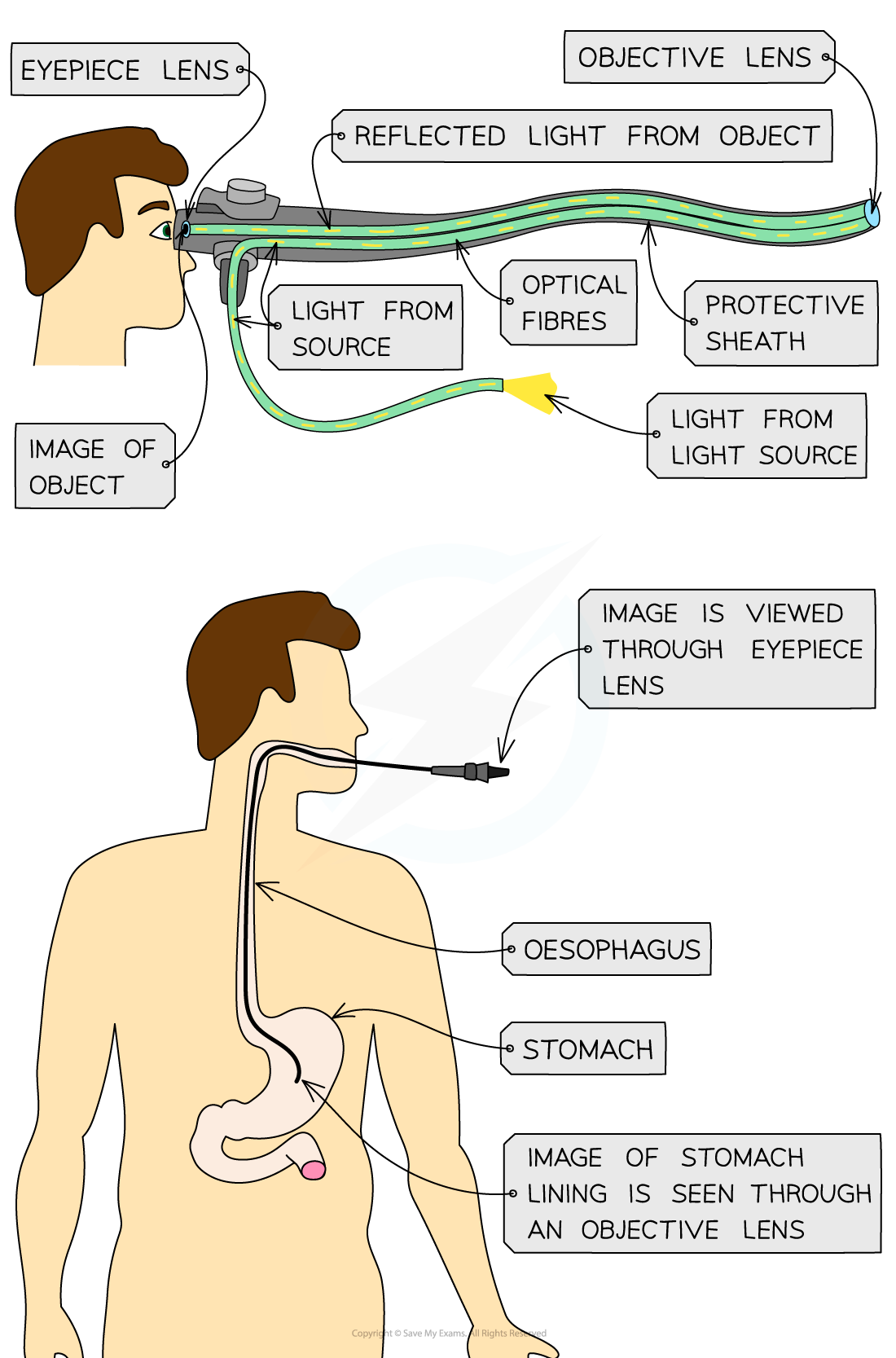
Endoscopes utilise total internal reflection to see inside a patient's body
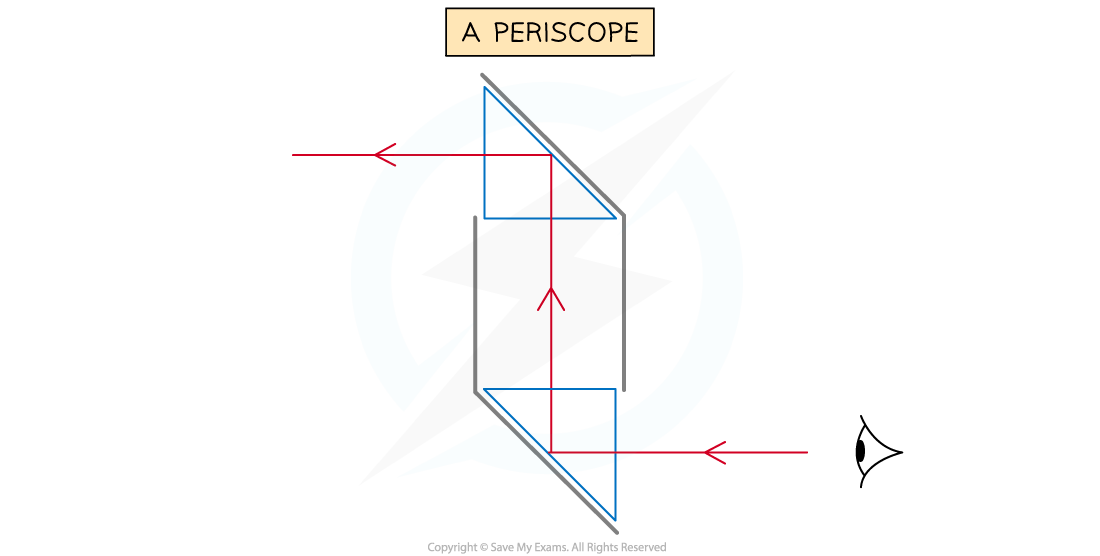
When light travels through a periscope, it totally internally reflects through prisms causing the light to reflect at right angles
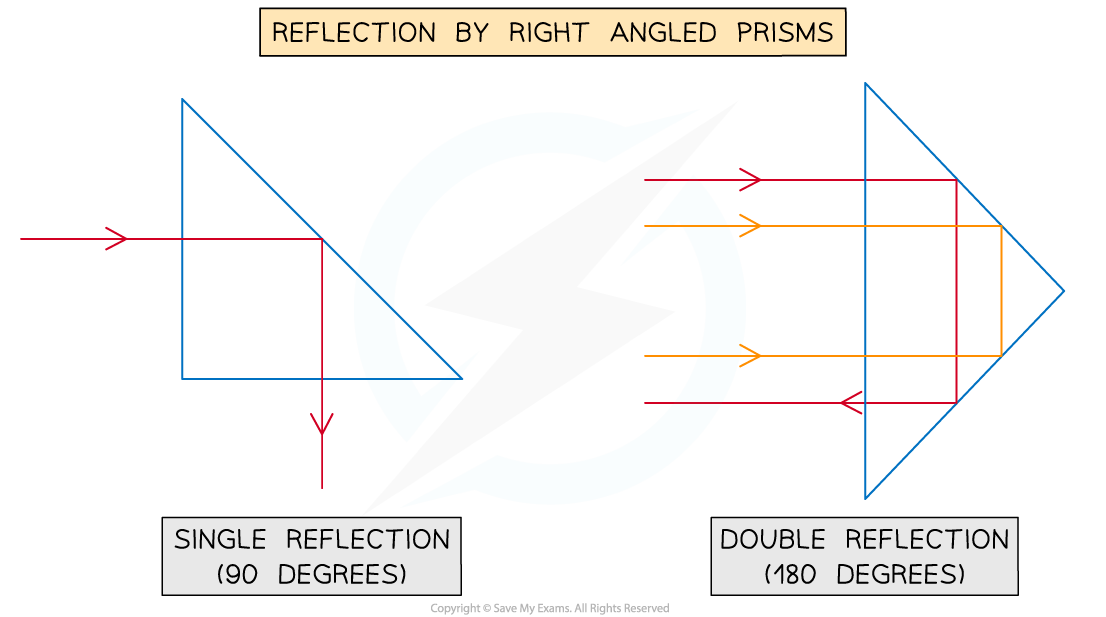
Single and double reflection through right-angled prisms
Guided content from the SME authoring corpus — note rn_HhjktGSR32fxhHPW, pinned at dad406f1ecd8 · promoted SyllabAI/syllabai-resources b3caaaa90c5e