Pressure in Liquids
2 guided lessons · 18 checks · 5. Solids, Liquids and Gases → Density & Pressure
Guided lessons for this note
Which concept don't you understand yet?
We'll explain it simply and check your understanding. Pick any lesson — any order works.
0 of 18 checks correct so far
Lesson 1 of 2
Pressure in fluids acts in all directions
A fluid at rest — liquid or gas — pushes on anything immersed in it from every side at once. The squeeze is even, and where it meets a surface the push always arrives head-on, at right angles.
What you know already
Divers feel it in their ears: fluid pressure grows with depth. These lessons show why a fluid at rest squeezes equally in all directions, then build the pressure-difference equation that turns depth, density and gravity into pascals.
Key points of understanding
- A fluid is a liquid or a gas.
- An object at rest in a fluid is squeezed by pressure acting evenly over its whole surface and in all directions.
- The fluid's pressure creates forces against the surfaces it touches.
- Those forces always act at right angles to the surface.
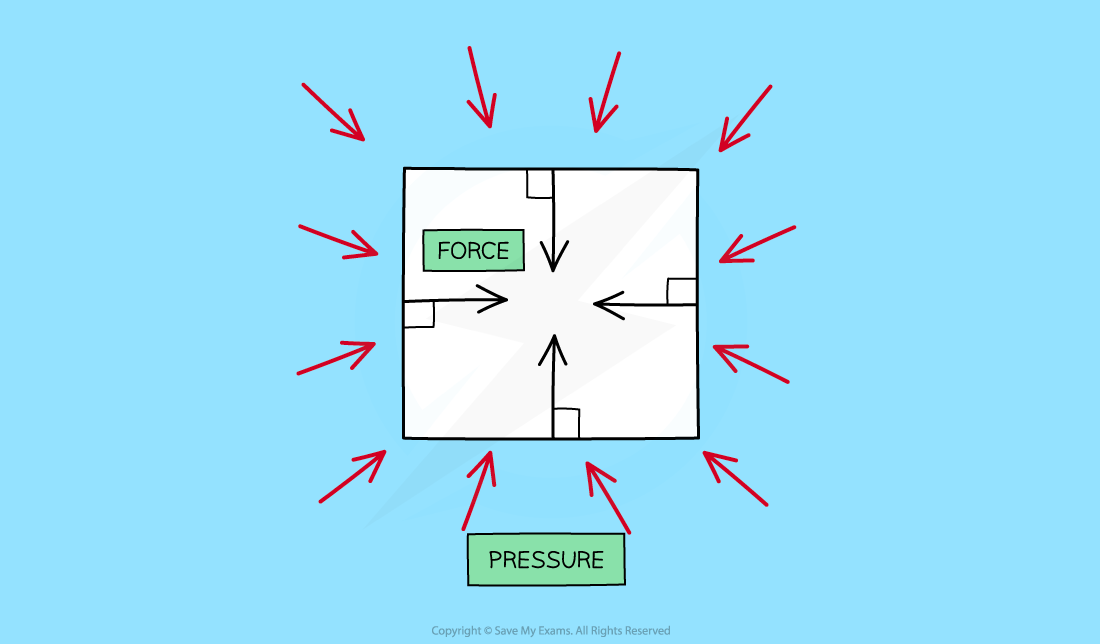
The pressure of a fluid on an object creates a force normal (at right angles) to the surface
Choose a confidence level to continue.
Prefer to read it all at once? Show the full lesson as a page
1.Pressure in fluids acts in all directions
A fluid at rest — liquid or gas — pushes on anything immersed in it from every side at once. The squeeze is even, and where it meets a surface the push always arrives head-on, at right angles.
The pressure of a fluid on an object creates a force normal (at right angles) to the surface
Key points
- A fluid is a liquid or a gas.
- An object at rest in a fluid is squeezed by pressure acting evenly over its whole surface and in all directions.
- The fluid's pressure creates forces against the surfaces it touches.
- Those forces always act at right angles to the surface.
First pass
Sink a ball into water: every point of its skin feels the same steady squeeze, from every compass direction, always straight into the surface. Fluids are democratic squeezers.
Analogy — A group hug with no favourite side: the water's push arrives from everywhere, each push perpendicular to wherever it lands.
Exam pointer — Draw the force arrows at 90 degrees to the surface in every fluid-pressure diagram — slanted arrows lose the mark.
Going deeper
For a fluid at rest, pressure at a point is directionless: it acts equally in all directions, delivering normal forces on any immersed surface. The evenness is what distinguishes fluid pressure from a single contact push, and it holds for liquids and gases alike.
Analogy — Inflation: a balloon's skin is pressed outward equally everywhere by the air inside — no side is favoured, and every patch is pushed straight out.
Exam pointer — State 'acts equally in all directions' verbatim for 5.6 — it is the sentence the specification rewards — then attach the right-angle rule for forces.
Checks
0 of 9 attempted · 0 correct
2.Pressure difference with depth
Dive deeper and the squeeze strengthens: the fluid column above grows heavier. The pressure-difference equation multiplies depth by density by gravitational field strength, and rearranges to predict pressures or depths.
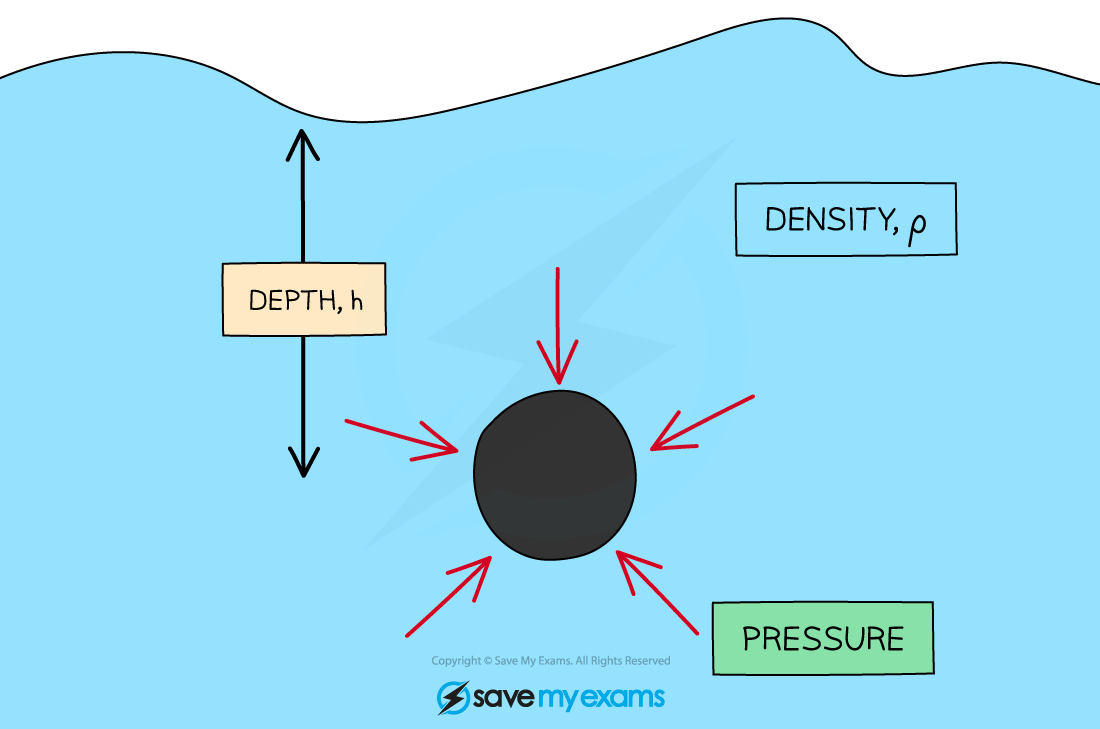
The force from the pressure of objects in a liquid is exerted evenly across its whole surface
Key points
- The pressure on an object in a fluid rises as the object sits deeper.
- Pressure difference = height × density × gravitational field strength, written p = h × ρ × g.
- Height (depth) enters in metres, density in kilograms per metre cubed, g in newtons per kilogram, giving pascals.
- The equation rearranges for any of the four quantities — including a depth prediction from a measured pressure.
First pass
Every metre down adds another layer of fluid pressing from above, so the deeper you go, the harder the squeeze. Multiply depth by the fluid's density by g and you have the extra pressure in pascals.
Analogy — A stack of mattresses: the bottom sleeper feels every mattress above; the top sleeper feels none. Depth is position in the stack.
Exam pointer — Rearranging is examined: h = p ÷ (ρ × g) predicts depth from pressure — the swimming-pool style question — and watch the kilopascal conversion.
Going deeper
The pressure-difference equation p = hρg prices the fluid column above the point of interest: deeper points carry taller columns, denser fluids heavier ones, and g converts mass to weight. It rearranges freely — depth from pressure, density from a measured difference — with all inputs in SI units so the answer lands in pascals.
Analogy — A skyscraper's ground-floor lobby carries every floor's weight above it; higher floors feel lighter loads. The lobby is the deep point; the penthouse is the surface.
Exam pointer — Convert kilopascals to pascals before substituting, and quote pascals or kilopascals consistently in the final line.
Checks
0 of 9 attempted · 0 correct
Guided content from the SME authoring corpus — note rn_HQhkn6sZhxfKfbj3, pinned at c40b8b284935 · promoted SyllabAI/syllabai-resources b3caaaa90c5e