Transverse & Longitudinal Waves
3 guided lessons · 27 checks · 3. Waves → Waves & The Electromagnetic Spectrum
Guided lessons for this note
Which concept don't you understand yet?
We'll explain it simply and check your understanding. Pick any lesson — any order works.
0 of 27 checks correct so far
Lesson 1 of 3
Transverse waves
Some waves shake sideways across their own path. When you flick a rope, each bit of rope moves up and down while the pulse runs away from your hand at right angles to that motion. Any wave whose vibrations sit at right angles to its direction of travel is called transverse, and ropes, water surfaces and light all behave this way.
What you know already
You already know that a disturbance can ripple outwards from a source: ripples crossing a pond, a pulse shaken along a rope, sound reaching your ears. Each of those is a wave carrying energy away from whatever made it. This lesson sorts waves into two families by the direction their vibrations swing relative to that travel.
Key points of understanding
- A transverse wave vibrates perpendicular to the direction of energy transfer, at right angles to it.
- The highest point above the resting level is the peak, also called the crest.
- The lowest point below the resting level is the trough.
- Ripples on water, a plucked guitar string and S-waves are transverse examples.
- Electromagnetic waves are transverse and can even travel through a vacuum.
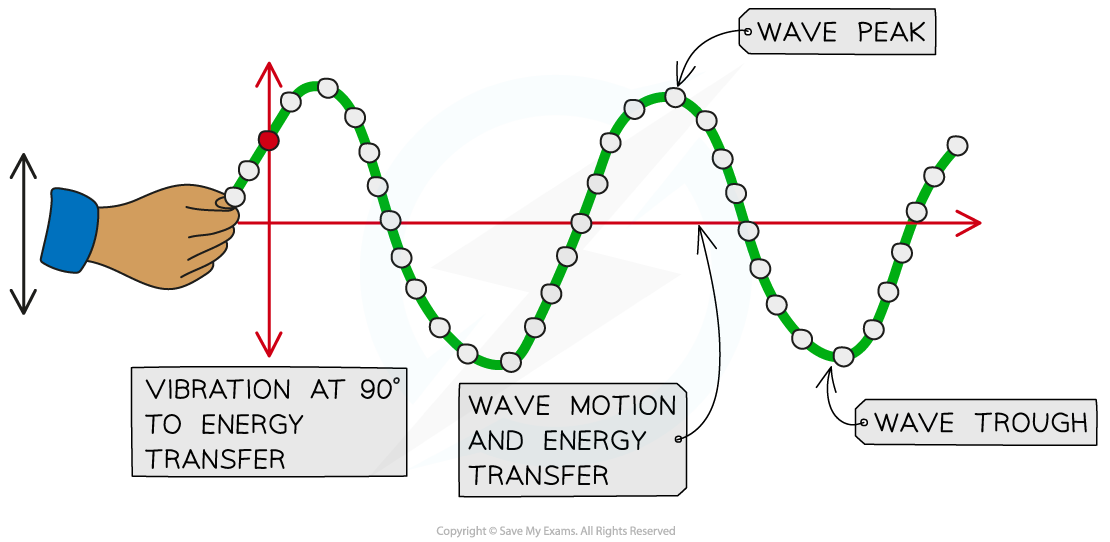
Transverse waves can be seen in a rope when it is moved quickly up and down
Choose a confidence level to continue.
Prefer to read it all at once? Show the full lesson as a page
1.Transverse waves
Some waves shake sideways across their own path. When you flick a rope, each bit of rope moves up and down while the pulse runs away from your hand at right angles to that motion. Any wave whose vibrations sit at right angles to its direction of travel is called transverse, and ropes, water surfaces and light all behave this way.
Transverse waves can be seen in a rope when it is moved quickly up and down
Key points
- A transverse wave vibrates perpendicular to the direction of energy transfer, at right angles to it.
- The highest point above the resting level is the peak, also called the crest.
- The lowest point below the resting level is the trough.
- Ripples on water, a plucked guitar string and S-waves are transverse examples.
- Electromagnetic waves are transverse and can even travel through a vacuum.
First pass
In a transverse wave the wiggling happens across the line the wave moves along, like shaking a rope up and down while the pulse travels forward.
Analogy — A stadium crowd doing a Mexican wave: each person stands and sits in place while the wave sweeps around the ground.
Exam pointer — If a question shows peaks and troughs, name the wave transverse and say the vibration is perpendicular to travel.
Going deeper
Transverse waves carry energy outward without carrying the material with them: the rope returns to rest after the pulse has gone.
Analogy — A line of dominos toppling passes energy along, yet every domino stays on its own spot on the table.
Exam pointer — Marks are available for pairing "perpendicular vibration" with "energy transferred, not the medium", so quote both.
Checks
0 of 9 attempted · 0 correct
2.Longitudinal waves
The second family vibrates along the journey instead of across it. Push and pull one end of a spring and the coils bunch together, then spread apart, and that pattern races down the spring. Waves built from these push-pull regions are longitudinal, and sound in air is the everyday example.
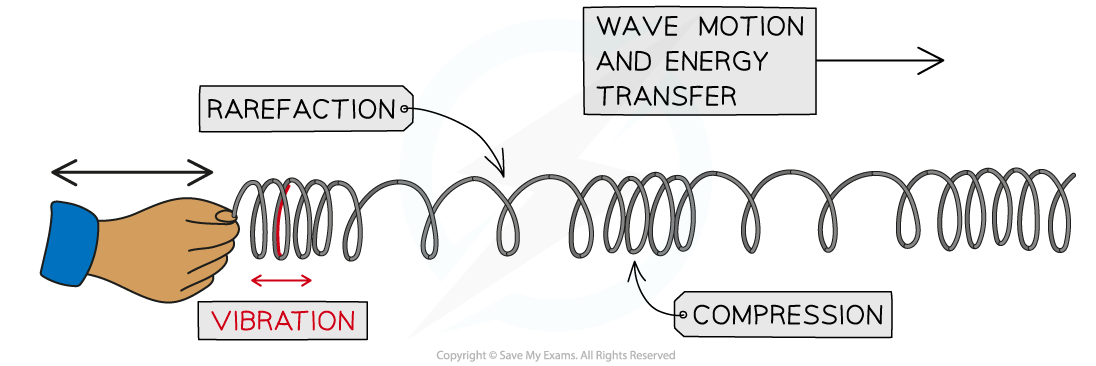
Longitudinal waves can be seen in a slinky spring when it is moved quickly backwards and forward
Key points
- A longitudinal wave vibrates parallel to the direction of energy transfer.
- Regions where particles crowd together are called compressions.
- Regions where particles are spread out are called rarefactions.
- Sound waves and P-waves are longitudinal examples.
- A longitudinal wave needs particles, so it cannot travel through a vacuum.
First pass
In a longitudinal wave the material shuffles back and forth along the same line that the wave travels, forming stretched and squeezed zones.
Analogy — Push one end of a slinky and watch a squeezed zone hurry along its length while each coil only slides a little.
Exam pointer — Label compressions and rarefactions on any longitudinal diagram; the labels themselves usually carry the mark.
Going deeper
The particles of the medium vibrate about their own positions while the compression-rarefaction pattern advances, so energy moves without any particle making the whole journey.
Analogy — A traffic jam wave on a motorway: the queue pattern sweeps backwards past cars that each only creep briefly.
Exam pointer — When asked why sound cannot cross a vacuum, answer that longitudinal waves need particles to compress in the first place.
Checks
0 of 9 attempted · 0 correct
3.Comparing the two families & energy transfer
Put the two families side by side and the contrast is sharpest in structure: peaks and troughs against compressions and rarefactions. What unites them matters more for exams: every wave, of either family, moves energy and information from source to receiver while the material it travels through stays put.
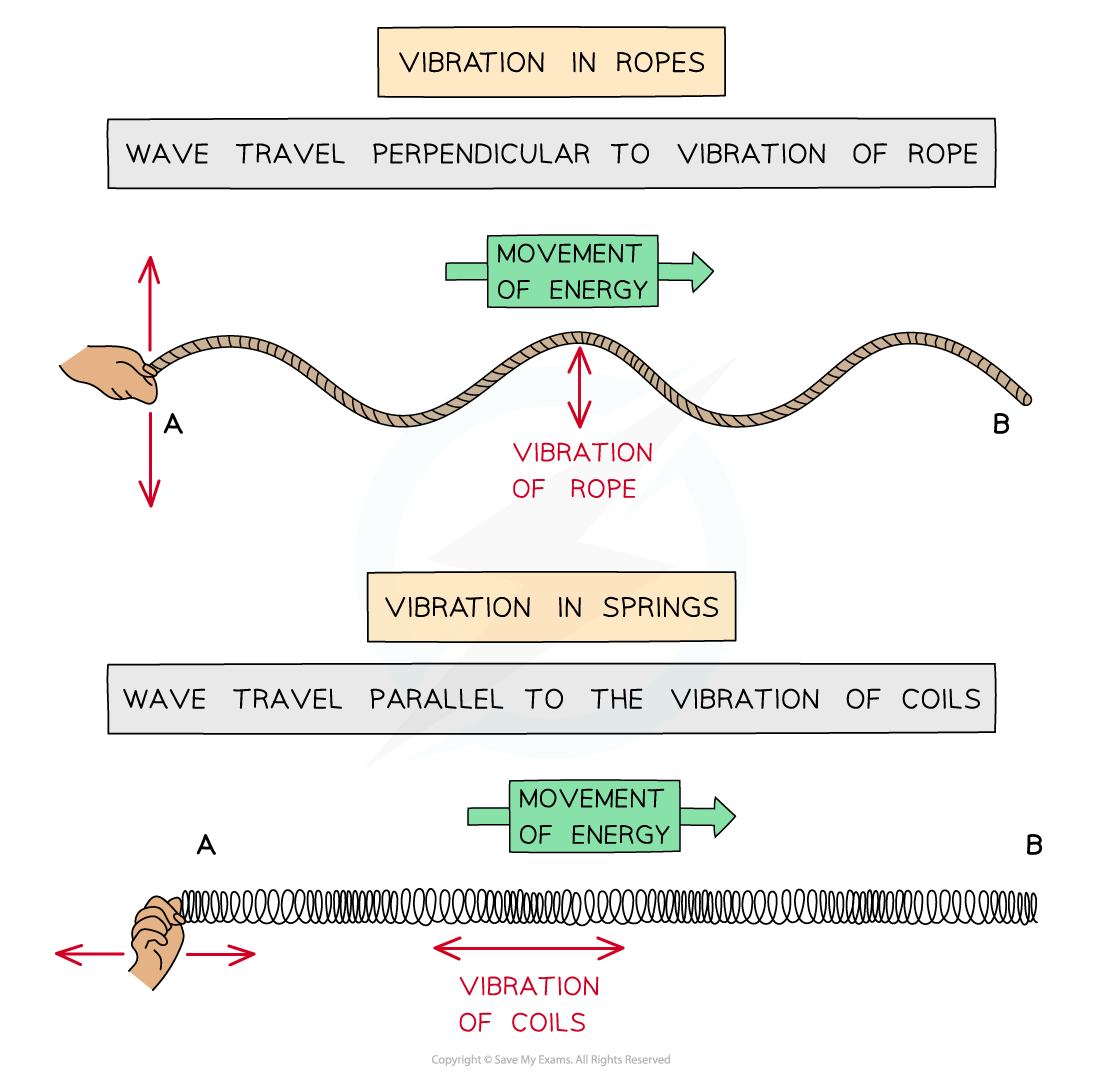
Waves can be shown through vibrations in ropes or springs
Key points
- Transverse waves show peaks and troughs; longitudinal waves show compressions and rarefactions.
- Transverse vibrations are perpendicular to travel; longitudinal vibrations are parallel to it.
- Only transverse electromagnetic waves cross a vacuum; longitudinal waves need a medium.
- Waves transfer energy and information without transferring matter.
- A floating duck bobs up and down as water waves pass, showing energy moves but the duck does not travel.
First pass
The two wave families differ in vibration direction and structure, yet both carry energy and information outward from a source without hauling the medium along.
Analogy — Two courier services, one on bicycles across a field and one through a tunnel: different routes, same parcel delivered.
Exam pointer — Comparison tables earn marks quickly: give structure, vibration direction and vacuum behaviour for both families.
Going deeper
Because the medium only oscillates locally, what advances is the disturbance: the energy of the source and any signal it encodes reach the receiver while each particle ends where it began.
Analogy — A message travelling along a line of people holding hands: each person sways in turn, and the squeeze passes down the line without anyone changing place.
Exam pointer — The duck-in-water observation is the classic evidence question: the duck bobs but does not drift, so energy transferred and matter did not.
Checks
0 of 9 attempted · 0 correct
From the revision note
Diagrams on this note's page that are not tied to a specific lesson.

Waves transfer energy and information, but not matter. This toy duck bobs up and down as water waves pass underneath
Guided content from the SME authoring corpus — note rn_HKZzkTMztGJvqXCd, pinned at dad406f1ecd8 · promoted SyllabAI/syllabai-resources b3caaaa90c5e