Specific Heat Capacity
2 guided lessons · 18 checks · 5. Solids, Liquids and Gases → Changes of State
Guided lessons for this note
Which concept don't you understand yet?
We'll explain it simply and check your understanding. Pick any lesson — any order works.
0 of 18 checks correct so far
Lesson 1 of 2
Defining specific heat capacity
Specific heat capacity is the price, in joules, of lifting one kilogram of a substance by one degree Celsius. High-capacity substances are slow to warm and slow to cool; low-capacity substances sprint through both.
What you know already
Different substances are differently stubborn about warming: water soaks up four thousand joules per kilogram per degree, metals far less. This note defines specific heat capacity, contrasts the high-capacity and low-capacity worlds, and drills the ΔQ = mcΔT calculation to a two-significant-figure finish.
Key points of understanding
- Specific heat capacity is the energy needed to warm 1 kg of a substance by 1 °C.
- Its unit is joules per kilogram per degree Celsius, written J/kg °C.
- Water has a high specific heat capacity, so it warms up and cools down slowly.
- Substances with a low specific heat capacity heat up and cool down quickly for the same energy.
- The temperature change for a given energy input depends on the mass and the material heated.
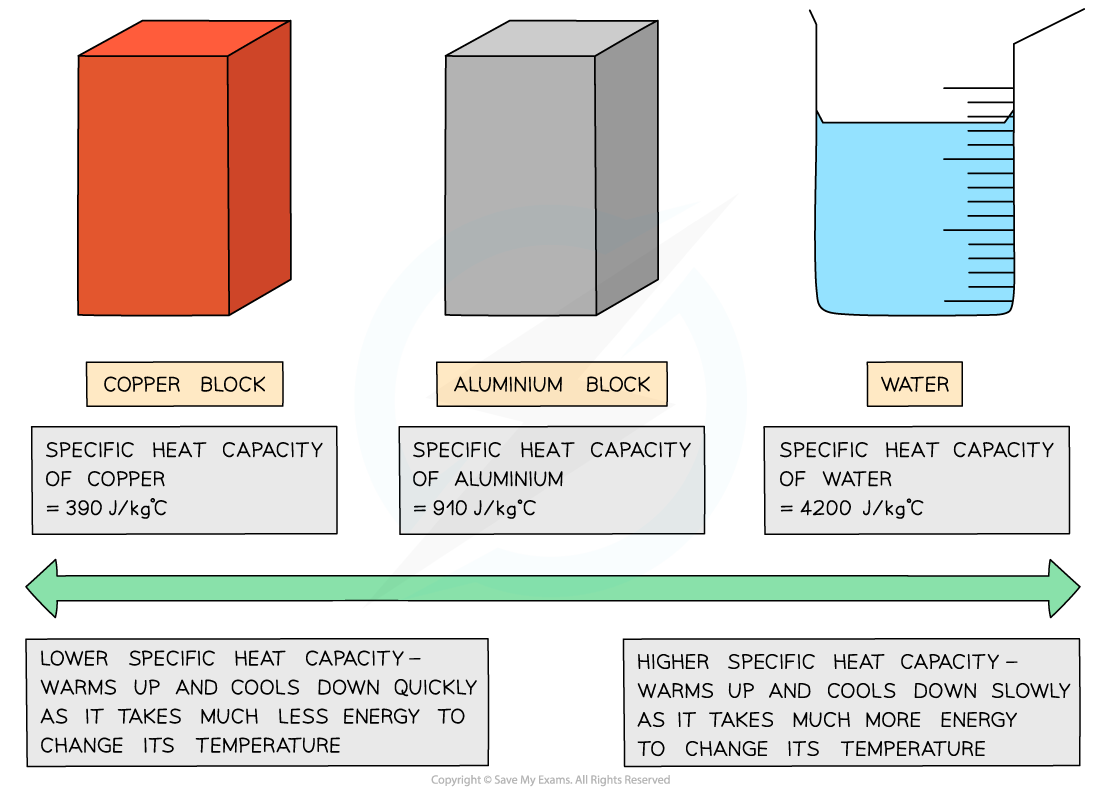
Low vs high specific heat capacity
Choose a confidence level to continue.
Prefer to read it all at once? Show the full lesson as a page
1.Defining specific heat capacity
Specific heat capacity is the price, in joules, of lifting one kilogram of a substance by one degree Celsius. High-capacity substances are slow to warm and slow to cool; low-capacity substances sprint through both.
Low vs high specific heat capacity
Key points
- Specific heat capacity is the energy needed to warm 1 kg of a substance by 1 °C.
- Its unit is joules per kilogram per degree Celsius, written J/kg °C.
- Water has a high specific heat capacity, so it warms up and cools down slowly.
- Substances with a low specific heat capacity heat up and cool down quickly for the same energy.
- The temperature change for a given energy input depends on the mass and the material heated.
First pass
Think of specific heat capacity as a per-kilogram, per-degree price tag. Water's tag is about 4200 J/kg °C, so a kettle needs thousands of joules for every single degree on every single kilogram.
Analogy — Filling buckets of different widths: the same jug of energy raises the narrow bucket (low capacity) far faster than the wide one (high capacity).
Exam pointer — Always attach all three units — J/kg °C — because dropping the 'per kilogram' or the 'per degree' makes the definition wrong on the mark scheme.
Going deeper
The definition is energetic, not thermal-intuitive: it is the energy per unit mass per unit temperature rise stored by the substance's particles. A high capacity means much of the supplied energy goes into the substance's internal store per degree, so temperature responds sluggishly in both heating and cooling directions.
Analogy — A wide harbour versus a narrow pool fed by the same stream: the harbour's level (temperature) creeps up while the pool leaps, even though the inflow (power) is identical.
Exam pointer — Comparison questions want the consequence chain: higher capacity means slower warming AND slower cooling — quote both directions or the mark is half-earned.
Checks
0 of 9 attempted · 0 correct
2.Calculating with ΔQ = mcΔT
One triangle equation runs the whole topic: change in thermal energy equals mass times specific heat capacity times temperature change. Rearranged, it also yields capacity from experiment data — the bridge to the core practical that follows this note.
Key points
- The equation is ΔQ = m × c × ΔT for a temperature change with no change of state.
- ΔQ is the change in thermal energy in joules, m the mass in kilograms, c the specific heat capacity, ΔT the temperature change in °C.
- Rearranged forms give c = ΔQ ÷ (mΔT) and ΔT = ΔQ ÷ (mc).
- Final answers should be quoted to an appropriate number of significant figures.
- The equation applies only while the substance stays in one state — latent heat governs melting and boiling instead.
First pass
Multiply the mass by the capacity by the temperature change and you have the energy bill. Know any three of the four quantities and the fourth falls out by rearranging.
Analogy — A restaurant bill: heads (mass) times set-menu price (capacity) times rounds (degrees) equals the total (energy).
Exam pointer — Write the equation first, substitute second, and quote units last — the three-line layout collects all the method marks.
Going deeper
ΔQ = mcΔT quantifies the kinetic-energy store change of the particles: heavier samples and high-capacity substances demand proportionally more energy per degree. The rearrangement c = ΔQ/(mΔT) is exactly how the immersion-heater practical measures capacity, turning two meter readings and a thermometer into a material property.
Analogy — A toll road: total fare (ΔQ) scales with the number of vehicles (m), the per-vehicle rate (c), and the number of zones crossed (ΔT) — know three, recover the fourth.
Exam pointer — Check the state before calculating: across a melting or boiling plateau ΔT is zero and the equation would wrongly return zero energy — that regime belongs to latent heat.
Checks
0 of 9 attempted · 0 correct
Guided content from the SME authoring corpus — note rn_H8r8FssR6Q3Ks7pc, pinned at 8788fc85a2c1 · promoted SyllabAI/syllabai-resources b3caaaa90c5e