Current in Series & Parallel
2 guided lessons · 18 checks · 2. Electricity → Components in Series & Parallel Circuits
Guided lessons for this note
Which concept don't you understand yet?
We'll explain it simply and check your understanding. Pick any lesson — any order works.
0 of 18 checks correct so far
Lesson 1 of 2
Current in series circuits
A series loop gives electrons exactly one road, so wherever you station a meter along it, the reading never changes. What does change the reading is the supply voltage and how many components share the loop. This lesson works both dials and reads the effect on the current.
What you know already
Wire two lamps one after another and they share a single loop; wire them side by side and the current gains choices. This note follows the current through both arrangements — unchanging along a series loop, splitting and recombining at the junctions of a parallel network — with charge conservation as the bookkeeping rule behind it all.
Key points of understanding
- A series circuit offers a single loop, so electrons have only one path to follow.
- The current is the same at every point of a series loop.
- A larger supply voltage drives a larger current around a series circuit.
- Adding components in series raises the total resistance and so lowers the current.
- The current size depends on both the source voltage and the number and type of components.
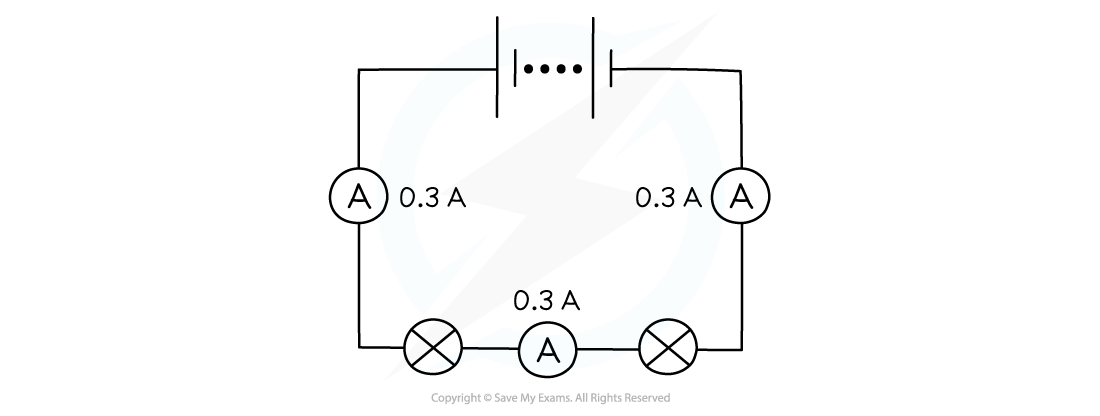
The current is the same at each point in a series circuit
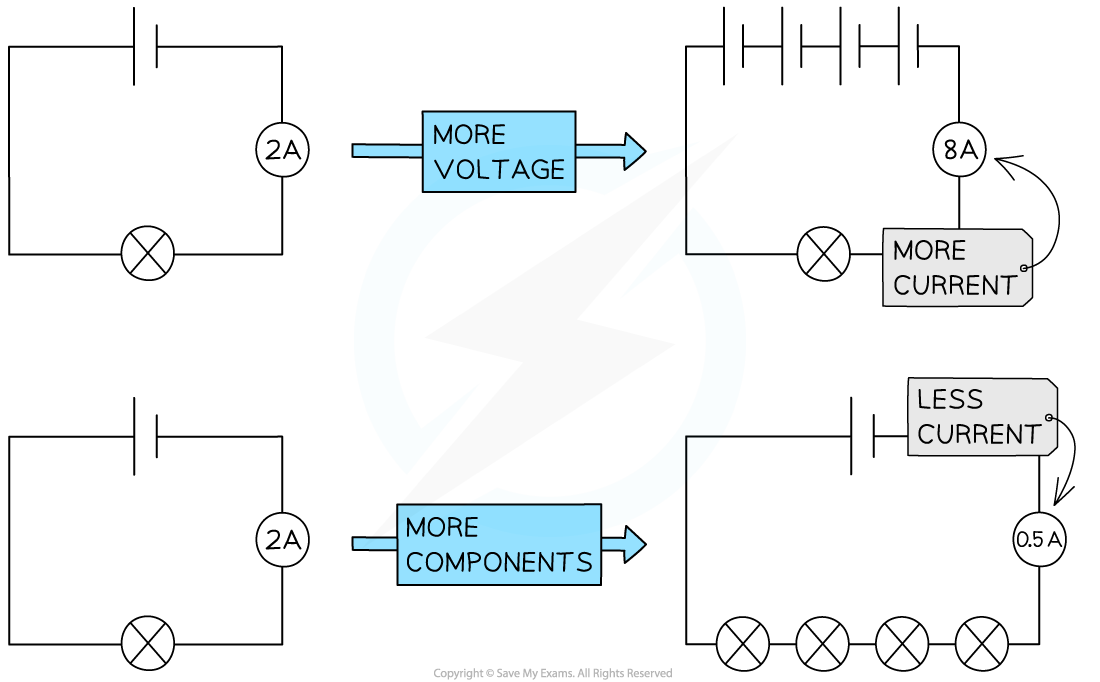
Current will increase if the voltage of the power supply increases and decreases if the number of components increases
Choose a confidence level to continue.
Prefer to read it all at once? Show the full lesson as a page
1.Current in series circuits
A series loop gives electrons exactly one road, so wherever you station a meter along it, the reading never changes. What does change the reading is the supply voltage and how many components share the loop. This lesson works both dials and reads the effect on the current.
The current is the same at each point in a series circuit
Current will increase if the voltage of the power supply increases and decreases if the number of components increases
Key points
- A series circuit offers a single loop, so electrons have only one path to follow.
- The current is the same at every point of a series loop.
- A larger supply voltage drives a larger current around a series circuit.
- Adding components in series raises the total resistance and so lowers the current.
- The current size depends on both the source voltage and the number and type of components.
First pass
One loop, one current: every component in series carries exactly the same flow.
Analogy — A single-lane ring road — every car that passes one tollbooth must pass them all, so the counts match.
Exam pointer — Quote 'same current at every point' when a question asks what an ammeter reads anywhere in a series loop.
Going deeper
The loop's current is set by a tug-of-war: the supply voltage pushes harder, each extra component drags harder.
Analogy — Pedal harder (more voltage) and the bike speeds up; add more hills (more components) and it slows again.
Exam pointer — Compare before-and-after circuits carefully: which knob moved, the voltage or the component count, decides which way the current goes.
Checks
0 of 9 attempted · 0 correct
2.Current in parallel circuits
Give the electrons a choice of roads and the flow divides: some take one branch, some take another, and everyone rejoins further on. The rule that keeps it all honest is simple — whatever arrives at a junction must leave it. This lesson counts the currents at a junction and explains why the books always balance.
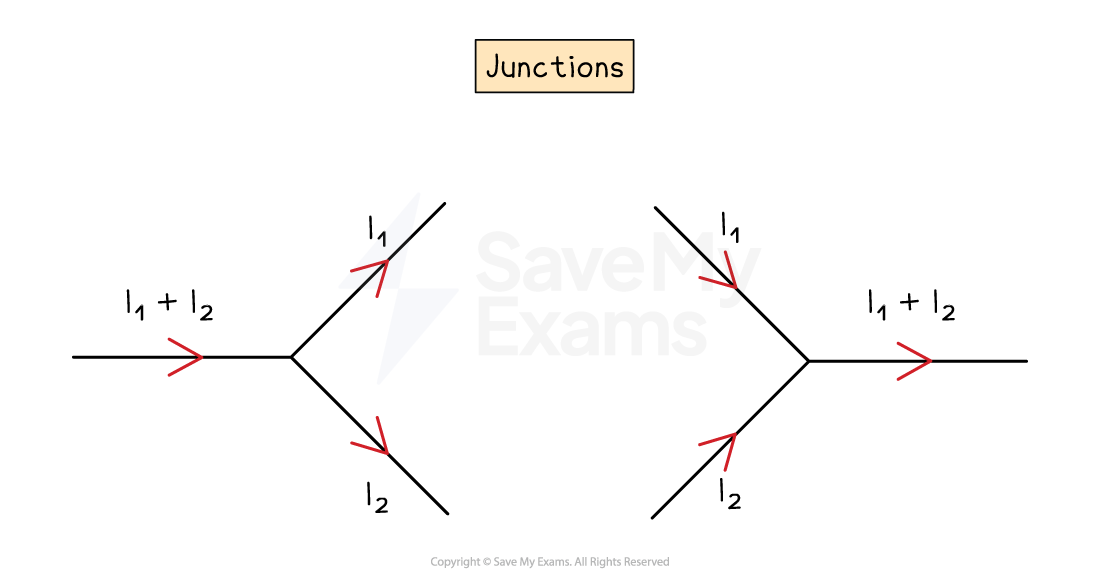
Current splits at a junction into individual branches

Key points
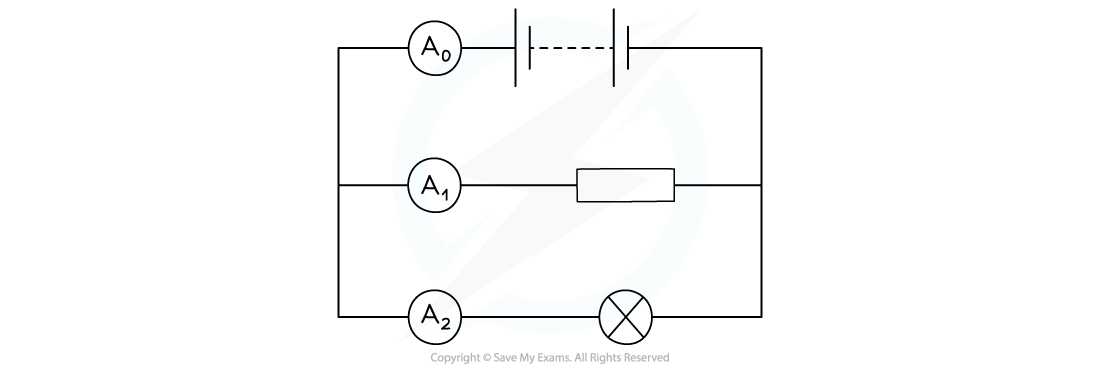
- A parallel circuit gives electrons two or more loops to travel around.
- Junctions are meeting points where the current splits into branches.
- The branch currents add back up to the total current entering (and leaving) the junction.
- Current is conserved at a junction because charge cannot be created or destroyed.
- Branch currents share unequally unless the branches carry identical resistances.
First pass
At a junction the current splits among the branches, and the pieces always add back to the original.
Analogy — A river forking around an island: the two channels together carry exactly what the main stream brought.
Exam pointer — Use the in-equals-out rule at each junction; label every branch current before doing any arithmetic.
Going deeper
Conservation is exact bookkeeping: charge cannot pile up or vanish at a junction, so inflow equals outflow by necessity.
Analogy — A roundabout with equal entry and exit counts — cars neither materialise nor evaporate between junctions.
Exam pointer — Branches split the current equally only when their resistances match; otherwise expect unequal shares.
Checks
0 of 9 attempted · 0 correct
Guided content from the SME authoring corpus — note rn_BFQBSmVz2xFZVsB6, pinned at 275f3b535d78 · promoted SyllabAI/syllabai-resources b3caaaa90c5e