Light & Sound Waves
2 guided lessons · 18 checks · 3. Waves → Reflection & Refraction
Guided lessons for this note
Which concept don't you understand yet?
We'll explain it simply and check your understanding. Pick any lesson — any order works.
0 of 18 checks correct so far
Lesson 1 of 2
Light waves
Light belongs to the electromagnetic spectrum, so it is a transverse wave: its fields vibrate across the direction of travel, the way a drawn wave on a rope does. Two things light famously does at surfaces and boundaries are reflection and refraction, both of which get their own diagrams later in this topic.
What you know already
The wave families from earlier now earn their places in optics: light is the transverse wave you see by, sound the longitudinal wave you hear by. Both can bounce off surfaces and bend between media, and each is drawn with its own diagram style. This lesson pairs the two and shows how each is represented.
Key points of understanding
- Light waves are transverse waves.
- Light can be reflected.
- Light can be refracted.
- A transverse wave is drawn as a wavy line with peaks and troughs.
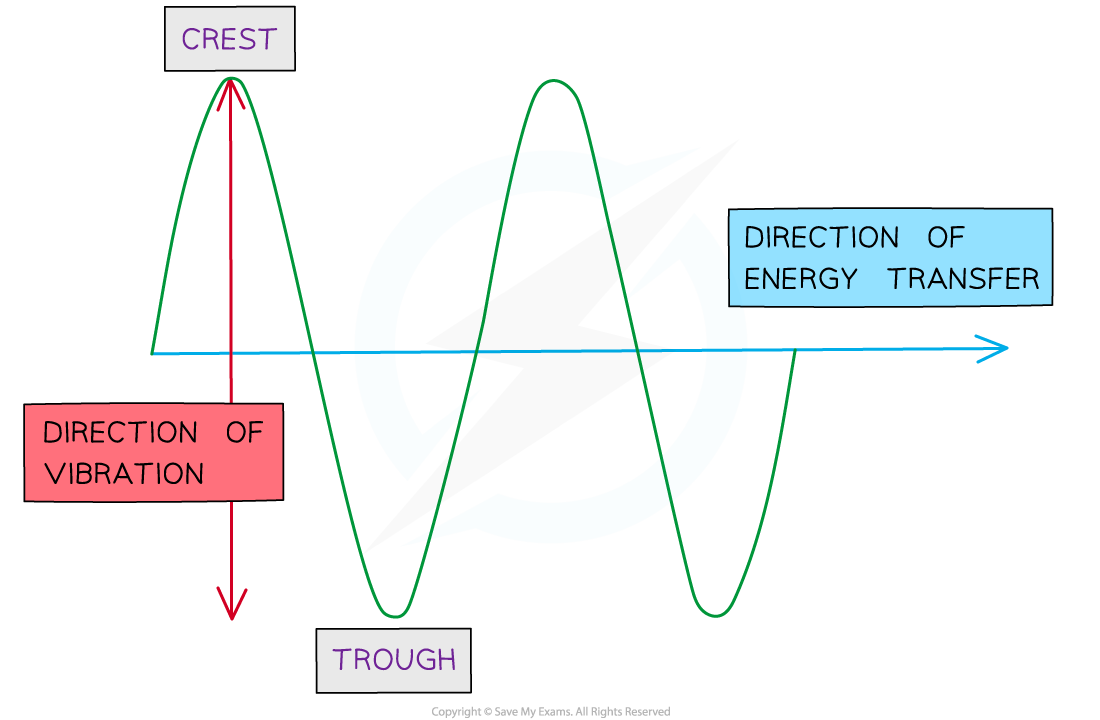
Light waves are transverse: the particles vibrate in a perpendicular direction to the energy transfer
Choose a confidence level to continue.
Prefer to read it all at once? Show the full lesson as a page
1.Light waves
Light belongs to the electromagnetic spectrum, so it is a transverse wave: its fields vibrate across the direction of travel, the way a drawn wave on a rope does. Two things light famously does at surfaces and boundaries are reflection and refraction, both of which get their own diagrams later in this topic.
Light waves are transverse: the particles vibrate in a perpendicular direction to the energy transfer
Key points
- Light waves are transverse waves.
- Light can be reflected.
- Light can be refracted.
- A transverse wave is drawn as a wavy line with peaks and troughs.
First pass
Light is a transverse electromagnetic wave, which is why it is drawn with the peak-and-trough style and why it bounces and bends at boundaries.
Analogy — Light behaves like the rope wave: shake across the path, travel along it.
Exam pointer — When asked for the wave type of light, answer transverse and be ready to add electromagnetic for the second mark.
Going deeper
Being transverse and electromagnetic lets light cross vacuum and still reflect and refract at boundaries, since those behaviours depend on wavefronts meeting media changes rather than on the medium carrying the wave.
Analogy — A courier who needs no road (vacuum) but still turns at every junction (boundary).
Exam pointer — Link questions: light is transverse because it is EM; it crosses vacuum for the same reason.
Checks
0 of 9 attempted · 0 correct
2.Sound waves
Sound is the longitudinal partner: air particles shuffle along the travel direction, forming compressions and rarefactions that are drawn as lines packed close together and spread apart. Like light, sound can reflect, heard as an echo, and refract between media, though it always needs a material to travel in.
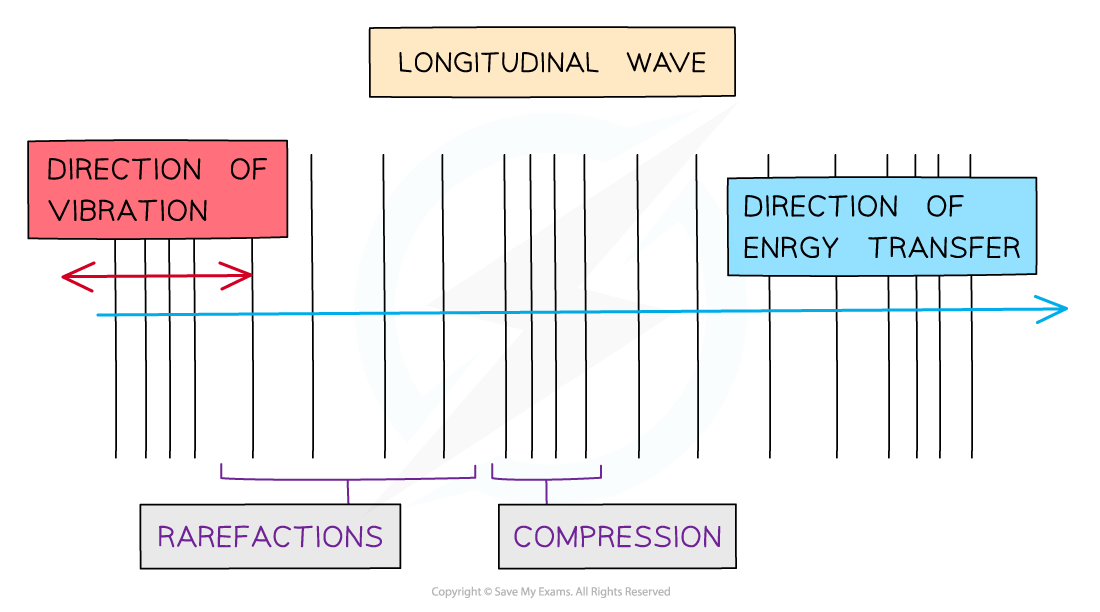
Longitudinal waves are represented as sets of lines with rarefactions and compressions
Key points
- Sound waves are longitudinal waves.
- Sound can be reflected; the reflection of a sound wave is called an echo.
- Sound can be refracted.
- Longitudinal waves are drawn as lines along the travel direction, with close lines showing compressions and spread lines showing rarefactions.
First pass
Sound is a longitudinal wave, drawn as lines that bunch and spread along the direction of travel, and its reflection arrives at your ears as an echo.
Analogy — A slinky pushed lengthways: squeezed zones and stretched zones chasing each other down the coils.
Exam pointer — Name the echo explicitly when a question mentions reflected sound; the vocabulary is the mark.
Going deeper
Because sound is mechanical and longitudinal, it shares reflection and refraction with light yet differs in needing particles, so the same boundary diagrams apply with the medium, not vacuum, doing the carrying.
Analogy — Light and sound are two couriers through a building: same turns taken, but one needs corridors with air and one does not.
Exam pointer — Contrast questions love the vacuum difference: sound dies in space, light does not; quote the particle requirement.
Checks
0 of 9 attempted · 0 correct
Guided content from the SME authoring corpus — note rn_25TjVtFjyh6Hmr8X, pinned at dad406f1ecd8 · promoted SyllabAI/syllabai-resources b3caaaa90c5e