12 marks
Find the Lowest Common Multiple (LCM) of 60 and 135 Show your working clearly.
29 questions · 100 marks · ≈ 2 hours
Calculator not allowed · Answer all questions · Show all your working
Find the Lowest Common Multiple (LCM) of 60 and 135 Show your working clearly.
The nth term of a sequence is given by 9n − 7 Determine whether 214 is a term of this sequence. Show your working clearly.
Here are four numbers written in order of size. w 7 x 24 The range of the four numbers is 18 The median of the four numbers is 10 Find the value of w and the value of x. w = x =
The diagram shows a right circular cylinder of radius 8 cm and height 12 cm. Calculate the volume, in cm³ to the nearest cm³, of the cylinder cm³
Figure not shown in this reconstruction — the printed paper includes a diagram (not drawn accurately). Figure values: 8, 12.
Solve =9 x = ……………Solve =9 x =
Q = c² − 4c Work out the value of Q when c = −6 Q = ……………Q = c² − 4c Work out the value of Q when c = −6 Q =
Without using a calculator and showing all your working, work out 3 11 2 ÷ 4 12 Give your answer in its simplest form.
x 132° D C A, B, C and D are points on a circle, centre O. Angle ADC = 132° Calculate, in degrees, the size of angle x. °
Figure not shown in this reconstruction — the printed paper includes a diagram (not drawn accurately). Labels in the original figure: B, A, O, D, C · Figure values: 132°.
y = 4x3 − 7/x² dy Find dx dy = ……………dx
y = 4x3 − 7/x² dy Find dx dy = dx
Given that a is a positive integer, expand and simplify fully 5a ( 20a + a 5a )
A, C, B and D are four points on a circle. The chord AB intersects the chord CD at P. AP = 7 cm PB = 5 cm PD = 4 cm Calculate, in cm, the length of CP cm
Figure not shown in this reconstruction — the printed paper includes a diagram (not drawn accurately). Labels in the original figure: A, C, P, D, B · Figure values: 7, 4, 5.
y x=1 4 1 y= x x+y=6 O 1 2 3 4 5 6 7 x Write down the three inequalities that define the shaded region in the diagram above.
Figure not shown in this reconstruction — the printed paper includes a diagram (not drawn accurately). Use the text description to work through it.
A motorbike was bought for £8600 The motorbike depreciated in value by 20% in the first year after it was bought and by 15% in each of the following years. Find the value of the motorbike exactly 3 years after it was bought. £
A= ⎜ B= 2 −1 2 y 7 8 27⎞ Given that 5A + nB = ⎜ where n is an integer, ⎝ 1 −26 find the value of n, the value of x and the value of y. n = x = y =
x u 105 + y u 103 = k u 105 Express k in terms of x and y. Give your answer in its simplest form. k =
Calculate (8.5 u 1064) u (4 u 1068) Give your answer in standard form.
The diagram shows triangle ACE. The point B on CA and the point D on CE are such that BD is parallel to AE. BD = 7.2 cm to 2 significant figures. AE = 9.3 cm to 2 significant figures. Area of △BCD = 15.4 cm² to 3 significant figures. Calculate the upper bound, to 3 significant figures, for the area of △ACE cm²
Figure not shown in this reconstruction — the printed paper includes a diagram (not drawn accurately). Labels in the original figure: C, B, D, A, E.
x F G E C The diagram shows three straight lines ABC, DBE and FECG. ∠ABD = 67° and ∠BEF = 123° Calculate the size, in degrees, of angle x. Give a reason for each stage of your working. °
Figure not shown in this reconstruction — the printed paper includes a diagram (not drawn accurately). Labels in the original figure: D, A, B, F, G, E, C · Figure values: 67°, 123°.
Martin, Jonas and Suzy are three art students. Martin has x crayons. Jonas has three times as many crayons as Martin. Suzy has 7 fewer crayons than Jonas. These three students have a total of 56 crayons.
Use all this information to write down an equation in x.
Find the number of crayons Suzy has.
The sum of the interior angles of a regular polygon is 2700° Calculate the size, in degrees to one decimal place, of each interior angle of the regular polygon.
…………… °
− √2 ) cm accurately drawn D C The diagram shows rectangle ABCD. AD = BC = (2 − √2 ) cm Area of ABCD = 3(5√2 − 2) cm² Show that the length of AB can be written in the form (a + b√2 ) cm where a and b are integers to be found. Show your working clearly.
Figure not shown in this reconstruction — the printed paper includes a diagram (not drawn accurately). Labels in the original figure: A, B · Other figure text: (2.
Solve the simultaneous equations 3x + 4y = 4.5 2x – 3y = 11.5 Show clear algebraic working. x = y =
ABC is an isosceles triangle with AB = AC. D and E are the midpoints of the sides AB and AC respectively. Prove that triangles EBC and DCB are congruent.
Figure not shown in this reconstruction — the printed paper includes a diagram (not drawn accurately). Labels in the original figure: A, D, E, B, C.
Given that = 32x × 3x + 1 9y find an expression for y in terms of x. Give your answer in its simplest form. y =
The scale drawing shows the positions of two posts, A and B. N N A B Scale: 1 cm represents 50 metres A third post, C, is equidistant from A and B.
Using ruler and compasses only, construct the locus of points that are equidistant from A and B. Given that C is also on a bearing of 250° from B …………… , ……………
find and mark the position of C on the scale drawing with a cross (×). Label the cross C.
Find by measurement from the scale drawing, the distance, in metres to the nearest metre, of C from A m
The line L1 has equation 5x + 4y = 16 The line L2 is parallel to L1 and passes through the point with coordinates (8, 15) L2 crosses the x-axis at the point A and the y-axis at the point B. Calculate the length, to the nearest whole number, of AB.
Use the factor theorem to show that (2x − 1) is a factor of 6x3 + 23x2 − 5x − 4 6 x + 23 x − 5 x − 4 3 2
Hence, solve =0 2x − 1 Show clear algebraic working.
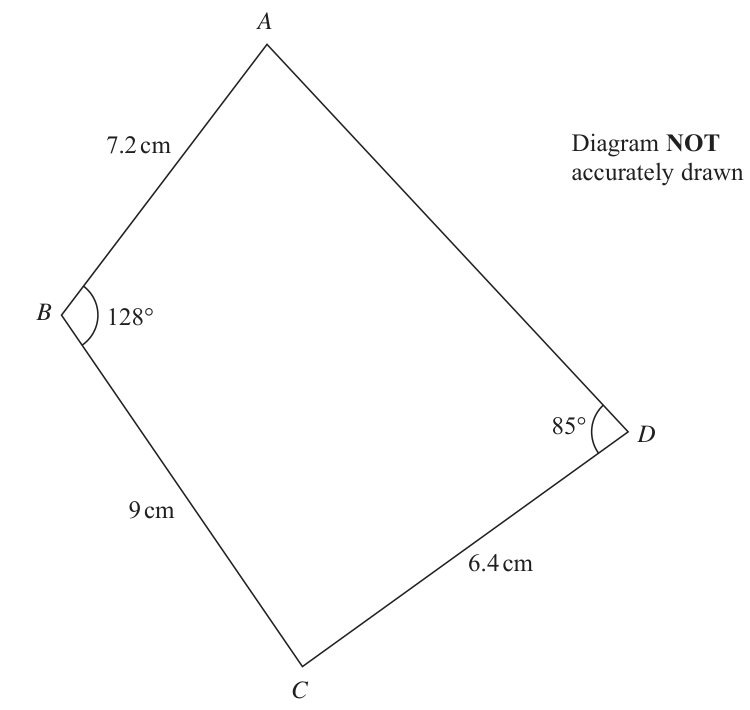
The diagram shows quadrilateral ABCD. A 7.2 cm Diagram NOT accurately drawn B 128° 85° D 9 cm 6.4 cm C AB = 7.2 cm BC = 9 cm CD = 6.4 cm ∠ABC = 128° ∠ADC = 85° Calculate the area, in cm² to 3 significant figures, of quadrilateral ABCD cm²
The table below gives information about the lengths of time, in minutes, that 75 cars were parked in a car park on Sunday.
| Time ( minutes) | Frequency |
|---|---|
| 8 | |
| 10 | |
| 15 | |
| 17 | |
| 25 |
Calculate an estimate for the mean length of time, in minutes to one decimal place, that the 75 cars were parked in the car park on Sunday
The incomplete table and incomplete histogram give information about the lengths of time, in minutes, that 132 cars were parked in the car park on Monday.
| Time ( minutes) | Frequency |
|---|---|
| 12 | |
| 27 | |
| 18 |
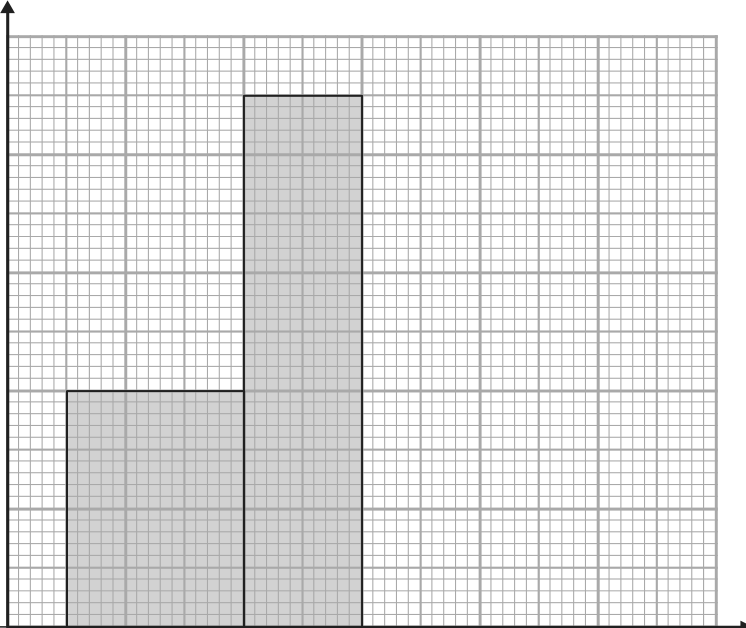
Complete the histogram and the table. Frequency density 0 10 20 30 40 50 60 Time (t minutes)
Given that P is inversely proportional to the square of w and that P = 16 when w = 5
find the value of P when w = 12.5 P = Given also that P is inversely proportional to y and that P = 75 when y = 4
find the value of y when w = 2 y =