Using Differentiation for Kinematics (Edexcel IGCSE Maths)
Kinematics
Spec point —
3.4E
What does kinematics mean?
-
Kinematics is the study of the motion of an object
- It is a branch of Physics
-
Objects are called particles
- They are modelled as single moving points
-
Over time, the particles move and
- can be at different distances from a fixed origin (displacement)
- can move with different speeds in different directions (velocity)
- can speed up or slow down (acceleration)
What is displacement?
-
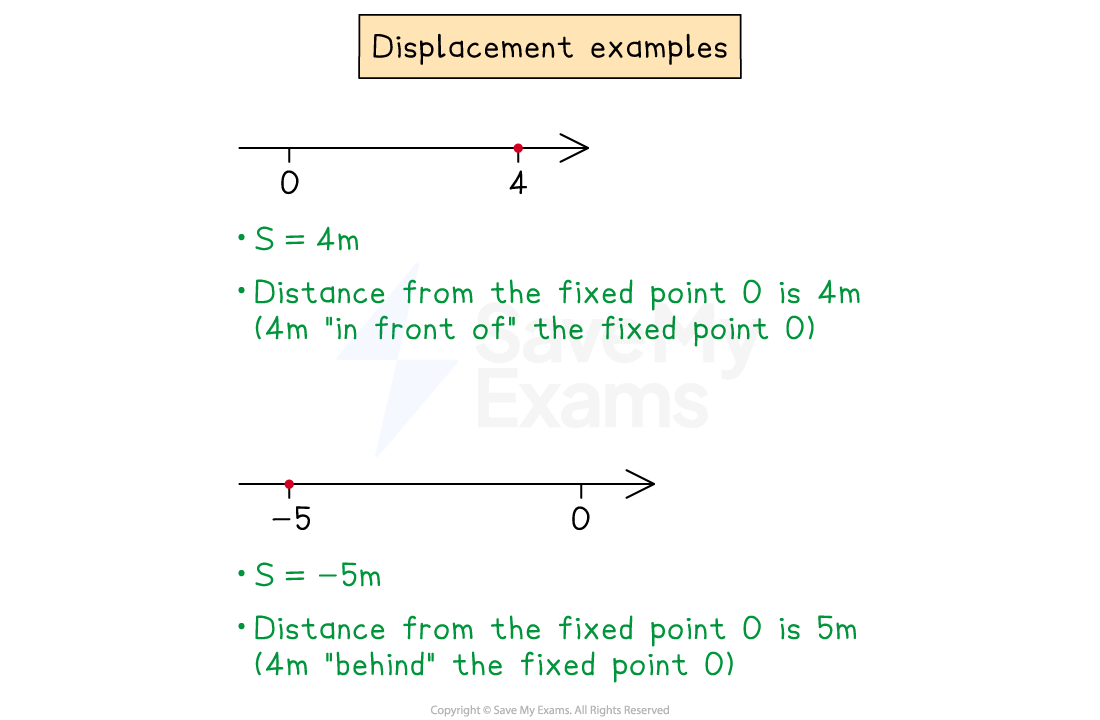
The displacement of an object is how far away it is from a fixed origin
- It can be positive (in front of the origin)
- or negative(behind the origin)
-
Do not confuse displacement with distance
- Distance is always positive!
- Displacement can have a sign
-
Displacement is given the letter in kinematics
- Do not confuse this letter for speed!
- Displacement is measured in metres
What is a displacement function?
-
The displacement of an object, metres, can be written as a function of time, seconds
-
Substitute a value of time in to find its displacement at that time
-
For example,
- Initially, gives (1 metre in front of the origin)
- After 3 seconds, gives (2 metres behind the origin)
-
What is the velocity and how do I find it?
-
Velocity is the speed and direction of an object
-
It is positive if moving forwards
-
It is negative if moving backwards
-
Do not confuse velocity and speed
- Speed is always positive!
-
-
To find the velocity of an object, metres per second, differentiate its displacement function
-
For example, if then (by differentiation)
-
The initial velocity () is ms-1
-
The velocity after 1 second () is ms-1
- Its speed is 3 ms-1
-
-
If a velocity is zero at any point in time, it is said to be at instantaneous rest
-
It is stationary (not moving) at that instant in time
- but not stationary all the time
-
To find the times at which the particle is at rest, set and solve to find
-
What is the acceleration and how do I find it?
-
Acceleration is rate at which the velocity changes
-
It is positive if speeding up (when moving forwards)
-
It is negative if slowing down (when moving forwards)
- A negative acceleration is also called a deceleration
- The magnitude of acceleration is always positive
-
-
To find the acceleration of an object, metres per second per second, differentiate its velocity function
-
For example, if then
- You can substitute times in to find accelerations
-
It the acceleration is always zero then the particle moves at a constant speed
How do I find the acceleration from the displacement?
-
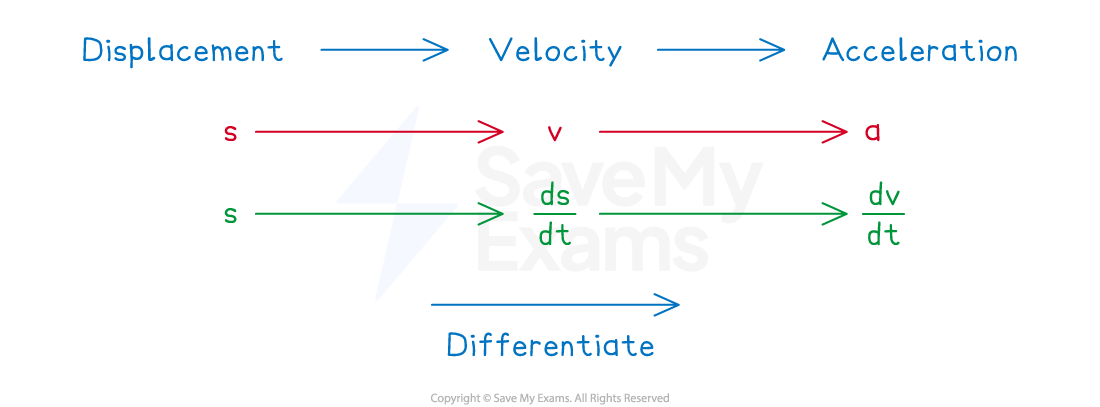
You differentiate displacement to get velocity, then differentiate velocity to get acceleration
- So you differentiate displacement twice to get acceleration
Exam Hint
Harder exam questions may jump back and forth between displacement, velocity and acceleration
- so make sure you use the labels , and to make your working clear
Worked Example A particle moves along a straight line.
The displacement of the particle from a fixed point, O, on the line at time seconds is metres, where
(a) Find the initial distance of the particle from O.
Answer:
Initial means Substitute into to find the initial displacement
Distance is always positive, so convert -3 into 3
Final answer: The particle is initially at a distance of 3 metres from O
(b) Find an expression for the velocity, ms-1, at time seconds.
Answer:
To find the velocity, differentiate the displacement
This is an expression for the velocity in terms of time,
Final answer: ms-1
(c) Find how long, after , it takes for the particle to come to rest.
Answer:
The particle is at rest when Set and solve to find
or
After the next point of rest is
Final answer: After, it takes 4 seconds for the particle to come to rest
(d) Find the time at which the particle is decelerating at 3 ms-2.
Answer:
A deceleration of 3 means an acceleration of -3 Differentiate the velocity function to find acceleration
Set and solve for
Final answer: The particle is decelerating at 3 ms-2at 1.5 seconds
Was this revision note helpful?