Forming Equations from Shapes (Edexcel IGCSE Maths)
Spec point —
4.2E
Forming equations from shapes
How do I form equations from shapes?
-
You need to use all the information given on the diagram and any specific properties of that shape
-
Common 2D shapes that you should know properties for are
- Triangles: equilateral, isosceles, scalene, right-angled
- Quadrilaterals: square, rectangle, kite, rhombus, parallelogram, trapezium
-
You may be asked about perimeter, area or angles
-
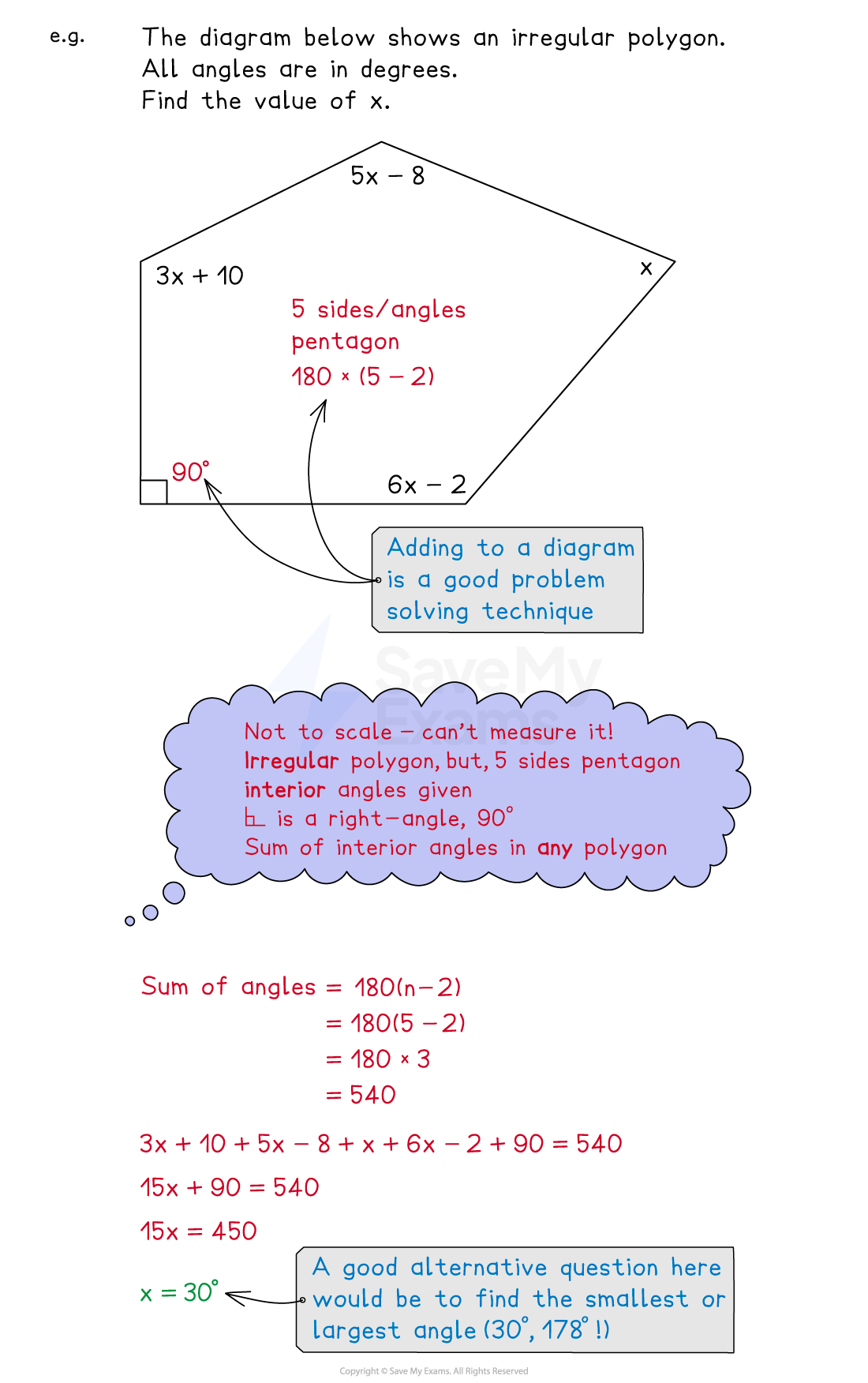
You may be asked about polygons
-
Regular vs irregular polygons
-
Interior vs exterior angles
- The sum of interior angles is 180(n-2) for an n-sided polygon
-
-
You may be asked about angles in parallel lines
- Alternative, corresponding and co-interior
-
You may be asked about 3D shapes involving surface area and volume
-
Prisms have constant cross sections
- Volume is cross-section area multiplied by length
-
Is there anything else that can help?
-
Sketch a diagram if none is given
-
Split up uncommon shapes into the sum or difference of common shapes
-
Look out for important extra information
- For example, a trapezium "with a line of symmetry"
-
With **irregular **shapes, assume all angles and lengths are different (unless told otherwise)
-
Put** brackets** around algebraic expressions when substituting them into geometric properties
Exam Hint Read the question carefully - does it want an angle? perimeter? total area? curved surface area? etc.
For surface area and volume questions, check the list of formulas given in the exam.
Worked Example A rectangle has a length of cm and a width of cm.
Its perimeter is equal to 22 cm.
(a) Use the above information to find the value of x.
Answer:
The perimeter of a rectangle is 2 × length + 2 × width
Expand the brackets
Simplify by collecting like terms
This perimeter is 22, so set this expression equal to 22
Solve this equation by adding 8 then dividing by 10
(b) Find the area of the rectangle.
Answer:
The area of a rectangle is its length multiplied by is width Substitute the value of x from part (a) into the length and width given in the question
length is 3 × 3 + 1 = 10
width is 2 × 3 - 5 = 1
Find the area (multiply length by width)
10 × 1
Include the correct units for area
Final answer: Area = 10 cm2
Was this revision note helpful?
Build on this topic