Solving Quadratic Inequalities (Edexcel IGCSE Maths)
Spec point —
2.8A
Solving quadratic inequalities
What are quadratic inequalities?
-
A quadratic inequality has the form
-
There is an term and any inequality sign,
-
They can usually be factorised
- For example,
-
-
Solutions to quadratic inequalities are ranges ofvalues
- For example,
How do I solve a quadratic inequality?
-
Quadratic inequalities are solved by sketching a graph
- The solutions then appears along the -axis
-
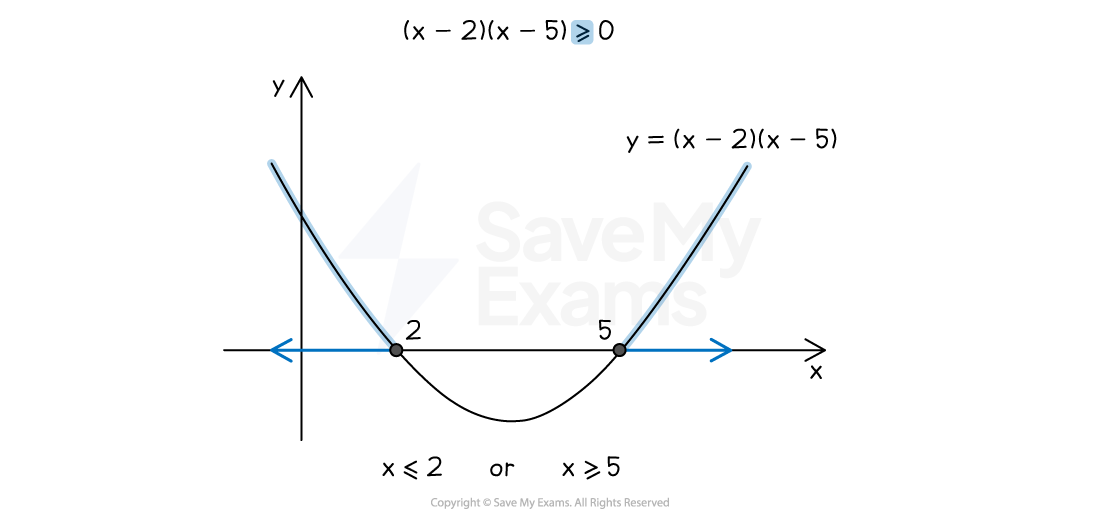
For example, to solve
-
Sketch the graph of
y=(x−2)(x−5)- Show the -intercepts of 2 and 5
- These come from solving
(x−2)(x−5)=0
-
As the inequality is , shade any parts of the curve that are above the-axis
- These are left of and right of
-
The solutions are the ranges on the -axis for those shaded parts
- or
- Use the word "or" for two separate parts
- In set notation this is
-
What do I do if the sign of the inequality changes?
-
If the quadratic inequality is where is positive
- then shade the parts of the curve above the -axis
-
If the quadratic inequality is where is positive
- then shade the part of the curve below the -axis
-
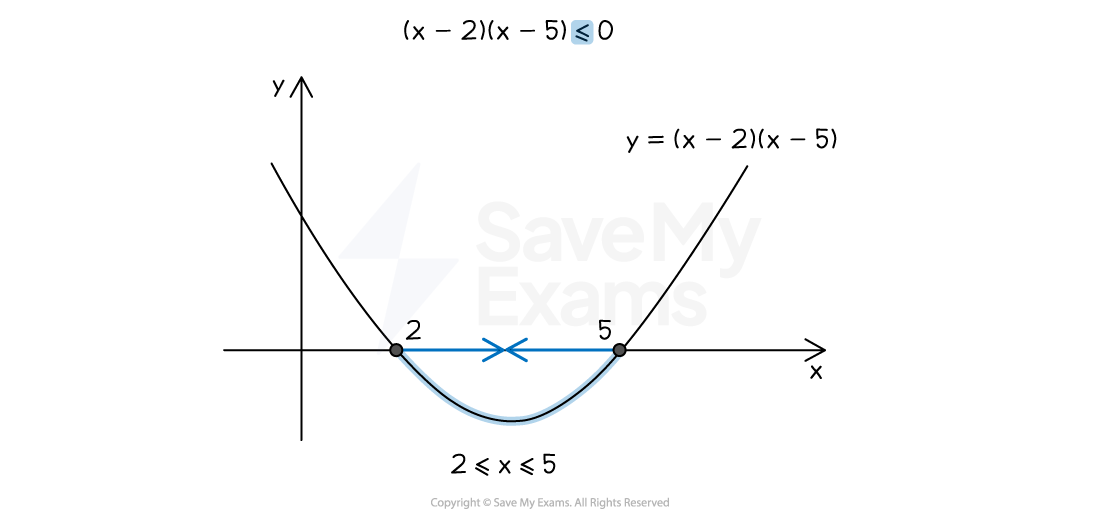
For example, to solve
-
Repeat the process above but shade where the curve is below the -axis
- The solution is
- (You do not use the word "or", but could say "and" )
- In set notation this is , or alternatively
-
-
If strict inequality signs are used, or
- then you must use strict inequalities in your final answer
How can quadratic inequalities be made harder?
-
You may need to bring all the terms to one side first
-
For example becomes
- It is easier to pick the side with a positive
-
-
You may have to factorise the quadratic inequality first
-
This may involve factorising
- into double brackets
a² x²−b²=(a x+b)(a x−b)(the difference of two squares)a x²+b x=x (a x+b)(factorising out an )
-
If it does not factorise, you may need the quadratic formula to find -intercepts
-
-
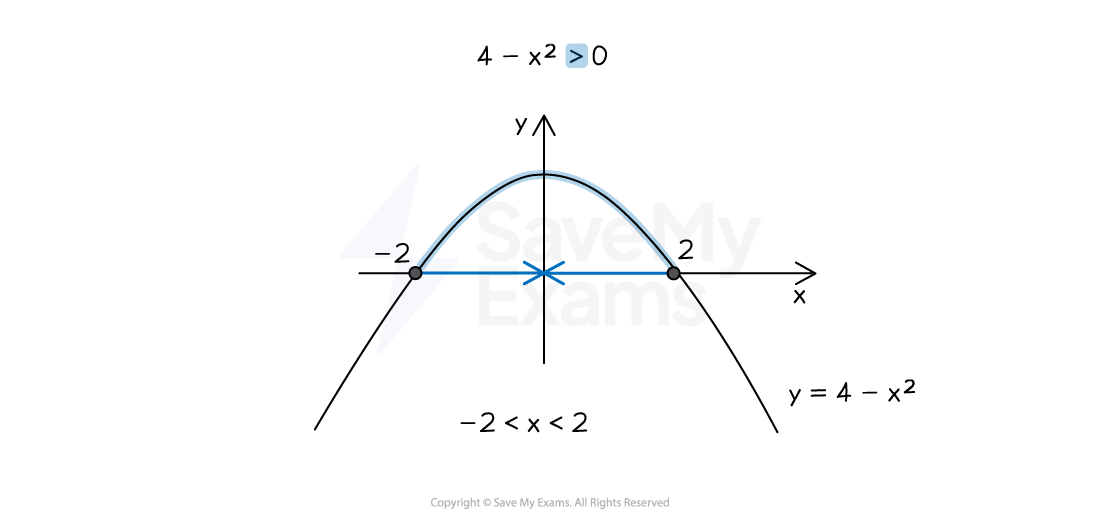
You may be given a quadratic inequality where is negative
- This means the sketch will be an shape
-
For example, solve
- The intercepts are found from giving
- The same process is then applied, but the graph has an shape
Exam Hint Think of inequalities with terms as graph-sketching questions in the exam.
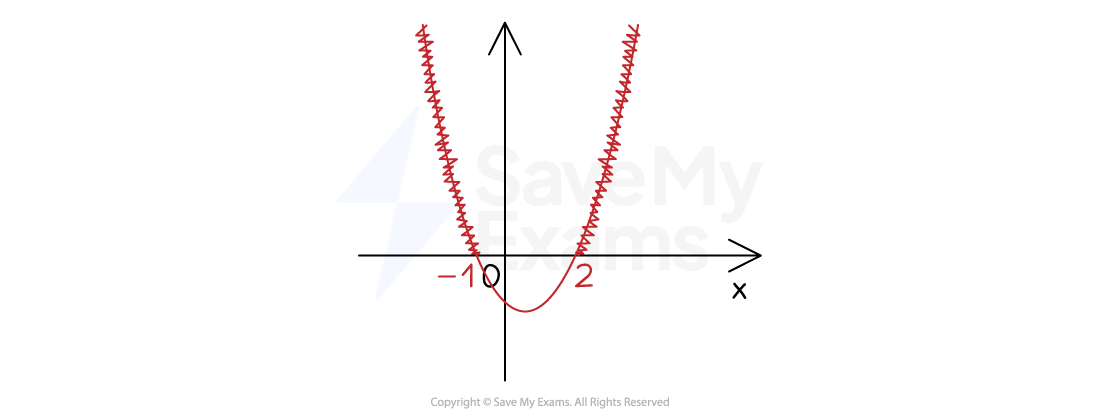
Worked Example Find the set of values for which
Answer:
Rearrange to get a zero on one side
Divide everything by 2 as it is a common factor
Find the roots of the quadratic
x squared minus x minus 2 equals 0 x equals 2 comma space x equals negative 1
Sketch the graph and identify the parts which are above the x-axis
Was this revision note helpful?