Intersecting Chord Theorem (Edexcel IGCSE Maths)
Spec point —
4.6A
Intersecting chord theorem
What is the intersecting chord theorem?
-
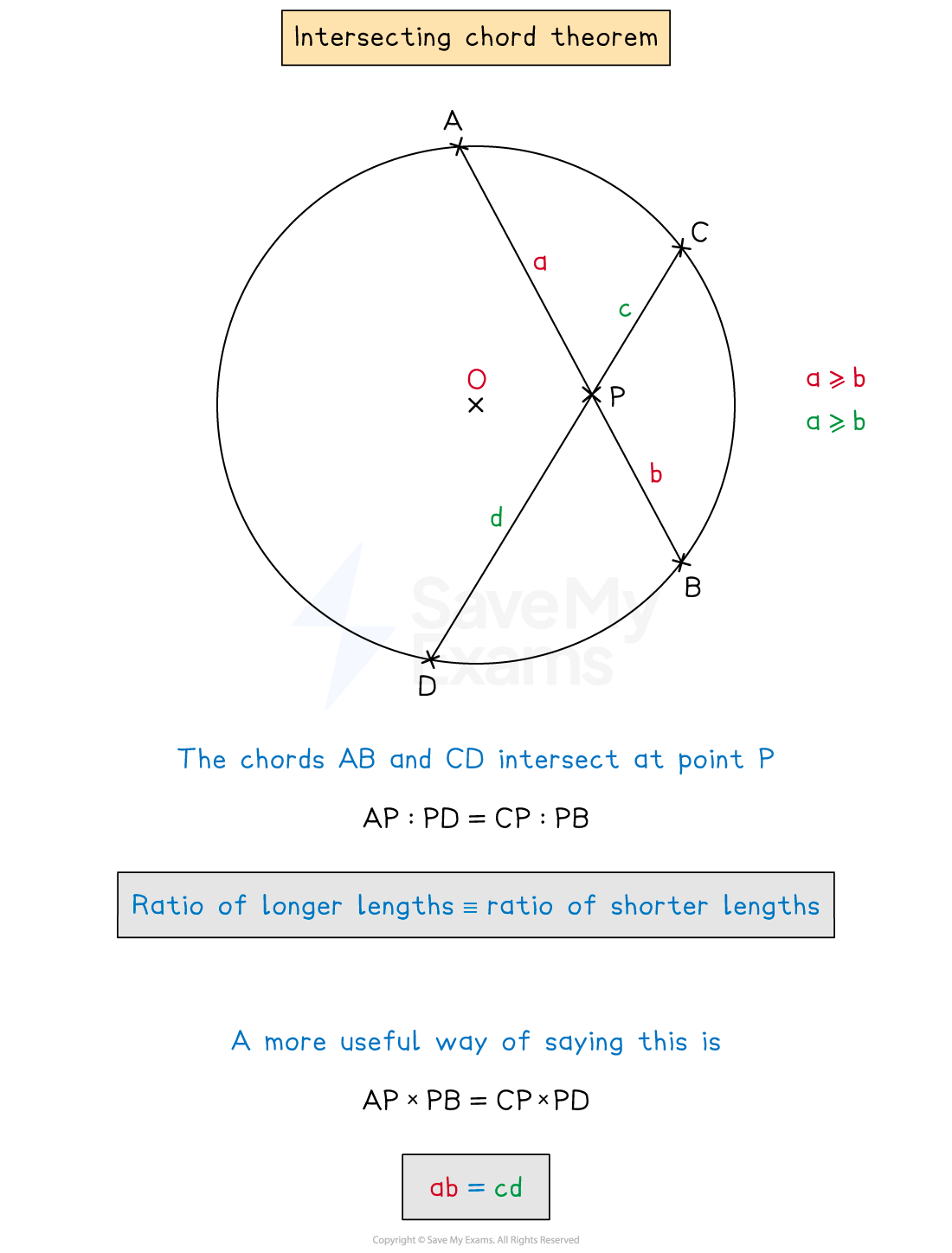
For two chords, AB and CD that meet at point P
- AP : PD ≡ CP : PB
- Ratio of longer lengths (of chords) ≡ Ratio of shorter lengths (of chords)
- This can also be written as AP × PB = CP × PD
-
You do not need to know the proof of this theorem
-
This theorem is closely related to similar shapes
How do I use the intersecting chord theorem to solve problems?
-
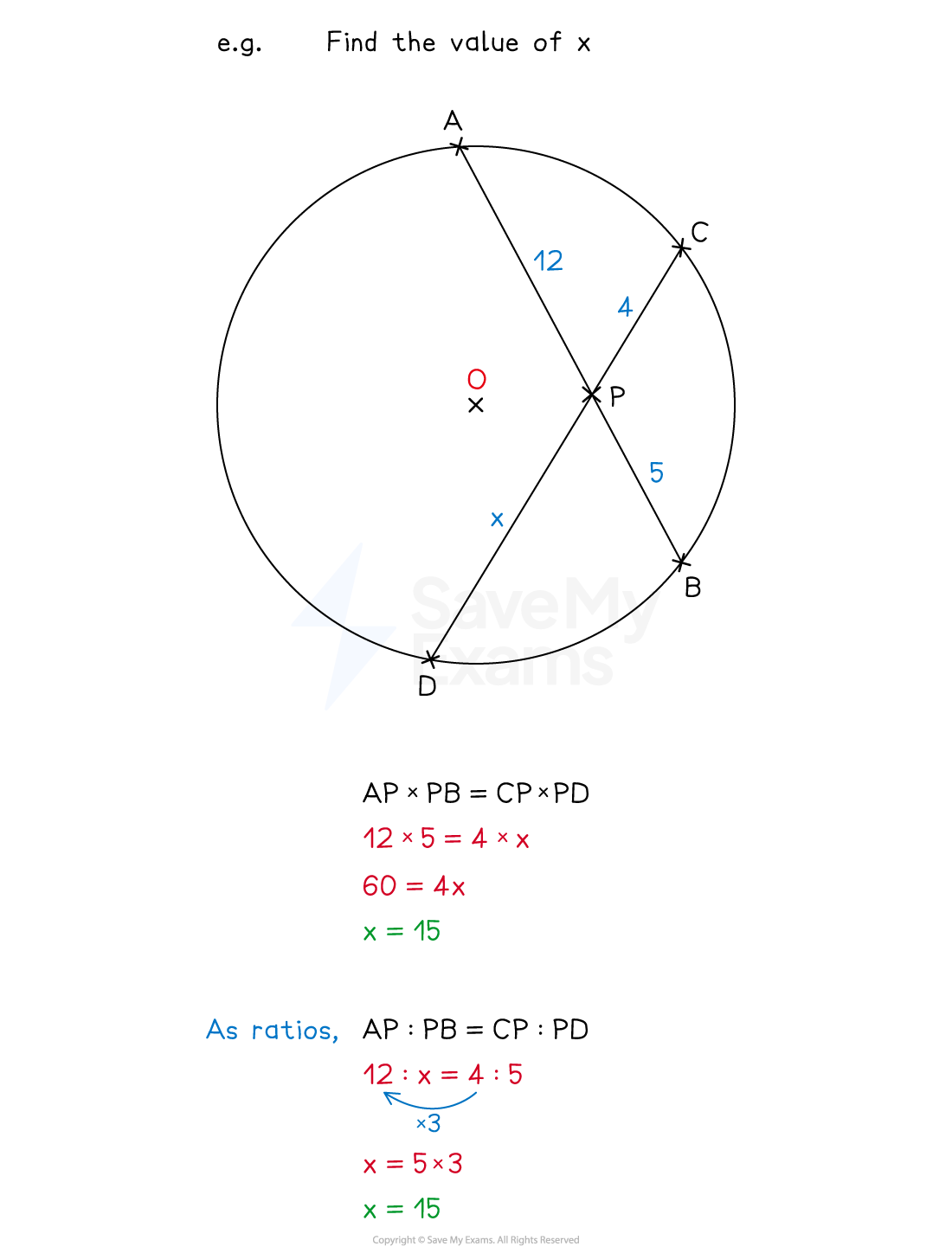
If two chords intersect, you can find a missing length using the intersecting chord theorem
- You can usually choose to solve the problem either using multiplication (AP × PB = CP × PD) or using ratio (AP : PD ≡ CP : PB)
-
Carefully keep track of which distance is associated with each part of each chord
What if the lengths are algebraic?
- If any of the lengths are algebraic expressions, use the fact that AP × PB = CP × PD to form an equation and then solve it
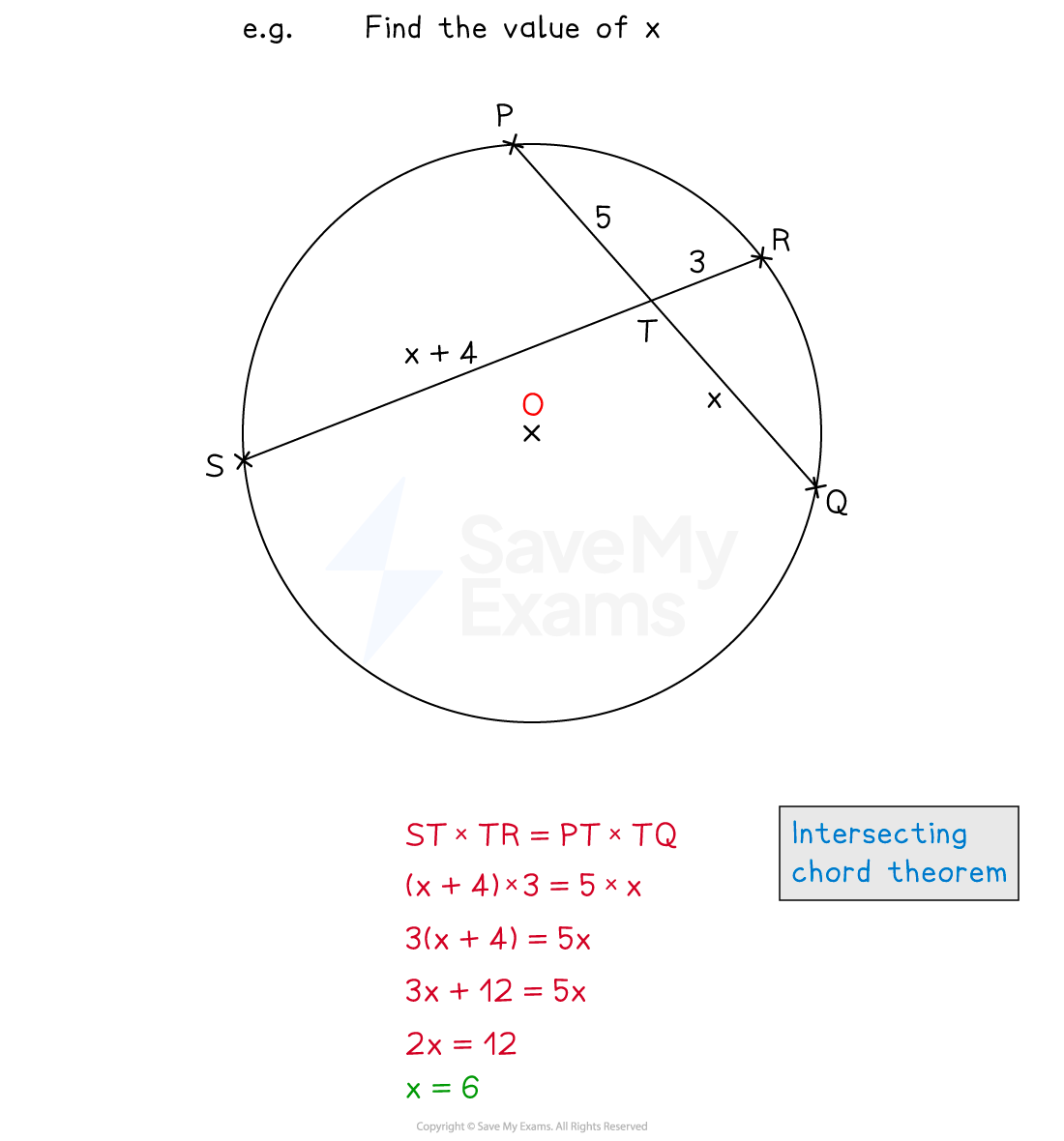
Worked Example The diagram below shows a circle with centre O and two chords, PQ and RS.
The chords PQ and RS meet at the point T.
(a) Find the possible value(s) of .
Answer:
Using the intersecting chord theorem which states that
Fill in the information from the diagram
Simplify
Solve by factorising
Consider if both answers are possible
refers to a length, so cannot be zero
(b) Hence, or otherwise, write down the simplified ratio of PT:RT.
Answer:
Method 1
Substitute the found value of * into the expressions on the diagram for PT and RT*
Write as a ratio PT:RT
Simplify
Method 2
Using the ratio form of the intersecting chord theorem, and the expressions on the diagram
This shows that the ratio of PT:RT is the same as the ratio of TS:TQ
Intersecting Chord Theorem (External)
Spec point —
4.6A
What is the external case of the intersecting chord theorem?
-
The intersecting secant theorem is the mathematical name given to the external case of the intersecting chord theorem
- A secant is a line which extends through a circle cutting the circumference at two points
-
It occurs when two chords intersect outside of the circle
-
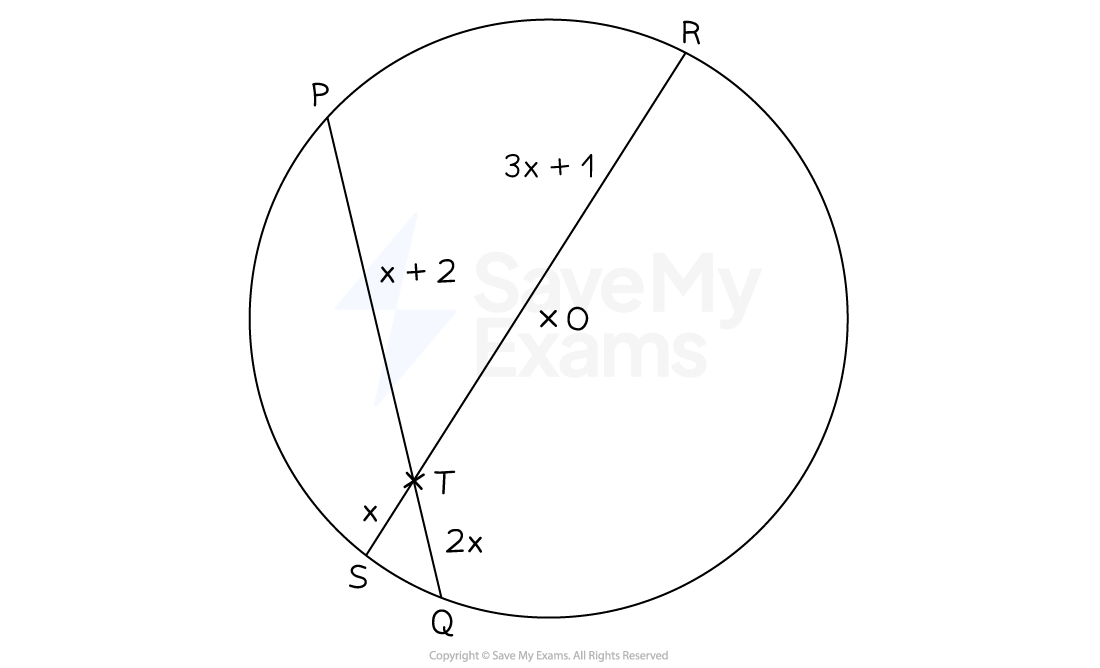
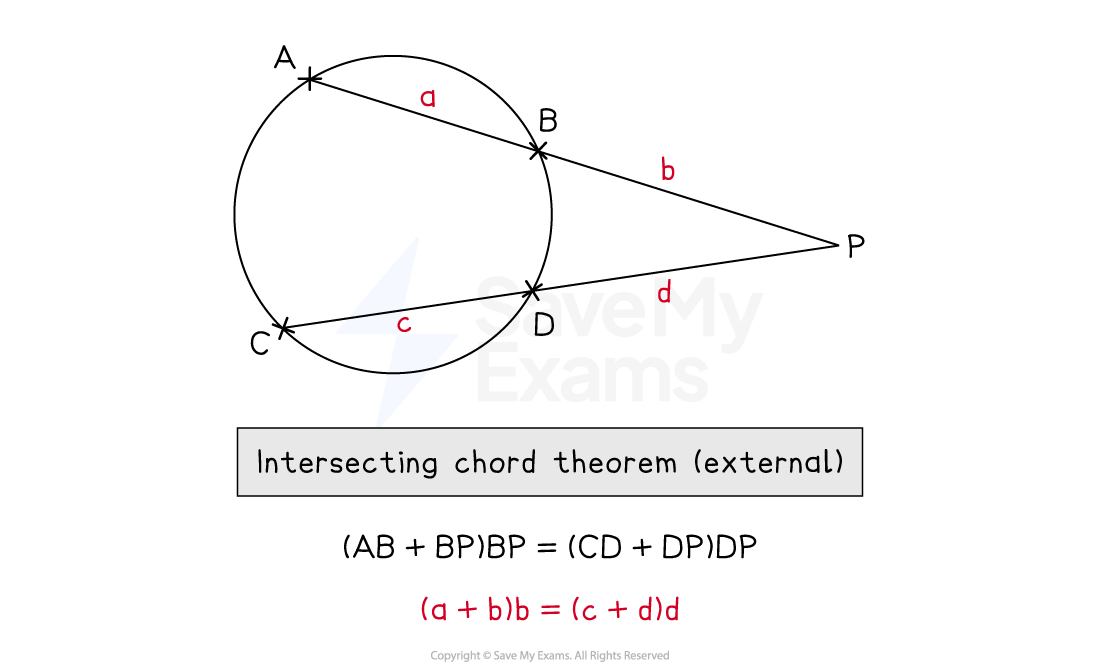
For two chords, AB and CD that extend and meet at point P outside of the circle
- AP : PD ≡ CP : PB where AP = AB + BP and CP = CD + DP
- Therefore (AB + BP) : PD ≡ (CD + DP) : PB
-
A more practical way to deal with most problems involving the intersecting secant theorem is
- BP(AB + BP) = DP(CD + DP)
-
How do I use the intersecting secant theorem to solve problems?
-
If two chords intersect outside of a circle, you can find a missing length using the intersecting secant theorem
- Substitute the values into the multiplication formula
- BP(AB + BP) = DP(CD + DP)
-
If any of the lengths are algebraic expressions, an equation will be formed which can then be solved
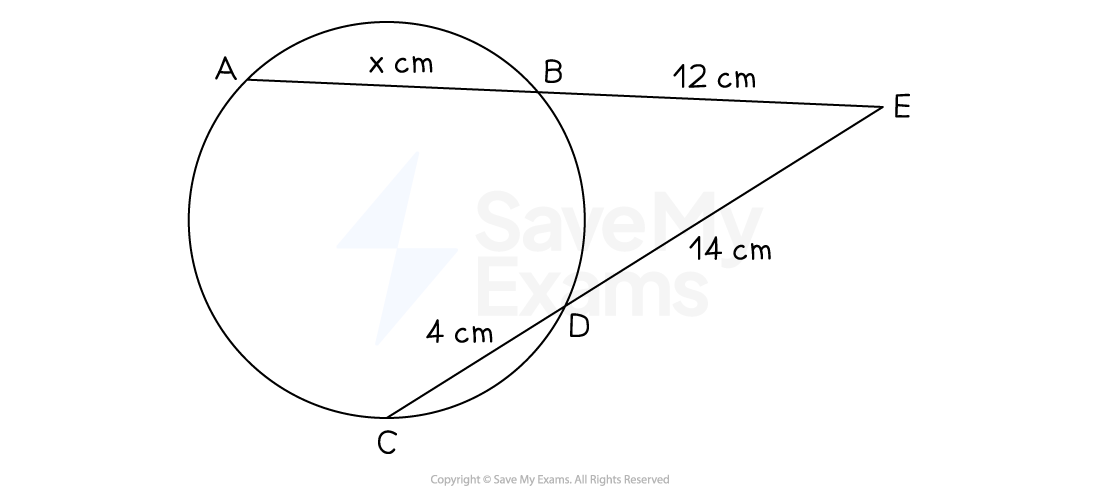
Worked Example In the diagram below, A, B, C and D are points on a circle.
ABE and CDE are straight lines. AB = cm BE = 12 cm CD = 4 cm DE = 14 cm
Work out the value of .
Answer:
Using the properties of Intersecting Chords (external intersection)
Or equivalently
Substitute the values from the diagram
Solve for
What if one of the lines is a tangent?
-
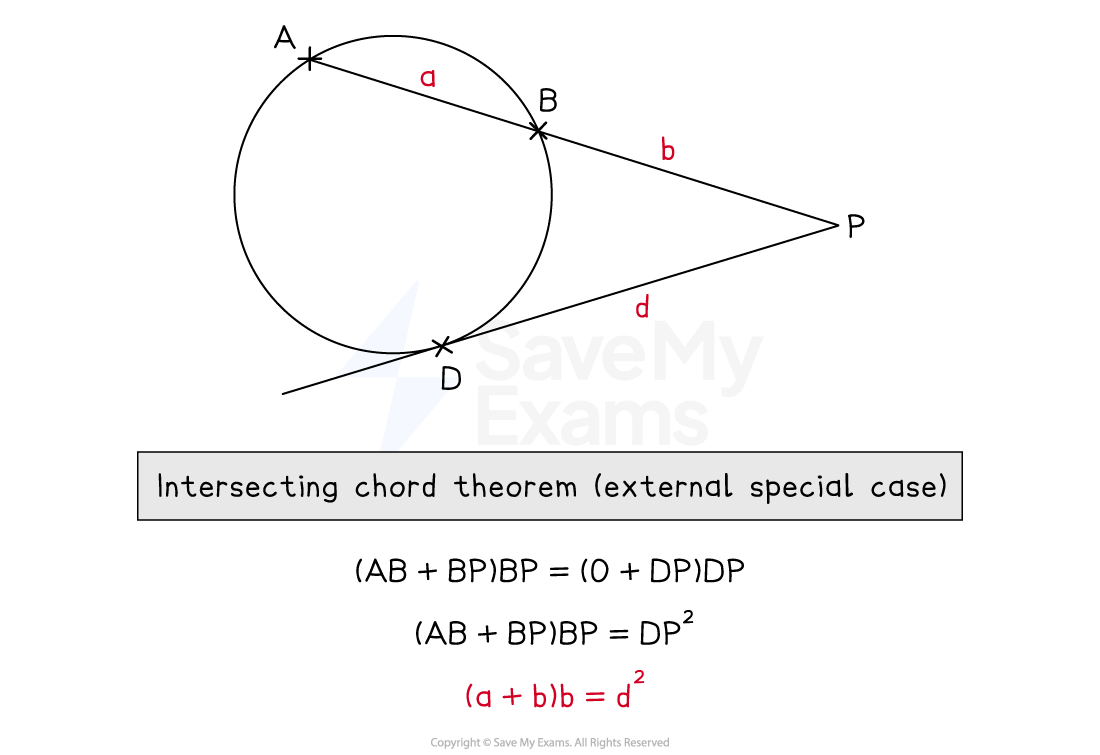
A special case of the intersecting secant theorem is when one of the lines is a tangent, rather than a secant
-
A tangent touches the circumference of the circle once, rather than intersecting it
-
In this case,one of the lengths becomes zero
- BP(AB + BP) = DP(0 + DP)
- BP(AB + BP) = DP2
-
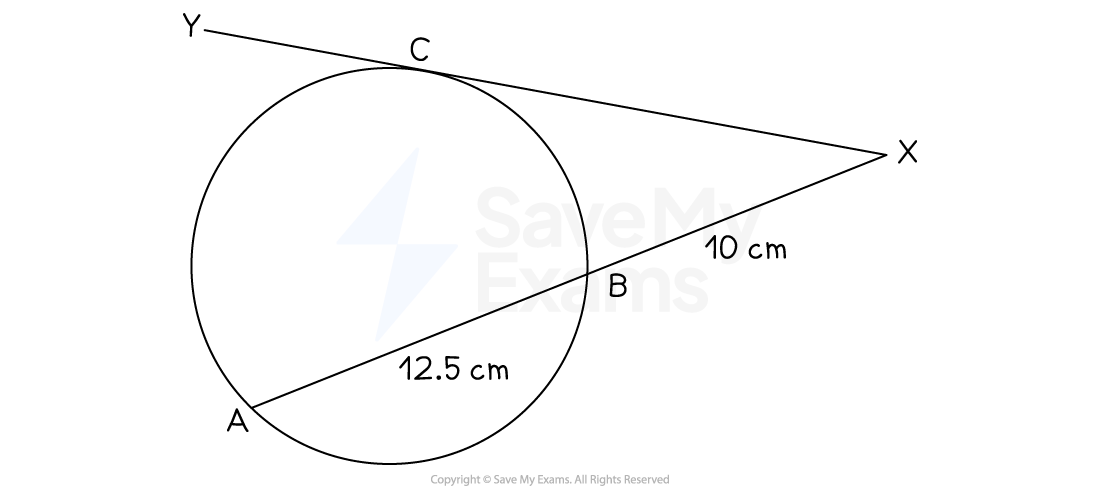
Worked Example In the diagram below, A, B, and C are points on a circle.
ABX is a straight line. YCX is a tangent to the circle. AB = 12.5 cm BE = 10 cm
Work out the length of CX.
Answer:
This is a special case of the properties of Intersecting Chords (external intersection), where one of the lines is a tangent, and therefore one of the line segments has length zero
Substitute the values from the diagram
Simplify and solve for
Final answer: CX = 15 cm
Was this revision note helpful?
Build on this topic