Finding Stationary Points & Turning Points (Edexcel IGCSE Maths)
Spec point —
3.4C
Finding stationary points & turning points
What is a stationary point?
-
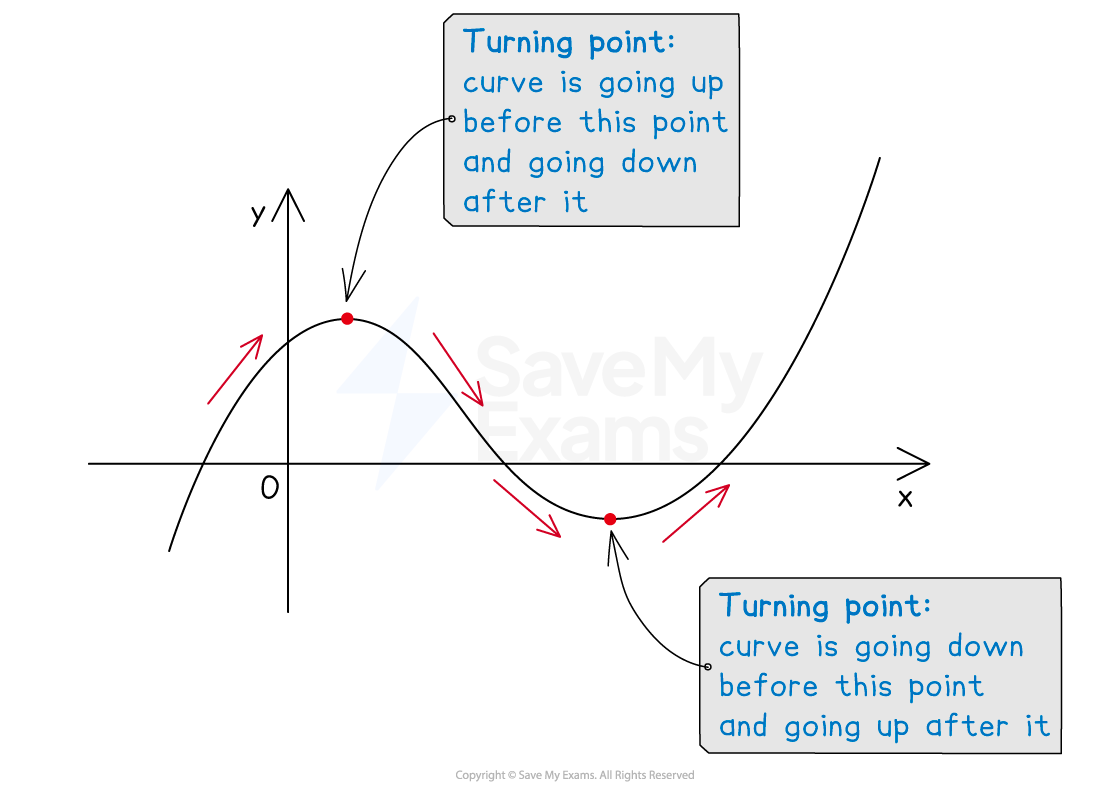
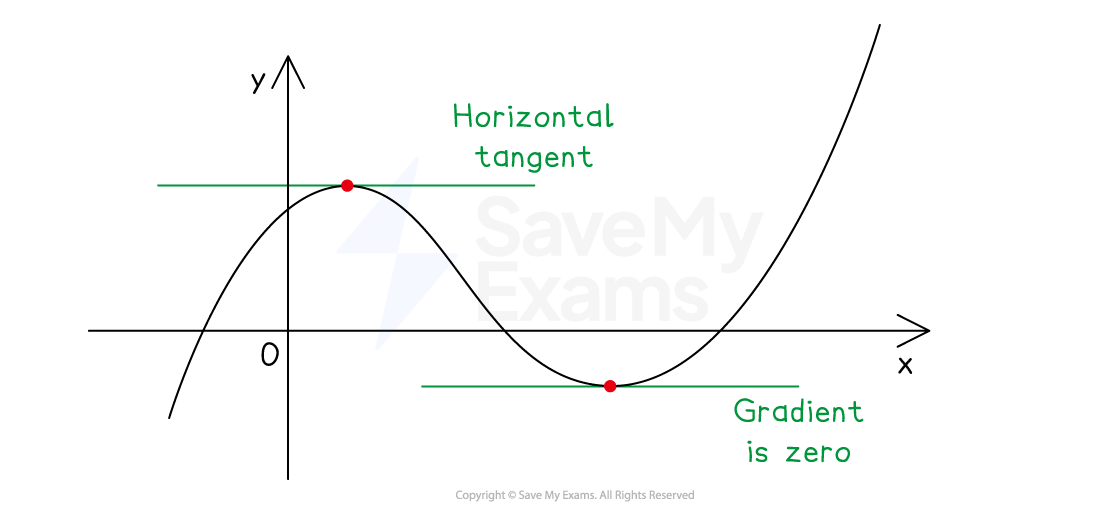
A stationary point is a point on the graph at which the gradient is zero (a tangent drawn at this point will be horizontal)
- These include peaks (maximum points) and troughs (minimum points)
-
Maximum points and minimum points are collectively know as turning points
- At a turning point a curve changes from moving upwards to moving downwards, or vice versa
-
At a turning point the gradient of the curve is zero
- If a tangent is drawn at a turning point it will be a horizontal line
- Horizontal lines have a gradient of zero
-
Because the gradient at a turning point is zero
- Substituting the x-coordinate of a turning point into the gradient function (the derivative) will give an output of zero
How do I find the coordinates of a turning point?
-
STEP 1 Find the gradient function(derivative) of the original equation
- E.g. Find the coordinates of the turning point of the equation
-
STEP 2 Set the gradient function (derivative) equal to zero and solve for
- This will find the x-coordinate of the turning point
- E.g. , so
-
STEP 3 Substitute the x-coordinate into the original equation of the graph
- This will find the y-coordinate of the turning point
- E.g.
-
STEP 4 Write out the coordinates of the turning point
- E.g. The turning point is at
Exam Hint
Remember to read the questions carefully
- Sometimes only the x-coordinate of a turning point is required
Worked Example Find the coordinates of the turning point on the curve with equation .
Answer:
Use differentiation to find the gradient function (derivative) of the equation
*Set the derivative equal to 0 and solve for *x
*Substitute the x-coordinate into the origination equation of the curve and solve for *y
Form a set of coordinates
Final answer:** The turning point has coordinates
Was this revision note helpful?