Simultaneous Equations (Edexcel IGCSE Maths)
Linear Simultaneous Equations
Spec point —
2.6A
What are linear simultaneous equations?
-
When there are two unknowns (x and y), we need two equations to find them both
-
For example, 3x + 2y = 11 and 2x - y = 5
- The values that work for both equations at the same time are x = 3 and y = 1
-
-
These are called linear simultaneous equations
- Linear because there are no complicated terms like x2 or y2
- Simultaneous because the solutions satisfy both equations at the same time
How do I solve linear simultaneous equations by elimination?
-
Elimination removes one of the variables, x or y
-
To eliminate the x's from 3x + 2y = 11 and 2x - y = 5, make the number in front of the x (the coefficient) in both equations the same (the sign may be different)
-
Multiply every term in the first equation by 2
- 6x + 4y = 22
-
Multiply every term in the second equation by 3
- 6x - 3y = 15
-
Subtracting the second equation from the first eliminates x
- When the sign in front of the term you want to eliminate is the same, subtract the equations
-
- bottom | 6 x + 4 y = 22 | | 6 x - 3 y = 15 | | 7 y = 7
-
The y terms have become 4y - (-3y) = 7*y *(be careful with negatives)
- Solve the resulting equation to find y
- y = 1
-
Then substitute y = 1 into one of the original equations to find x
- 3x + 2 = 11, so 3*x *= 9, giving x = 3
-
Write out both solutions together, x = 3 and y = 1
-
Alternatively, you could have eliminated the y's from 3x + 2y * = 11 and 2x *- y = 5 by making the coefficient of y in both equations the same
-
Multiply every term in the second equation by 2
-
Adding this to the first equation eliminates y (and so on)
- When the sign in front of the term you want to eliminate is different, add the equations
-
+ bottom | 3 x + 2 y = 11 | | 4 x - 2 y = 10 | | 7 x = 21
How do I solve linear simultaneous equations by substitution?
-
Substitution means substituting one equation into the other
-
This is an alternative method to elimination
- You can still use elimination if you prefer
-
-
To solve 3x + 2y = 11 and 2x - y = 5 by substitution
-
Rearrange one of the equations into y = ... (or x = ...)
- For example, the second equation becomes y = 2x - 5
-
Substitute this into the first equation
- This means replace all y's with 2*x *- 5 in brackets
- 3x + 2(2x - 5) = 11
-
Solve this equation to find x
- x = 3
-
Then substitute x = 3 into y = 2x - 5 to find y
- y = 1
-
How do I solve linear simultaneous equations graphically?
-
Plot both equations on the same set of axes
-
To do this, you can use a table of values
- or rearrange into y = mx + c if that helps
-
-
Find where the lines intersect (cross over)
- The x and *y solutions to the simultaneous equations are the *x and y coordinates of the point of intersection
-
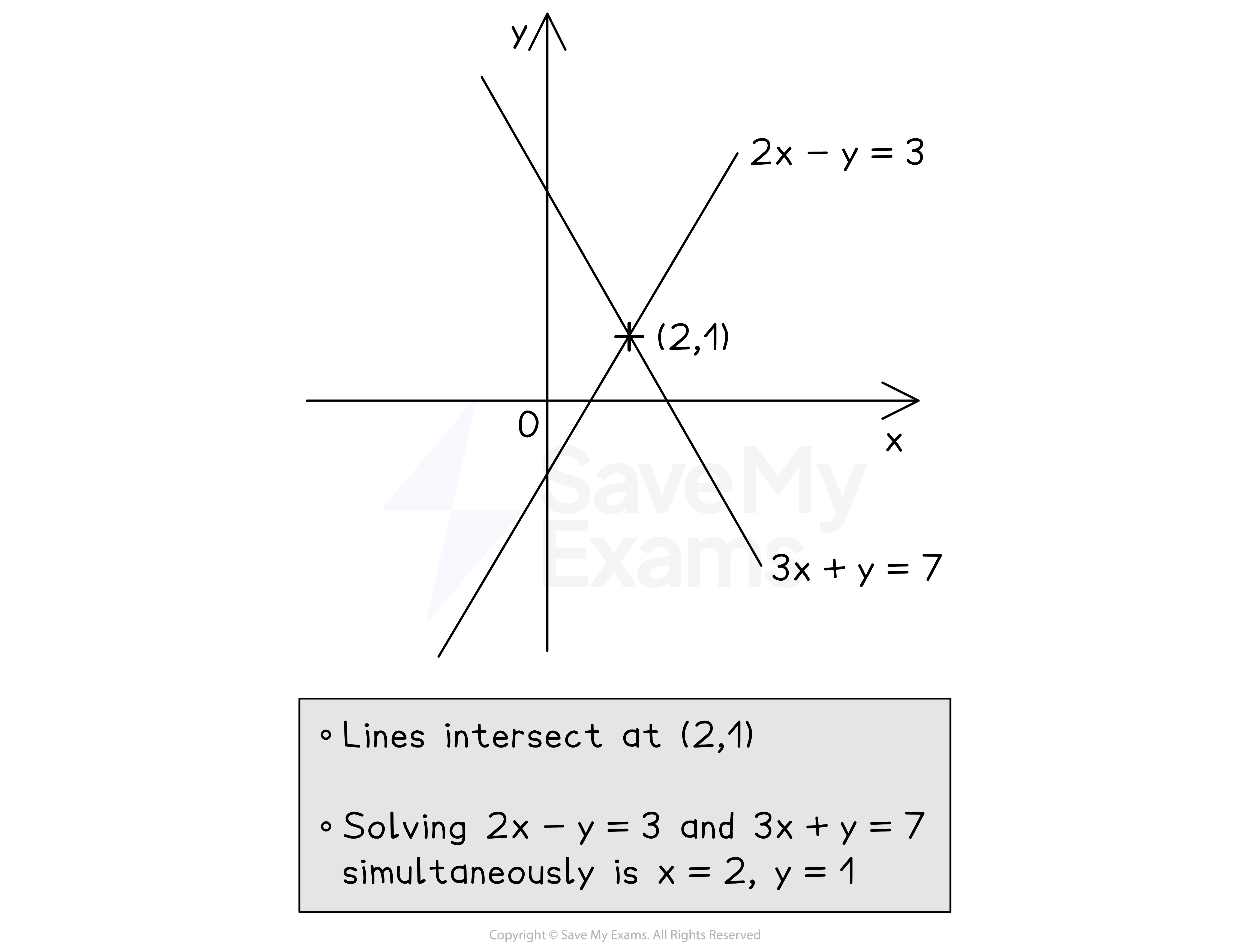
For example, to solve 2x - y = 3 and 3x + y = 7 simultaneously
- First plot them both on the same axes (see graph)
- Find the point of intersection, (2, 1)
- The solution is x = 2 and y = 1
Exam Hint
- Always check that your final solutions satisfy both original simultaneous equations!
- Write out both solutions (x and y) together at the end to avoid examiners missing a solution in your working.
Worked Example Solve the simultaneous equations
Answer:
It helps to number the equations
We will choose to eliminate the y terms Make the y terms equal by multiplying all parts of equation 1 by 3 and all parts of equation 2 by 2
*The 6 y terms have different signs, so they can be eliminated by adding equation 4 to equation 3 *
15 x + 6 y = 33 > bottom + 8 x - 6 y = 36 > 23 x = 69Solve the equation to find x(divide both sides by 23)
Substitute x = 3 into either of the two original equations
* *
Solve this equation to find* y*
Substitute x = 3 and y= - 2 into the other equation to check that they are correct
* *
*
Write out both solutions together
Was this revision note helpful?