Problem Solving with Volumes (Edexcel IGCSE Maths)
Spec point —
4.11C
Problem-solving with volumes
What is problem-solving?
-
Problem solving, usually has two key features:
-
A question is given as a real-life scenario
- eg. The volume of water in a swimming pool...
-
There is usually more than one topic of maths you will need in order to answer the question
- eg. Volume and money
-
What are common problems that involve volume?
-
Volume is a commonly used topic of 'real-world' maths
- For example, a carton of juice in the shape of a cuboid, a cylindrical tin and a triangular prism chocolate box all involve volume
-
Typically, the 'real-world' scenarios also have a cost
- A lot of volume problems also involve calculations with money
How do I solve problems involving volume?
-
Often the 3D object in a question will not be a standard cuboid, cone, sphere, etc.
-
It will likely either be:
- A prism (3D shape with the same cross-section running through it)
- A portion or fraction of a standard shape (a hemisphere for example)
- A compound object (an object made up of two or more standard 3D objects)
-
-
If the object is a prism, recall that the volume of a prism is the cross-sectional area × its length
-
The cross-sectional area may be a compound 2D shape
- For example, an L-shape, or a combination of a rectangle and a triangle
-
-
If the object is a fraction of a standard shape, consider the "full" version of the object and find the appropriate fraction of it
-
A hemisphere is half a sphere
-
A frustum is a truncated(chopped-off) cone
- The volume of a frustum will be the volume of the smaller cone subtracted from the volume of the larger cone
-
-
If the object is a compound object, find the volumes of the individual standard 3D objects and add them together
-
Problem solving questions could appear on either a non-calculator paper or a calculator paper
Exam Hint
Before you start calculating, make a quick note of your plan to tackle the question
- For example, "Find the area of the triangle and the rectangle, add together, multiply by the length"
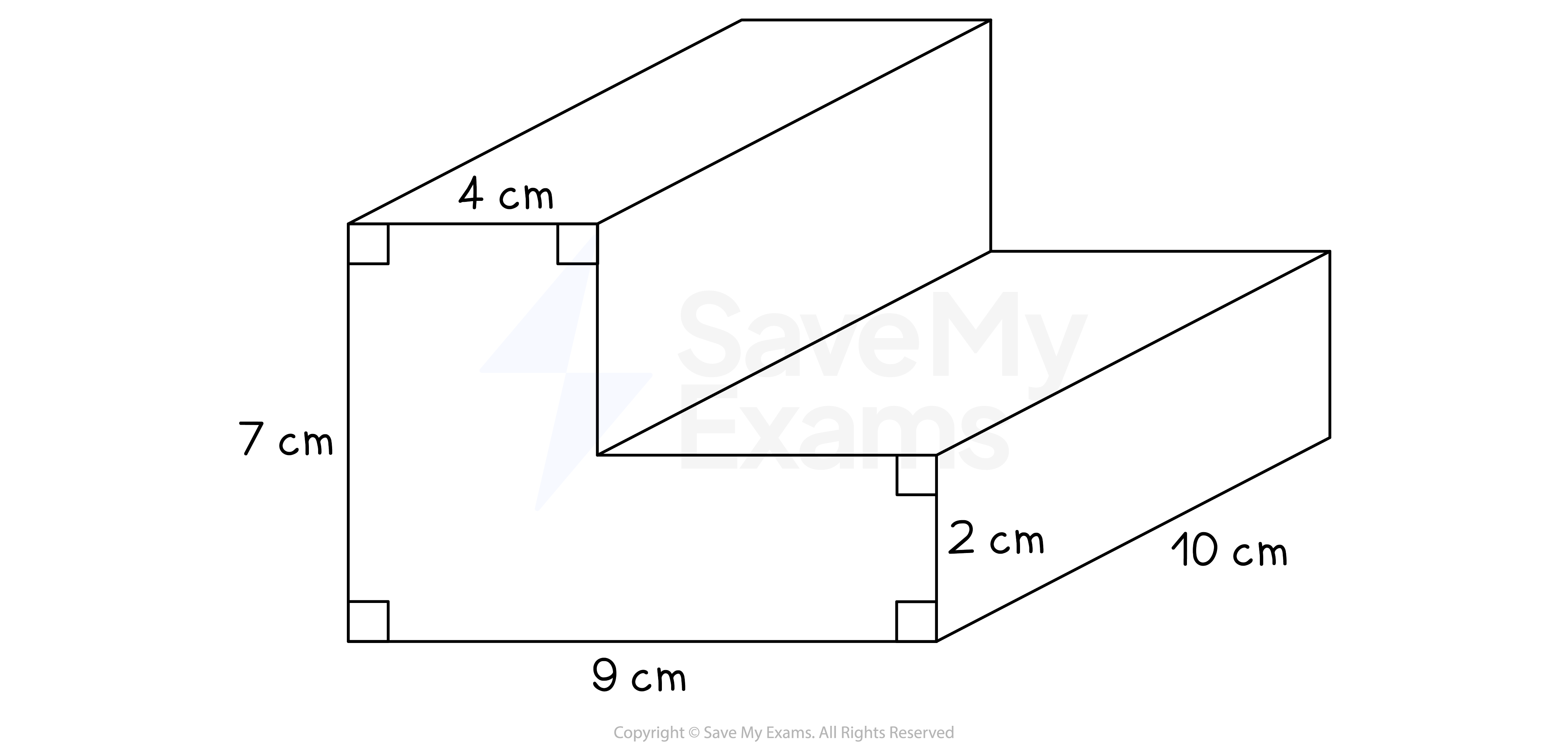
Worked Example The diagram shows a prism.
Work out the volume of the prism.
Answer:
The volume is the area of the cross section × length (10 cm) Find the area by splitting into a 7 × 4 and a (9 - 4) × 2 rectangle (or a 9 × 2 and a (7 - 2) × 4 rectangle)
7 × 4 + (9 - 4) × 2 = 38 cm2*
Find the volume (by multiplying 38 by 10)
38 × 10
Final answer: 380 cm3
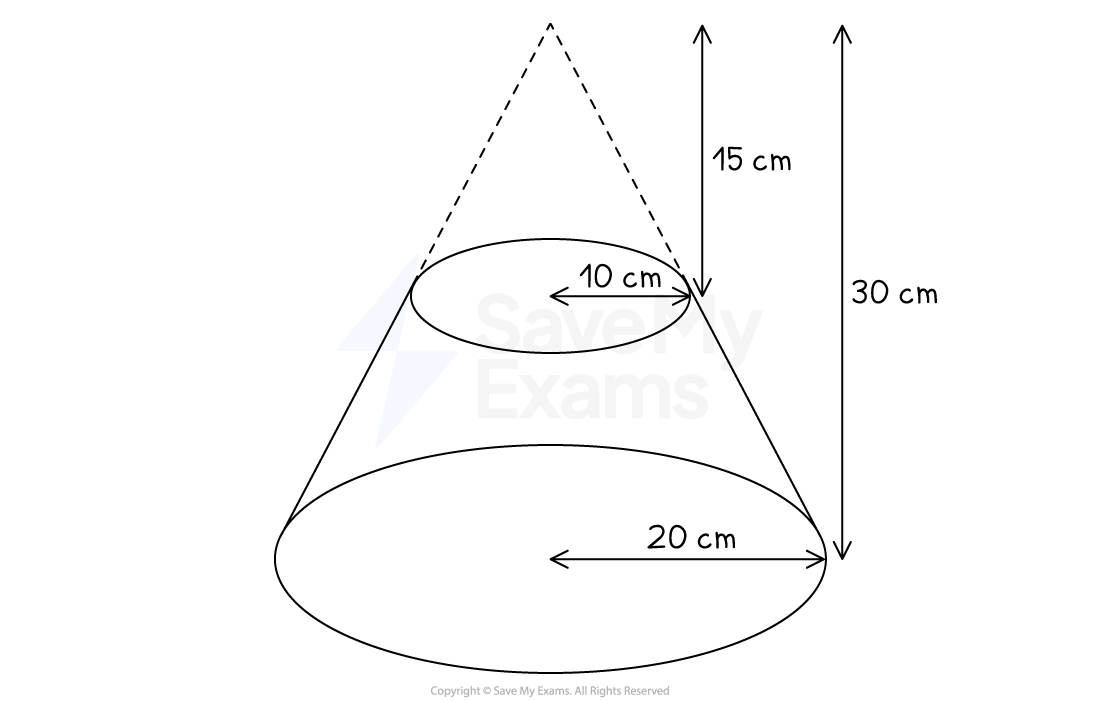
Worked Example The diagram shows a truncated cone (a frustum). Using the given dimensions, find the volume of the frustum to 3 significant figures.
Answer:
To find the volume of the frustum, find the volume of the larger cone (30 cm tall, with a radius of 20 cm), and subtract the volume of the smaller cone (15 cm tall, with a radius of 10 cm)
Formula for the volume of a cone:
Calculate the volume of the larger cone
Calculate the volume of the smaller cone
Find the difference
Round to 3 significant figures
Final answer: 11 000 cm3
Was this revision note helpful?
Build on this topic