13 marksmedium
1 mark
Use differentiation to find for the following:
1 mark
1 mark
35 questions · 210 marks · ≈ 4 hours
Use differentiation to find for the following:
Use differentiation to find for the following:
Use differentiation to find for the following:
For the curve with equation :
find
Find the coordinates of the point on the curve where the gradient is 2.
A curve has equation
Find
Find the gradient of the curve at the point where:
(i)
(2 marks)
(ii)
(2 marks)
What can you say about the tangents to the curves at these two points?
A particle passes the fixed point whilst moving along a straight line.
The displacement of , from , at time seconds is metres where
Find expressions for the velocity, , and the acceleration, of the particle at time seconds.
Find the time at which the acceleration is 3 .
The curve has equation .
Find .
= ..............................................
There are two points on the curve at which the gradient of the curve is .
Find the coordinate of each of these two points. Show clear algebraic working.
.
Find .
....................................
The curve with equation has two stationary points.
Work out the coordinates of these two stationary points.
The curve has equation .
Find .
Find the range of values of for which has a negative gradient.
Calculate the gradient of at .
Differentiate .
Find the coordinates of the turning point of the graph of .
( ...................... , ...................... )
The curve C has equation
Find
Find the coordinates of the points on C where the gradient is 4 Show clear algebraic working.
A curve has equation
Find the coordinates of the two points on the curve where the gradient is
A curve has equation .
Find: the coordinates where the curve crosses the -axis,
the coordinates where the curve crosses the -axis,
the coordinates of the turning point on the curve,
Sketch the curve showing the points you have found.
A particle is moving along a straight line. The fixed point lies on this line.
The displacement of the particle from at time seconds is metres where
Find an expression for the velocity, of the particle at time seconds.
Find the time at which the velocity is instantaneously zero.
For the curve with equation : find
find the -coordinates of the two turning points on the curve.
By considering the shape of the curve determine which of your answers to (b) is the -coordinate of a maximum point.
The curve has equation .
Part of the graph of is shown below.
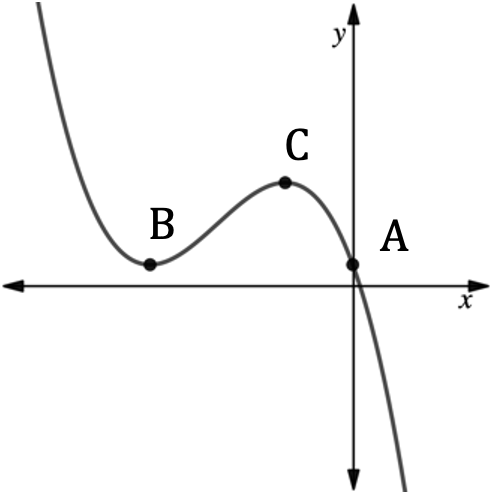
Write the coordinates of A.
Points B and C are stationary points on .
Find the coordinates of points B and C, stating the nature of the stationary point in each case.
For which values of is the gradient of the curve negative?
For the curve with equation
find
find the coordinates of the stationary points on the curve.
find the exact distance between the two stationary points.
A particle is moving along a straight line and passes a fixed point .
The displacement of the particle, from point , at time seconds is
where is measured in metres. Initially how far is the particle from ?
Find, in terms of , the velocity of the particle.
Find the time at which the particle’s velocity is at its minimum.
For how long is the particle decelerating?
A homeowner wishes to enclose a rectangular part of their garden by building a fence, using an existing wall as one side of the rectangle as shown in the diagram below.
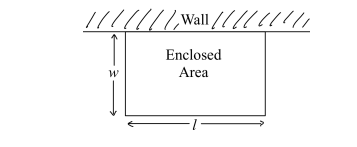
The width of the enclosed rectangle is metres and its length metres.
The homeowner has 40 metres of fence to use and would like to use it all in order to maximise the area of the garden to be enclosed. Show that
Show that the area of the garden to be enclosed, , is given by = 40 − 2
Find
Find the value of that maximises
Find the dimensions of the rectangle that produce the maximum area that can be enclosed using all of the fence.
Also find the maximum area.
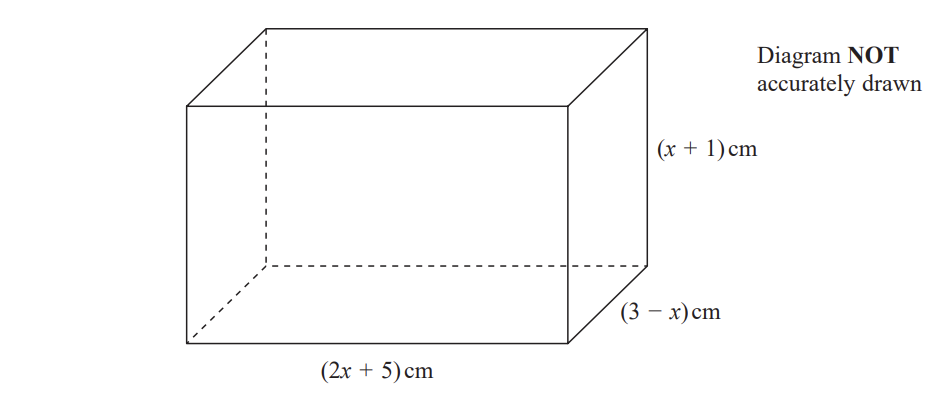
The diagram shows a cuboid of volume
Show that
There is a value of for which the volume of the cuboid is a maximum.
Find this value of . Show your working clearly. Give your answer correct to 3 significant figures.
A particle is moving along a straight line. The fixed point lies on this line. At time seconds where , the displacement, metres, of from is given by
Find the displacement of from when is instantaneously at rest.
Give your answer in the form where and are integers.
A cuboid with a square cross section is to be made from rods as shown in the diagram. The shorter rods making the square are of length xx cm and the longer rods
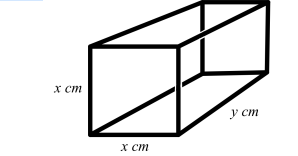
are of length cm.
Explain why 12 rods in total will be needed to make the cuboid, and state how many of each length will be required.
The total length of the rods is to be fixed at 36 cm.
The total length of the rods is to be fixed at 36 cm.
Find in terms of
Show that the volume of the cuboid, cm3 is = 9 − 2.
Find the value of that maximises the volume.
Find the maximum volume.
A particle is moving along a straight line that passes through the fixed point O. The displacement, metres, of the particle from O at time seconds is given by
Find the value of* *when the acceleration of the particle is 5 m/s²
A curve, , has equation where is a constant.
Show that when = 0, the turning point on has coordinates (0, -3).
Show that when ≠ 0, the turning point on must have a negative -coordinate.
When ≠ 0 determine whether or not the -coordinate of the turning point is negative.
Part of the graph with equation is shown below.
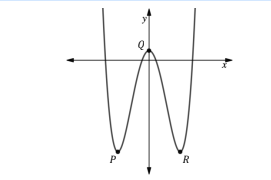
The graph has three stationary points, indicated on the graph by points , and. Find the area of the triangle .
The diagram shows a cuboid with a square cross-section.
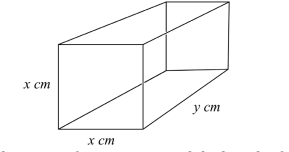
The sides of the square face are cm and the length of the cuboid is cm.
The cuboid is to have a fixed surface area, , of 25 cm2.
Show that the volume of the cuboid, cm3 is given by
Show that the value of that maximises the volume of the cuboid is
Find the maximum volume of the cuboid, correct to 3 significant figures.
A particle moves along a straight line that passes through the fixed point
The displacement, metres, offrom at time t seconds, where , is given by
The direction of motion of reverses when is at the point on the line.
The acceleration of at the instant when is at is . Find the value of .
a = .....................................
Find
.............................
The curve with equation has two stationary points. By finding a suitable quadratic to solve, work out the coordinates of these two points.
The curve with equation has two stationary points.
Using part (b) or otherwise, work out the coordinates of these two stationary points.
Two particles, and , move along a straight line.
The fixed point lies on this line.
The displacement of from at time seconds is metres, where
The displacement of from at time seconds is metres, where
Find the range of values of where for which both particles are moving in the same direction along the straight line.
The point A is the only stationary point on the curve with equation where is a constant.
Given that the coordinates of are
find the value of . Show your working clearly.
.................................................
The curve has equation where and are constants.
The point with coordinates (2, –6) lies on .
The gradient of the curve at is 16.
Find the coordinate of the point on the curve whose coordinate is 3. Show clear algebraic working.
A particle is moving along a straight line.
The fixed point lies on the line.
At time t seconds , the displacement of from is s metres where
Find the minimum speed of .
...................................................... m/s
is a five-sided shape.
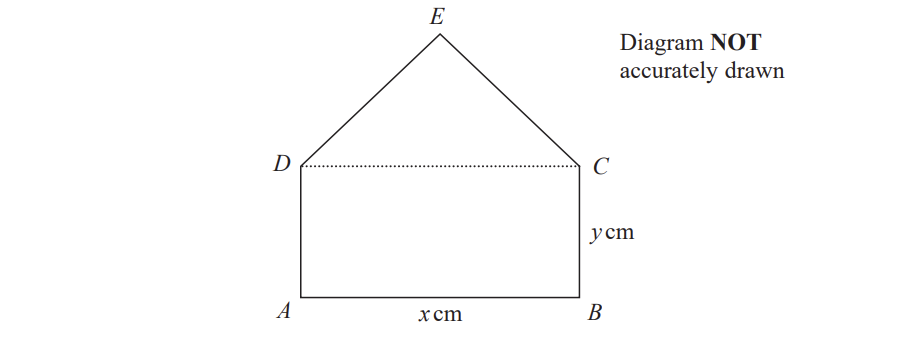
is a rectangle. is an equilateral triangle.
The perimeter of is 100 cm. The area of is cm2
Show that
(i) Find the value of for which has its maximum value.
Give your answer in the form where and are integers.
....................................................... [2]
(ii) Explain why the maximum value of is given by this value of .
(1 mark)
A particle moves along a straight line. The fixed point lies on this line. The displacement of the particle from at time seconds , , is metres where
At time seconds the velocity of is where
Find an expression for in terms of .
Give your expression in the form where and are integers to be found.