Theorems with Chords & Tangents (Edexcel IGCSE Maths)
Circles & Chords
Spec point —
4.6B
What is a chord?
-
A chord is any straight line is a circle that joins any two points on the circumference
- Chords of equal length are equidistant (the same distance) from the centre
Circle Theorem: The perpendicular bisector of a chord passes through the centre
-
If a line through the centre (such as a radius or diameter) goes through the midpoint of chord
- it will bisect (cut in half) that chord at right angles to it
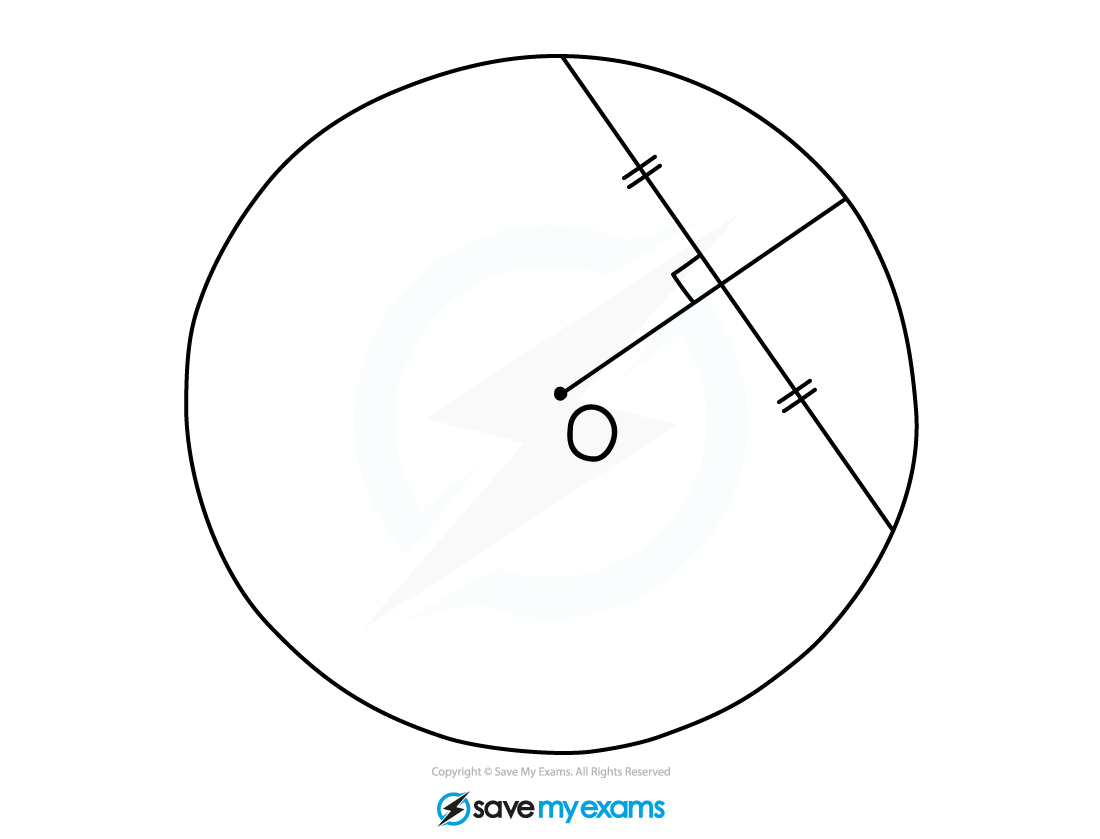
-
To spot this circle theorem on a diagram
- look for a radius and see if it intersects any chords
- or look to see if you could draw a radius that bisects a chord
-
When explaining this theorem in an exam you can use either phrase below:
- A radius bisects a chord at right angles
- The perpendicular bisector of a chord passes through the centre
Exam Hint
Look out for isosceles triangles formed by a chord and two radii
- Two angles in the triangle will be equal and there will be at least one line of symmetry
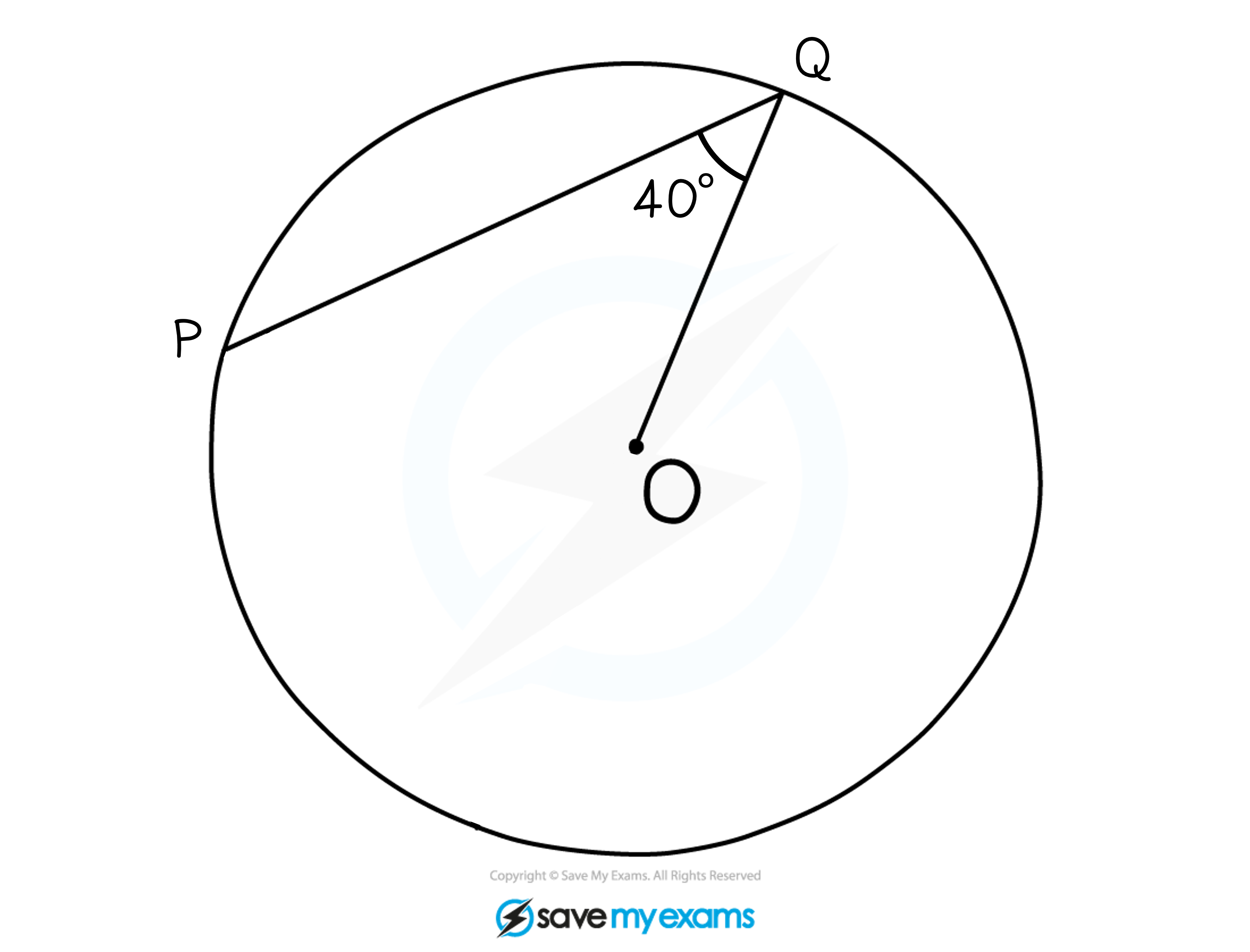
Worked Example The diagram below shows a circle with centre, O. Two points, P and Q, lie on its circumference. The radius of the circle is 6 cm. Angle OPQ = 40º.
Find the length PQ.
Answer:
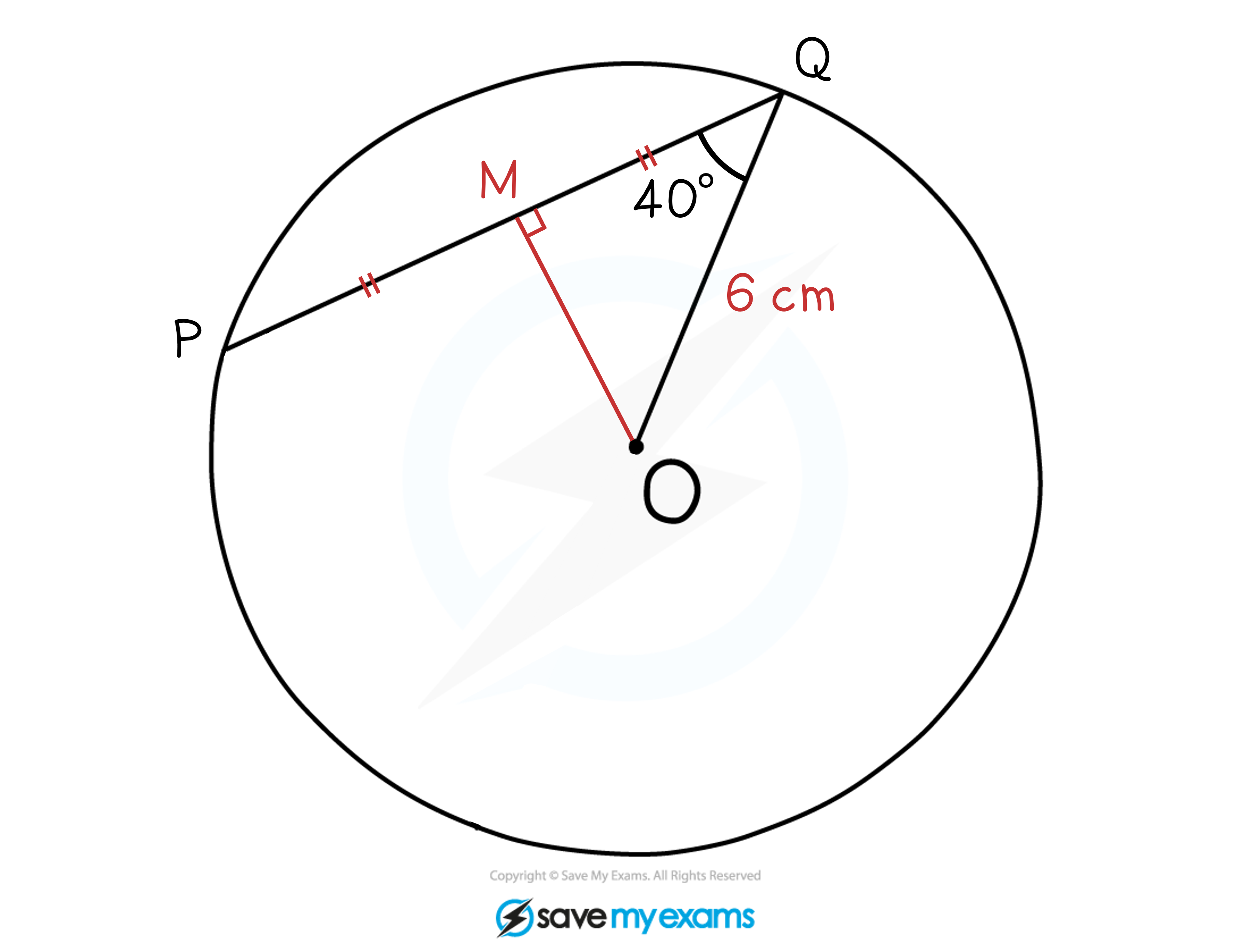
Label the radius on the diagram 6 cm
*Draw a line from O to the midpoint, M, of the line PQ The angle formed between the OM and PQ *will be a right angle
Use SOHCAHTOA on triangle OMQ to find the length* MQ*
* *
Double MQ to find the length PQ
Round to 3 significant figures
Final answer: PQ = 9.19 cm (3 s.f.)
Tangent & Radius
Spec point —
4.6B
What is a tangent?
- A tangent to a circle is a straight line outside of the circle that touches its circumference only once
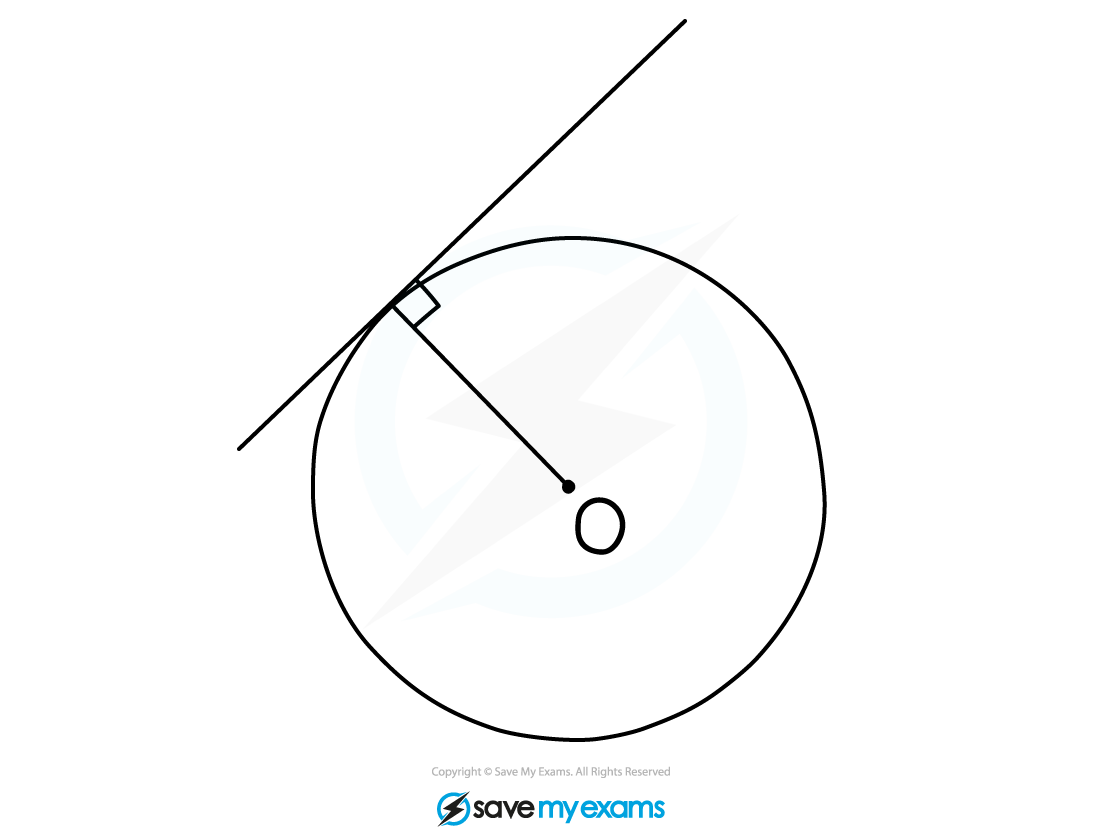
Circle Theorem: A radius and a tangent are perpendicular
-
This circle theorem states that a radius and a tangent meet at right angles (90°)
- This may also be described as being perpendicular to each other
-
When using this theorem in an exam you must use the keywords
- A radius and a tangent meet at right angles(or 90°)
Exam Hint
If you spot a tangent on a circle diagram, look to see if it meets a radius and label the right angle on the diagram
- In some cases just doing this can earn you a mark!
If you think you have spotted this circle theorem in a question, make sure it is a radius that meets the tangent, and not a chord
- A radius passes through the centre of the circle
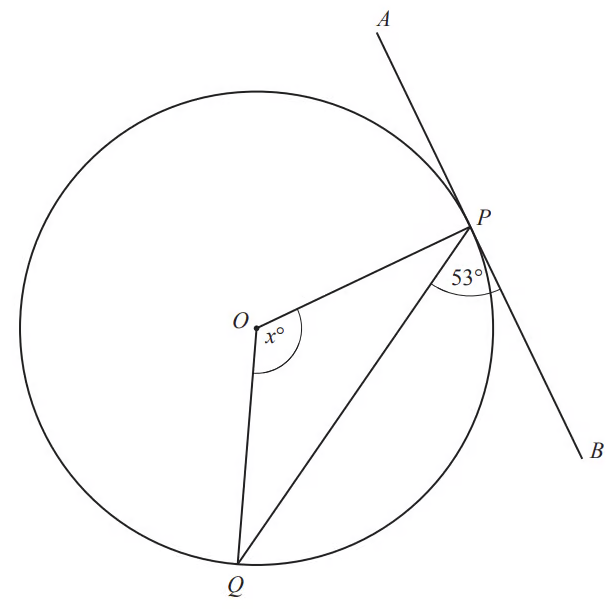
Worked Example P and Q are points on the circle, centre O.
APB is a tangent to the circle at P.
(i) Explain why angle OPB is 90°.
(ii) Find the value of
Answer:
(i)**
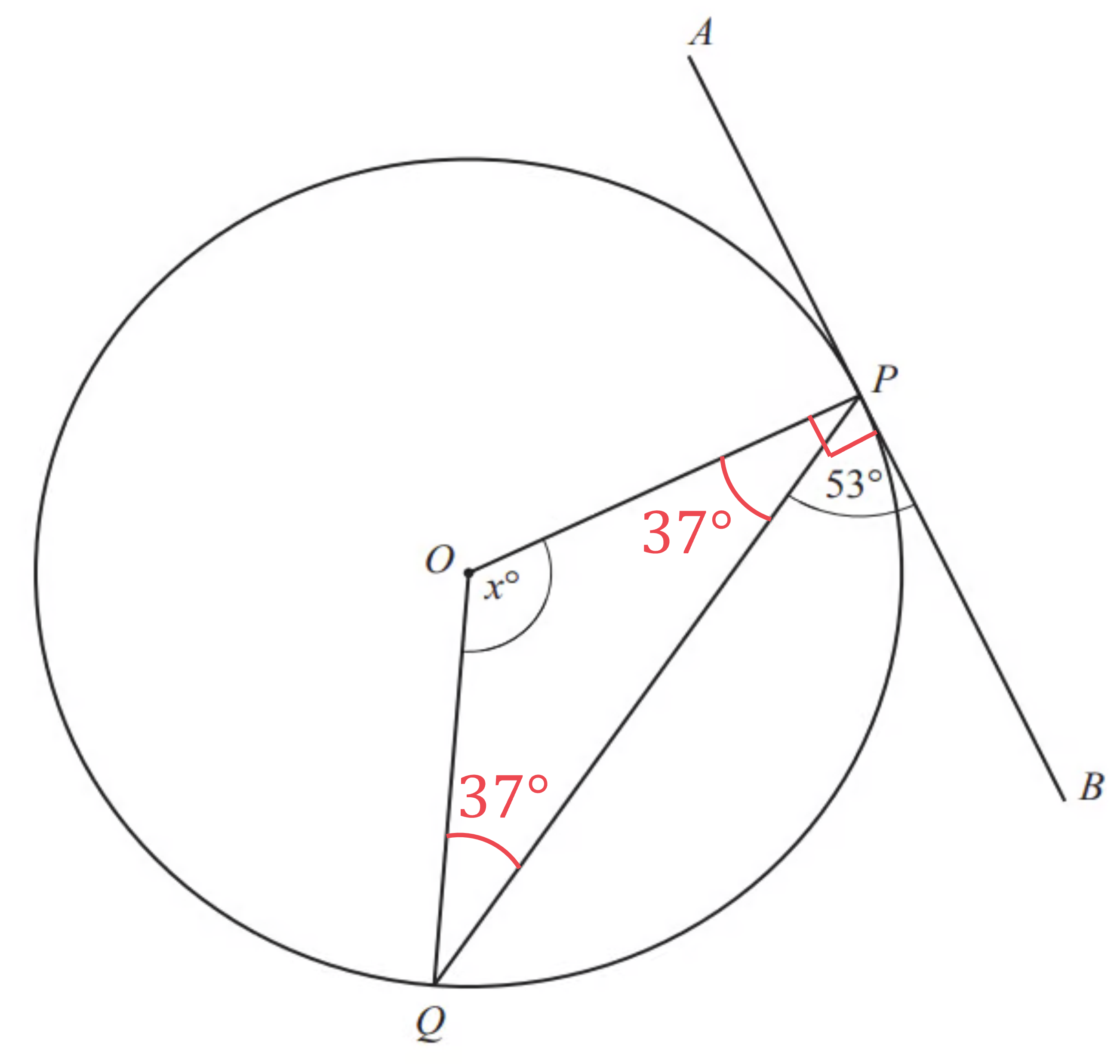
Final answer: Angle OPB is 90° because the angle between a tangent and a radius is 90° (and OP is a radius, and APB is a tangent).
(ii) As angle* OPB **is 90°, we can find angle **OPQ *
OPQ = 90 - 53 = 37° *
As OP and OQ are both the radius of the circle, they have the same length. This means the triangle* OPQ** is isosceles, so the base angles (OPQ and OQP) are equal *
Using the fact that the internal angles in a triangle sum to 180, we can find angle
Final answer:
Circle Theorem: Tangents from an external point are equal in length
-
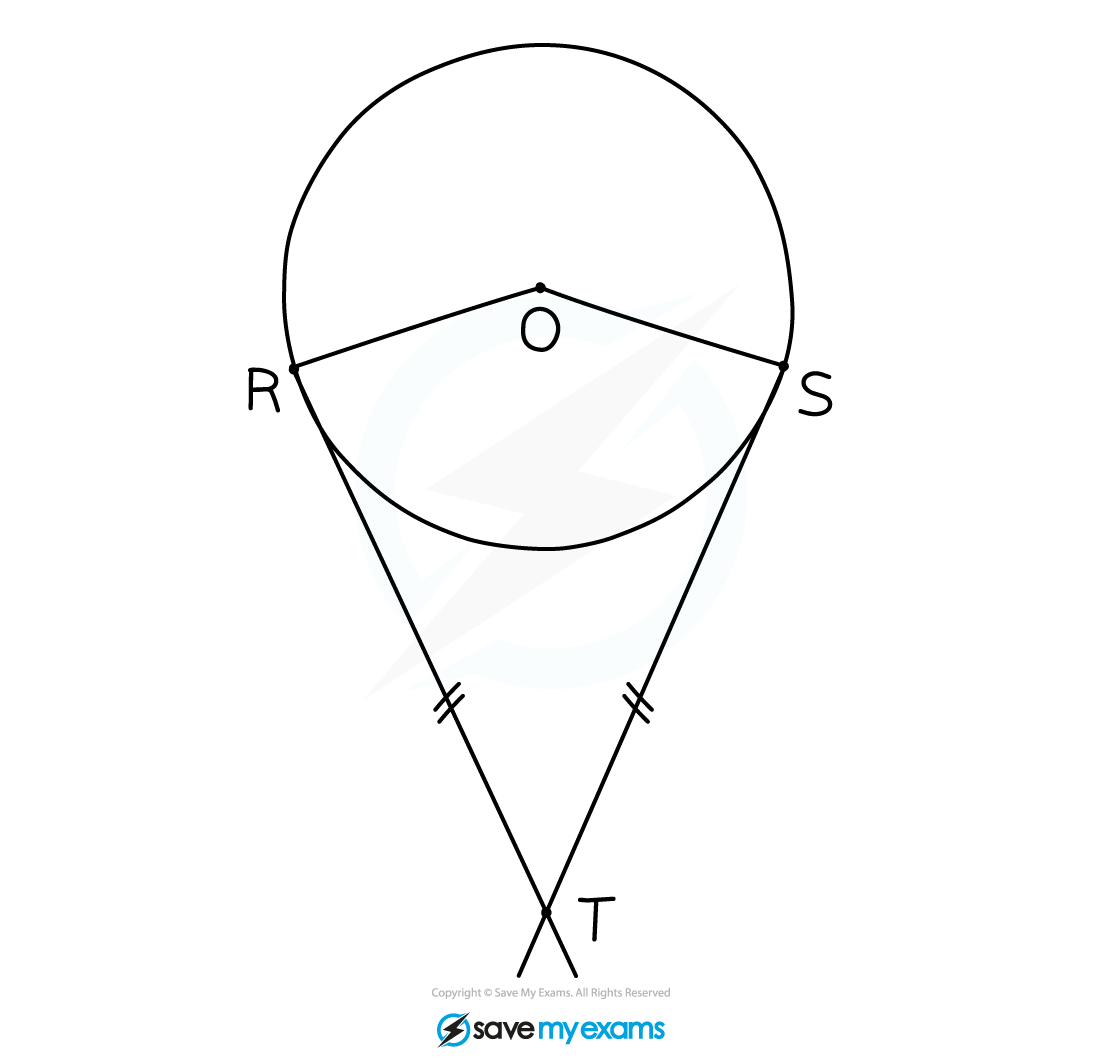
Two tangents from the same external point are equal in length
-
This means that a kite can be formed by two tangents meeting a circle
-
The kite below has a vertical line of symmetry
- It is formed from two congruent triangles back-to-back
-
The kite will have two right angles where the tangents meet the radii
- You can use Pythagoras and SOHCAHTOA on each of these triangles
-
Exam Hint
- Look for tangents in the exam and draw on the radius at right angles to see if it helps
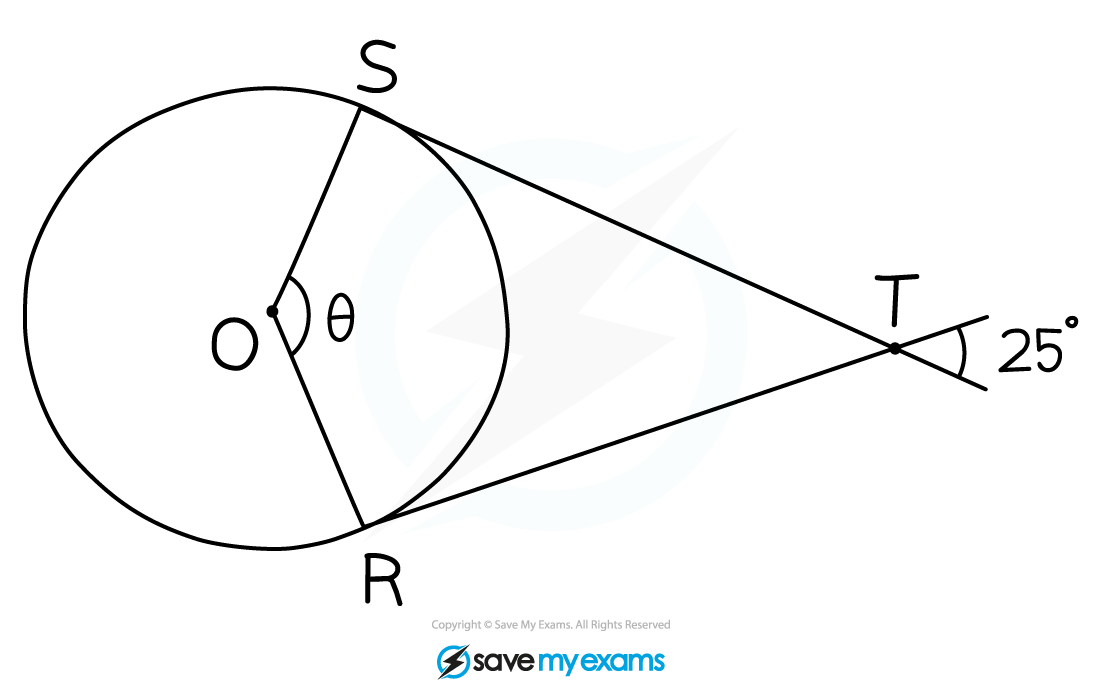
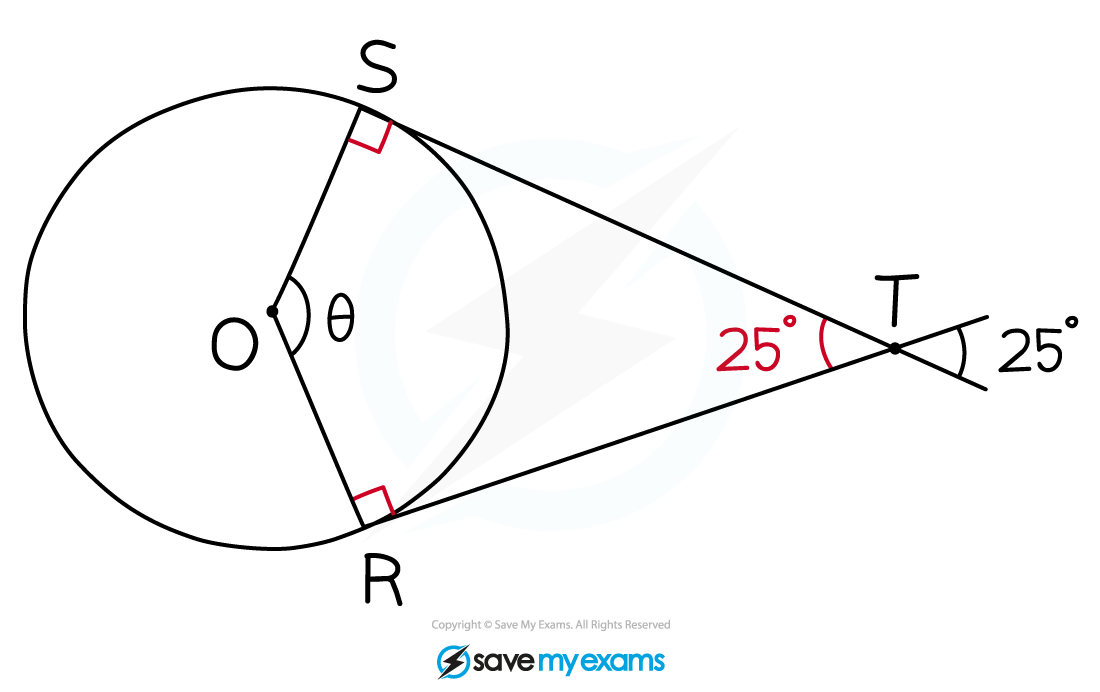
Worked Example Find the value of θ in the diagram below.
Answer:
The lines ST and RT are both tangents to the circle *They meet the two radii on the circumference at the points S and *T
Angle* TSO = angle TRO = 90°* A radius and a tangent meet at right angles
*Use vertically opposite angles to find the value of angle *RTS
Angle RTS = 25° Vertically opposite angles
Mark these angles clearly on the diagram
Angles in a quadrilateral add up to 360° Use this to form an equation for* θ*
Angles in a quadrilateral sum to 360º
Simplify
Solve
Was this revision note helpful?
Build on this topic