Measuring Development (Edexcel IGCSE Geography)
Spec point —
4GE1-S3.066
Measuring development
-
Measures of development can be economic, social or a combination
-
Some of the most commonly used include:
- literacy
- life expectancy
- infant mortality
- GDP
Literacy
-
Literacy is a measure of how many adults can read and write
- In developed countries literacy rates average 96%
- Less-developed countries have average literacy rates of 65%
Life expectancy
-
Life expectancy is the average age a person can be expected to live
-
Life expectancy is impacted by:
- physical and human environmental factors
- personal lifestyle
- incidence of disease
- access to healthcare
-
Infant mortality
-
Infant mortality rates refer to the number of children per 1000 who die below the age of 1
-
Over 18 countries have an infant mortality rate of over 50 per 1000
- These are all developing countries
- Most of these countries are in Sub-Saharan Africa
Gross Domestic Product (GDP) per capita
-
Gross Domestic Product (GDP) per capita is the total value of goods and services produced within a country in a year divided by the population of the country
- There can be huge differences in GDP depending on the size and population of a country
- Dividing it by the population means that more meaningful comparisons can be made between countries
-
GDP per capita is an average this means that the variation in wealth is hidden
- It is possible that two countries can have the same average GDP per capita but that one has a few very wealthy people and lots of people living in poverty whereas the other has a more equal distribution of wealth
-
There is no way of knowing what the GDP is spent on
- GDP increases after an earthquake due to rebuilding which is needed
- This does not mean that the country is more developed or that everyone's quality of life has improved
Human Development Index
Spec point —
4GE1-S3.066
-
The Human Development Index (HDI) is a combined measure of average achievement in key areas of human development, health, education and standard of living using the following data
- Life expectancy at birth
- Mean years of schooling for adults aged 25 years
- Expected years of education for children at school entering the age
- Gross National Income (GNI) per capita
-
Countries can be divided into four groups using HDI
- Very High Human Development (VHHD)
- High Human Development (HHD)
- Medium Human Development (MHD)
- Low Human Development (LHD)
-
HDI is scored from 0 to 1
-
The higher the HDI the higher the level of development and quality of life
-
Norway has the highest HDI at 0.957
-
Niger has the lowest HDI at 0.394
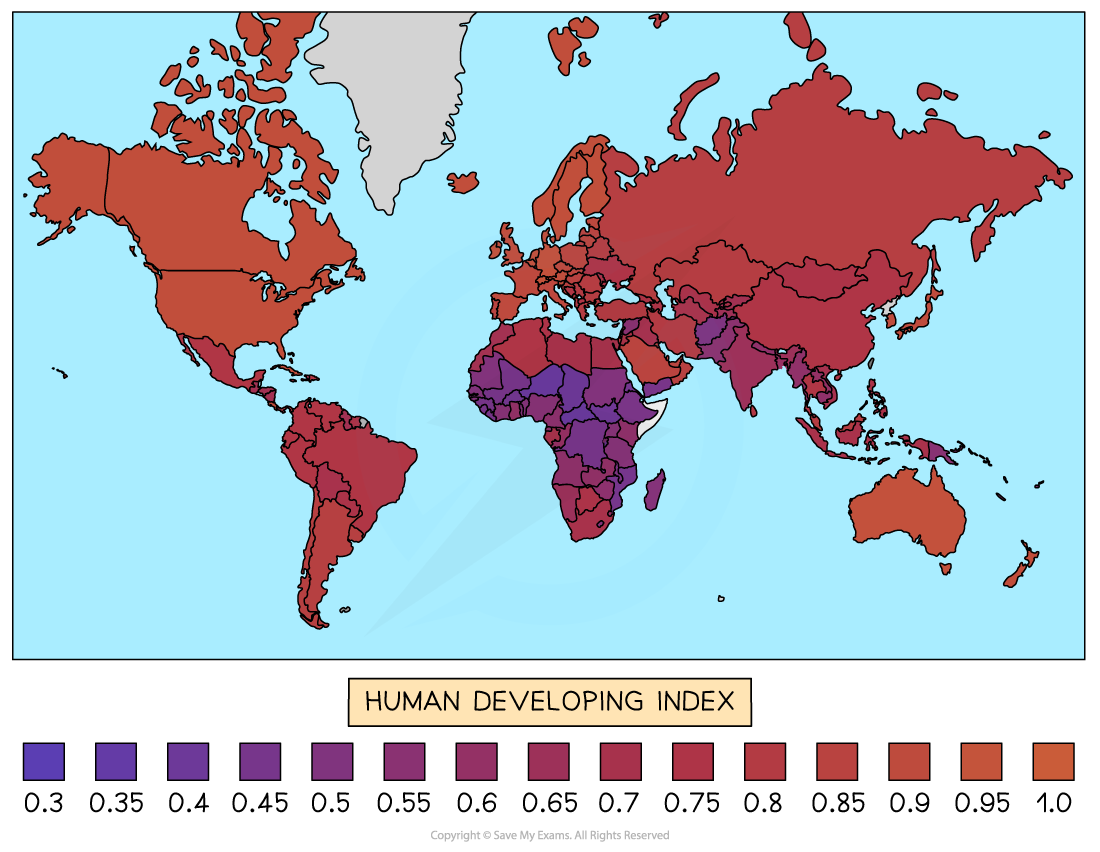
Map showing Human Development Index (HDI)
Measures of Inequality
Spec point —
4GE1-S3.066
-
GDP and HDI are not able to identify inequality within countries
-
In some countries, there is a significant gap between the wealthy and the poorest in the population
-
The Gini coefficient index is used to analyse the distribution of wealth and identify the countries where wealth distribution is most unequal
- Measured on a scale of 0 - 1.0 or as a percentage
- A low value means that the distribution of wealth is more equal - a measurement of 0 would mean that wealth is distributed completely equally
- A high value means the distribution of wealth is unequal - a measurement of 1 would indicate maximum inequality
- The Gini coefficient index is usually between 0.24 and 0.63 or 24%-63%
-
The highest inequality is currently in South Africa, Central Africa, Namibia, Zambia and Suriname
-
The lowest inequality is in the Czech Republic and Croatia
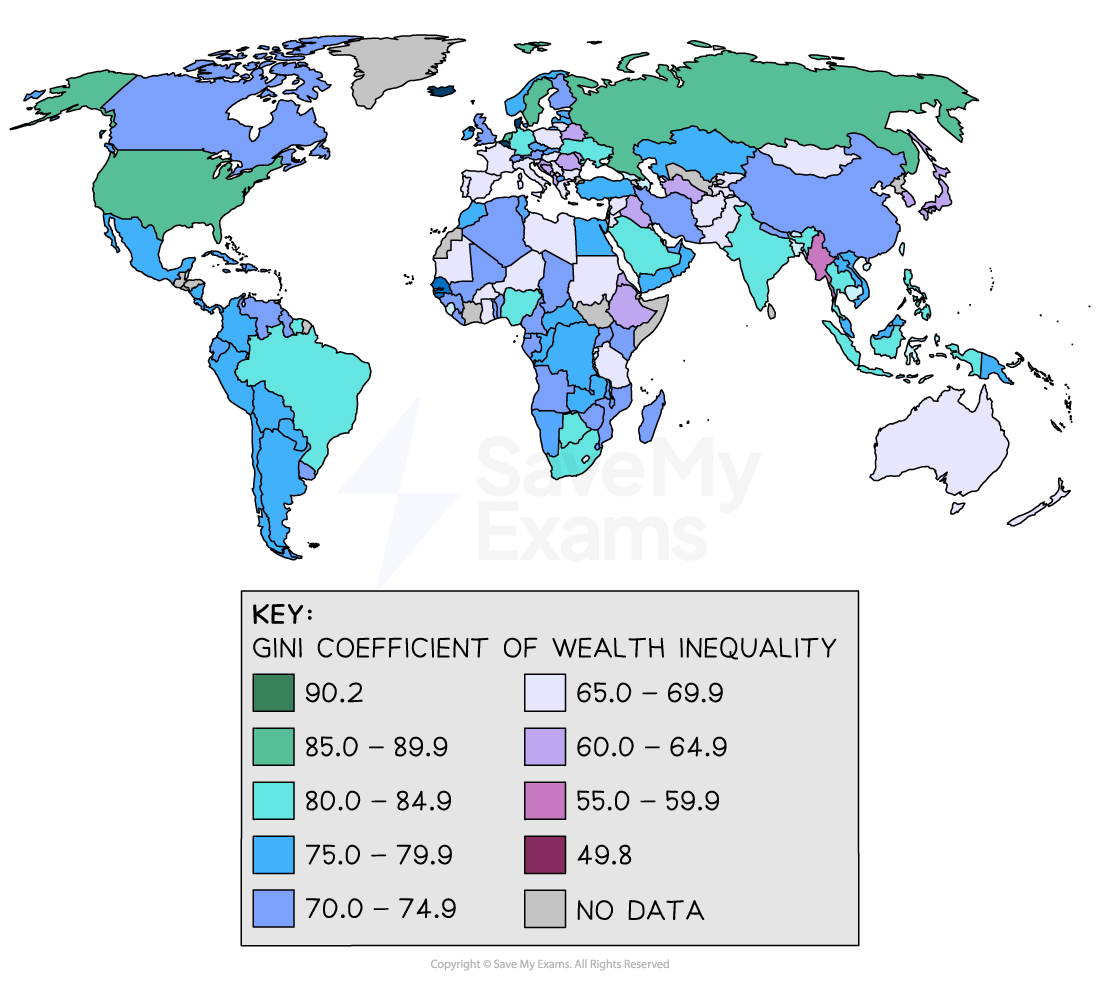
Gini Index - income inequality map
Indices of Political Corruption
Spec point —
4GE1-S3.066
-
Political corruption can have a devastating impact on both development and human welfare
- It means money is often not invested in infrastructure, development and human welfare but goes to wealthy individuals
- It leads to a lack of trust between local/national governments and the population
-
Transparency International scores 180 countries around the world out of 100 based on the levels of public sector corruption
-
The higher the score the less corruption has been found
- Denmark, New Zealand, Finland and Singapore have the lowest levels of public sector corruption scoring 85/100 or more
- Somalia, Syria and South Sudan have the highest levels of public sector corruption scoring less than 15/100
Worked Example **Suggest why GDP per capita is not necessarily a good indicator of the quality of life. **
(2 Marks)
Answer **- any two of the following
- GDP measures only economic production (1)
- Quality of life is not only about income** (1)**
- GDP is an average measure so many people may have incomes below this (1)
- The wealth is not shared equally across the population** (1)**
- It depends on what the GDP is spent on - weapons do not improve quality of life** (1)
- It does not consider health or education (1)
Exam Hint No measure of development will be completely reliable as they all look at different factors. Quality of life and development is a combination of a wide range of factors, not just a few.
Was this revision note helpful?
Build on this topic