Top Down & Bottom up Approaches (Edexcel IGCSE Geography)
Example Case Study: Top Down Approach - HS2, UK
Spec point —
4GE1-S3.066
Example case study: top-down approach - HS2, UK
- Top-down development schemes are usually expensive
- The schemes happen as a result of government or TNCs
- They often involve borrowing money
- Local people affected by the scheme often have little say in the process
Case Study
High Speed 2 (HS2)
Aims to reduce regional inequality increasing growth, productivity and incomes in the Midlands and the North of England
The first stage will be completed in 2026
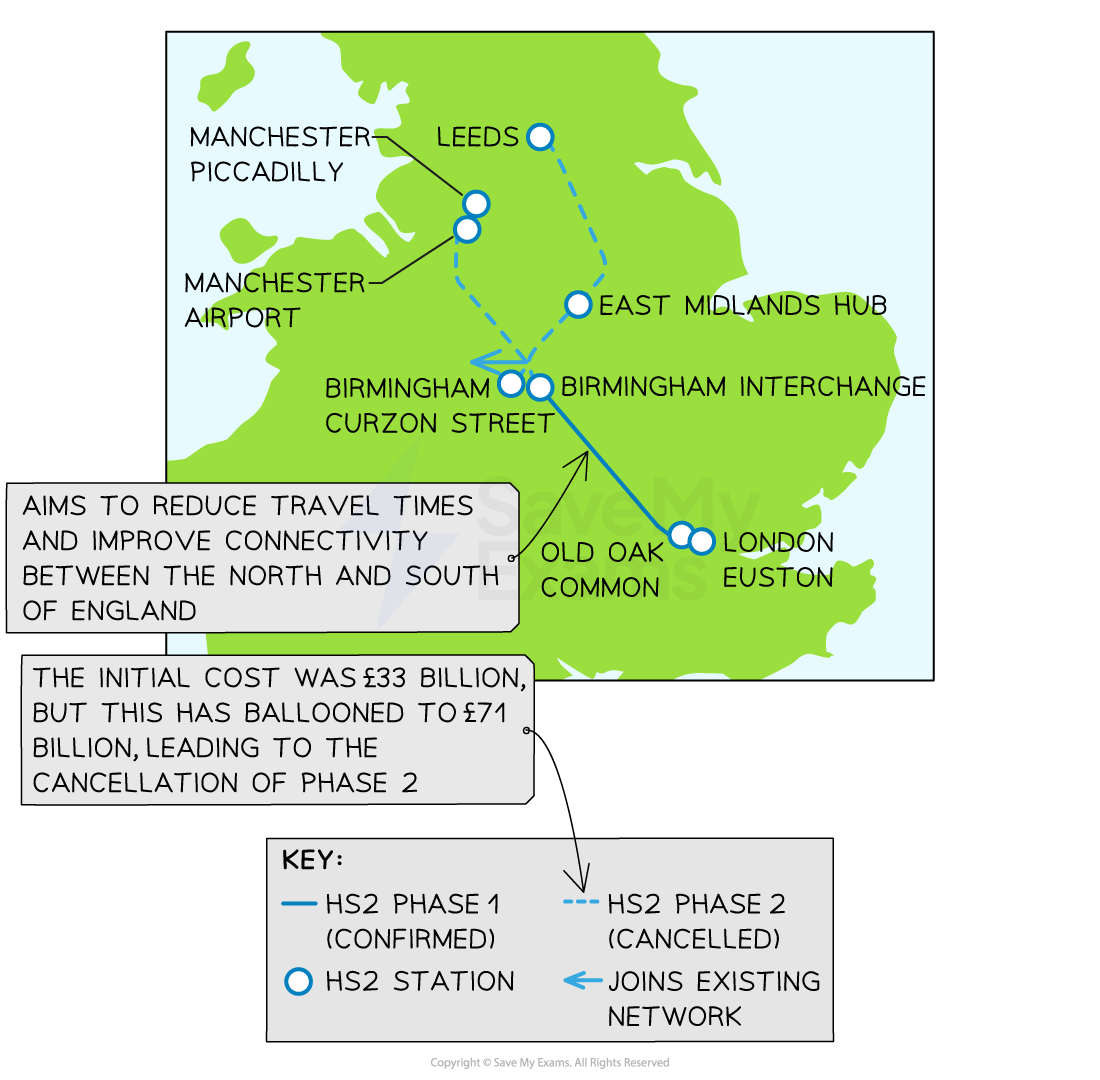
- It will link Birmingham and London
- Stage 2 included a link to Leeds - this part of the project has now been abandoned
Top down development - proposed route of HS2
Arguments for HS2
- Increase employment and productivity in the Midlands and North
- Over 22,000 construction jobs are to be created
- The government estimates an increase in the UK GDP of £15bn a year
- Increasing numbers of people will use trains instead of cars or planes reducing emissions
- Better transport connections reduce production costs
- The government estimates that 70% of jobs will be created outside of London
Arguments against HS2
- The cost has increased from £32.7bn to an estimated £72bn-£98bn
- Over 250 acres of green belt land will be built on
- It will cross Sites of Special Scientific Interest (SSSI)
- HS2 trains will use 50% more energy than Eurostar trains
- The money could be spent on many other projects to improve the quality of people's lives
- The consultation did not take into account the views of people along the proposed route
Example Case Study: Bottom Up Approach - Peru
Spec point —
4GE1-S3.066
Example case study: bottom-up approach - Peru
- Bottom-up development schemes are relatively low-cost
- Usually organised by NGOs and/or local people
- They target the poorest communities and involve local people at all stages
- Use appropriate technology which can be maintained and used by local people
Case Study
Micro-hydro schemes in Peru
Aims to provide electricity to remote rural areas where 50% of people were living on just US$2 a day
Practical Action has installed 47 micro-hydro schemes across Peru which provide:
- Metered electricity to 5,000 families
- Good quality lighting
- Refrigeration
- Access to televisions/computers
Over **25% **of households have started or expanded businesses as a result of having electricity
Approximately,** 60% **of household incomes have increased
Chambamontera, Peru
The cost of the scheme** was US$51,000** partly paid for by the community, Japan and Practical Action
Over 60 families directly benefit and an additional 100 families in neighbouring villages benefit
- Streetlights mean that people can go outside after dark
- Improved school facilities
- Completing homework in an evening is now possible
- Business development is possible
- Coffee processing has become mechanised
Worked Example **Explain the disadvantages of using top-down approaches to development **
(4 Marks)
The best way to approach this question is to make two points and then explain each one, stating why it is a disadvantage
Answer
- The projects are usually expensive and involve borrowing money which leads to increased debt (1); this means that there is less money available for investment in other areas of development (1);
- The projects often involve little consultation with the local population** (1)**; people may be significantly impacted and be forced to leave their homes (1)
- TNCs and governments make take advantage of the local workforce (1); people may be given low pay and poor working conditions which stop them from breaking out of poverty (1)
Was this revision note helpful?
Build on this topic