Distribution and Characteristic of Biomes (Edexcel IGCSE Geography)
Distribution & Characteristics of Biomes
Spec point —
4GE1-S6.068
- There are 11 biomes in Earth's biosphere
- A biome is a group of ecosystems around the world with similar characteristics
Biome distribution
- Latitude: with distance from the equator temperatures and sunshine hours decrease
- Precipitation: areas of high pressure experience low rainfall, and areas of low-pressure experience high rainfall
- Altitude: an increase in altitude leads to a decrease in temperature
- Continentality: locations further inland heat up more quickly in the summer and cool more quickly in the winter
- Ocean currents: warm and cold currents circulate in the oceans either warming or cooling the adjacent land
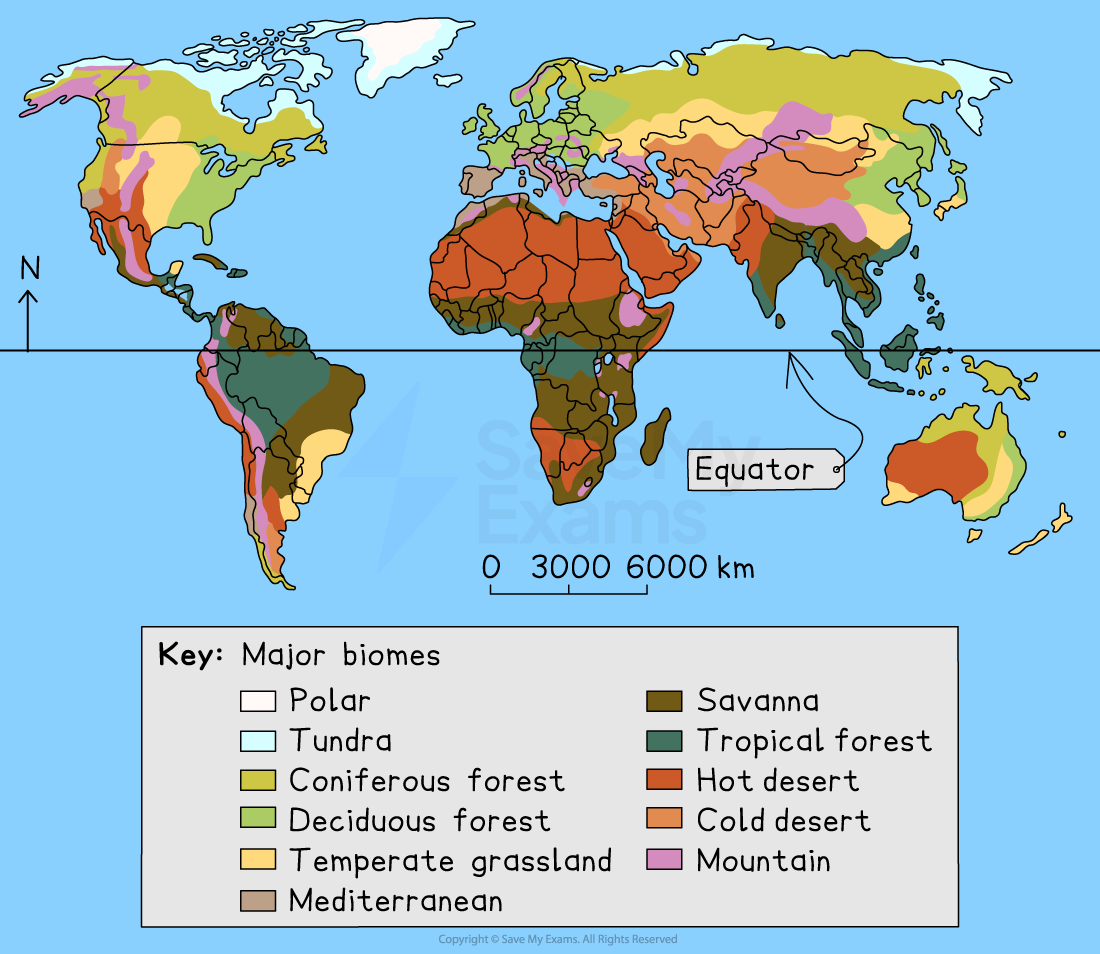
Map showing the distribution of the world biomes
Tropical Biomes
Spec point —
4GE1-S6.068
Tropical rainforest characteristics
-
Location
- Low latitudes
- Within the Tropics 23.5° north and south of the equator
- Amazon in South America, New Guinea, Southeast Asia, Zaire Basin
-
Precipitation and temperature range
- Over 2000mm of precipitation
- Between 26-28oC
-
Seasons
- No seasons - hot and wet all year round
- Growing season - all year
-
Soils
- Infertile due to leaching and rapid uptake of nutrients by plants
-
Biodiversity
-
About 50% of the world's plant and animal species live in the rainforest biome
-
Four layers of vegetation
- Plants include mahogany, teak trees, lianas, orchids
-
Animals include toucans, jaguars, frogs and snakes
-
Temperate & Boreal Forest Biomes
Spec point —
4GE1-S6.068
Deciduous & coniferous forest biomes
Deciduous forest
-
Location
- Between 40°-60° north and south of the equator
- Main locations include Western Europe, North-east USA, Eastern Asia
-
Precipitation and rainfall
- Average precipitation between 750-1500 mm
- Winter temperatures over 0oC
- Summer temperatures between 20oC-25oC
-
Seasons and growing season
- Four seasons of equal length - spring, summer, autumn and winter
- A 6-8 month growing season
-
Soils
- Fertile soils
- Nutrient-rich due to the decomposition of organic matter over autumn and winter
-
Biodiversity
- A wide range of animals and plants
- Deciduous trees including beech, oak, birch
- Animals include deer, rabbits, squirrels, bears
Coniferous forest
-
Location
- Between 50°-60° north and south of the equator
- Includes Canada, Russia, Scandinavia
-
Precipitation and temperature
- Between 300-900 mm of precipitation annually
- Winter temperatures average -30oC
- Summer temperatures reach an average 20oC
-
Seasons and growing season
- Two main seasons, winter and summer
- A growing season of 2-3 months
-
Soils
- Not very fertile often acidic and contains permafrost
- Shallow soil with a thick litter layer due to slow decomposition
-
Biodiversity
- Less biodiverse than temperate forests
- Coniferous trees
- Animals include squirrels, bears, reindeer, wolves
Tropical & Temperate Grassland Biomes
Spec point —
4GE1-S6.068
Savanna & temperate grassland biomes
Savanna
-
Location
- North and south of the tropical and monsoon forest biomes 5°-30° north and south of the equator
- Countries include Central Africa - Tanzania, Kenya
-
Precipitation and temperature
- Precipitation is between 800-900 mm
- Temperatures range from 15°C to 35°C
-
Seasons and growing seasons
- The grasslands have a wet and dry season
- The growing season is between 4-5 months (in the wet season)
-
Soils
- Free-draining soils with a thin layer of humus
- Soils are not very fertile most nutrients near the surface
-
Biodiversity
- Wide range of plant and animal species
- Plants include grasses, baobab and acacia trees
- Animals include zebras, elephants, giraffes
- The greatest diversity of hoofed animals
Temperate grasslands
-
Location
- The Velds of South Africa, the Pampas of Argentina, and Steppes of Russia and the plains of the USA
- Between 40°-60° north and south of the equator
-
Precipitation and temperature
- Between 250 - 750 mm
- Temperatures vary between -40°C to 40°C
-
Seasons and growing seasons
- Four seasons
- Growing season over the summer (dependent on temperature)
-
Soils
- Fertile soil
-
Biodiversity
- Large numbers of plant and animal species
- Grasses, sunflowers
- Bison, antelopes, rabbits
- Grasses and trees
Desert Biomes
Spec point —
4GE1-S6.068
Hot and cold desert biomes
Hot desert
-
Location
- Between 15° - 30° north and south of the equator
- North Africa - Sahara, Southern Africa - Kalahari and Namib, Australia, Middle East
-
Precipitation and temperature
- Precipitation is below 250 mm annually
- Daytime temperatures up to 50°C but average around 25°C
- Night time temperatures below 0°C
-
Seasons and growing season
- Two seasons summer and winter
- Growing season is all year round
-
Soils
- Soils are infertile
-
Biodiversity
- Low diversity
- Cacti, yucca
- Spiders, scorpions, camels, meerkats
Cold desert
-
Location
- Central Asia, Southeastern South America
-
Precipitation and temperature
- Precipitation is below 250 mm annually
- Summer temperatures up to 10°C
- Winter temperatures can be as low as -40°C
-
Seasons and growing season
- Two seasons summer and winter
-
Soils
- Soils are infertile
-
Biodiversity
- Low diversity
- Shrubs and grasses
- Camels, snakes, snow leopards
Tundra Biomes
Spec point —
4GE1-S6.068
Tundra and polar biomes
-
Location
- North of the Arctic Circle and Antarctica
-
Precipitation and temperature
- Less than 250 mm of precipitation
- Temperatures are below 0°C for 6-10 months
-
Seasons and growing season
- Two seasons, winter and summer
- Growing season of 6-10 weeks
-
Soils
- Thin, infertile soil
- Permafrost
-
Biodiversity
- Low biodiversity
- Animal species include Arctic fox, polar bears, snowy owls, Arctic wolves, Arctic hares, caribou
- Plant species include small grasses, mosses, lichen
Exam Hint You may be asked to describe and explain the distribution of biomes or climate patterns. Consider the following;
Biome distribution
Latitude
Country and continent names
Factors which affect the distribution - latitude, altitude, ocean currents, continentality
Climate patterns
- Temperature - maximum and minimum
- Seasonal variations
- Rainfall totals, maximum and minimum
Was this revision note helpful?