Classification of Economic Sectors & Employment (Edexcel IGCSE Geography)
The Four Economic Sectors
Spec point —
4GE1-S6.067
-
An economic activity is the production, purchase or sale of goods and services
-
Economic activities can be grouped into four sectors:
- Primary activities are the growth or extraction of raw materials - farming, fishing, mining and forestry
- Secondary activities are when materials are processed to produce a finished product, for example, car manufacture, food processing
- Tertiary activities involve the provision of a service, including retail, transport, schools, healthcare, etc.
- Quaternary activities include the provision of specialist information/knowledge, such as research and development, information technology, etc.
Worked Example Identify what is meant by an economic sector
(1 Mark)
A. The chain of production in manufacturing
**B. **An economic shift in employment
** C.** A classification of types of employment
D. A classification of employment structures
Answer:
- **C **(1)****- a classification system for types of employment
- The other answers are not related to employment sectors, which are the four groups - primary, secondary, tertiary and quaternary
Exam Hint Remember, the economic sectors can also be used to group employment types. For example, a farmer is employed in the primary sector, whereas a teacher is employed in the tertiary sector.
Changes over Time
Spec point —
4GE1-S6.067
-
Economic sectors are an indicator of a country's economic development
-
This can be either:
- The amount each sector contributes to the Gross Domestic Product (GDP)
- The percentage of the population they employ
-
The proportions of each economic sector's GDP contribution and percentage employment changes over time
Pre-industrial
-
In countries in the pre-industrial **period, the primary sector is dominant
-
The secondary and** tertiary sectors steadily increase
- As countries develop, the reliance on the primary sector for GDP and employment rapidly decreases
Industrial
-
During the industrial period, the amount of GDP and employment in the secondary sector increases to become dominant and then decreases
- The primary sector continues to decrease
- The tertiary sector increases
-
Developed countries such as the UK, Germany and France began to move out of this stage in the 1960s
- Newly industrialised (emerging) nations such as China and India began to move into this stage at that time
Post-industrial
-
In the post-industrial phase, the tertiary and quaternary sectors increase whilst the secondary and primary sectors decrease
- The tertiary sector dominates employment and GDP in the post-industrial period
- Countries such as Germany and the UK are currently in the post-industrial phase
Clark-Fisher model
- The Clark-Fisher model illustrates how employment in each economic sector changes as countries develop
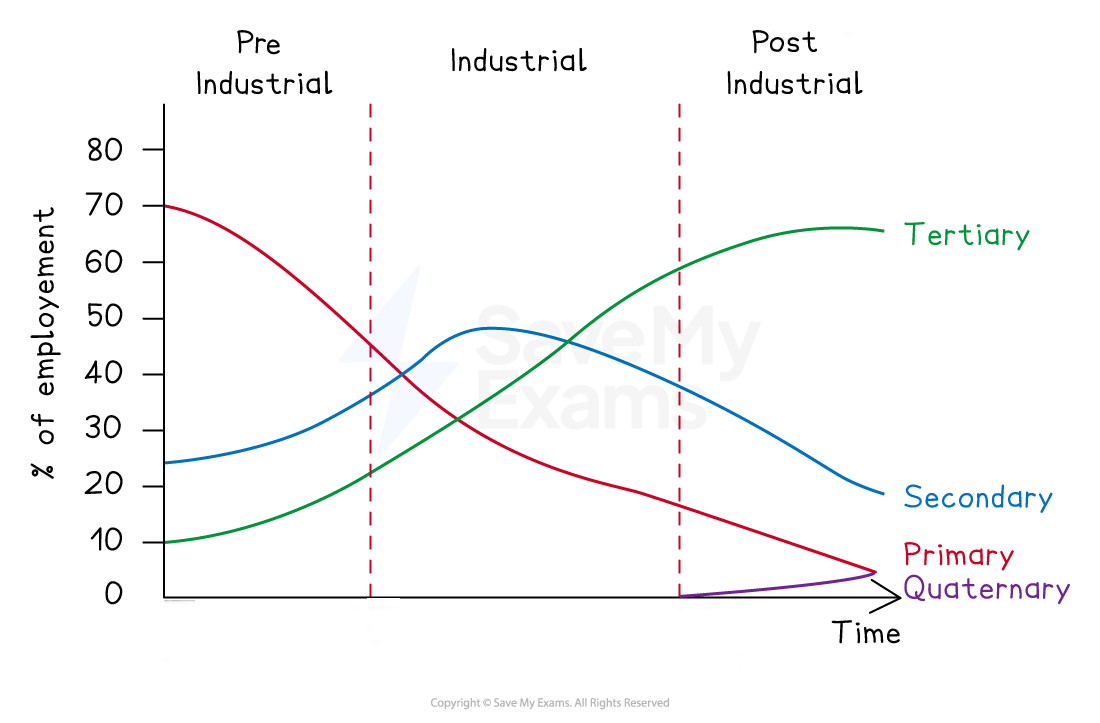
The Clark-Fisher Model
Causes of changes over time
-
There are several reasons for the change in percentages employed in each sector:
- Increasing mechanisation in agriculture led to a decrease in the number of jobs available
- People move to urban areas to find jobs in the secondary and tertiary sectors
- Increasing mechanisation and global changes then lead to a decrease in secondary employment in some countries - this is known as deindustrialisation
- Technological improvements lead to an increase in tertiary and quaternary employment
Exam Hint You should be able to look at a pie chart or graph of the economic sectors and work out a country's stage of development.
- A developing country will be dominated by primary economic activities
- An emerging country is likely to have fairly equal amounts of each type of economic sector employment
- A developed country will be dominated by tertiary economic activities.
Was this revision note helpful?