Response to Earthquakes (Edexcel IGCSE Geography)
Short-term Response & Relief
Spec point —
4GE1-S3.044
-
The emergency response is the actions taken immediately after a hazard event such as an earthquake:
- Searching collapsed buildings to rescue people who are trapped
- Providing medical assistance
- Distribution of food and water
- Ensuring that people have shelter
- Clearing rubble and other debris
-
This response has to be coordinated as many NGOs and government organisations, including the armed forces, may be involved
-
The stages of hazard response can be seen in Park's hazard response curve
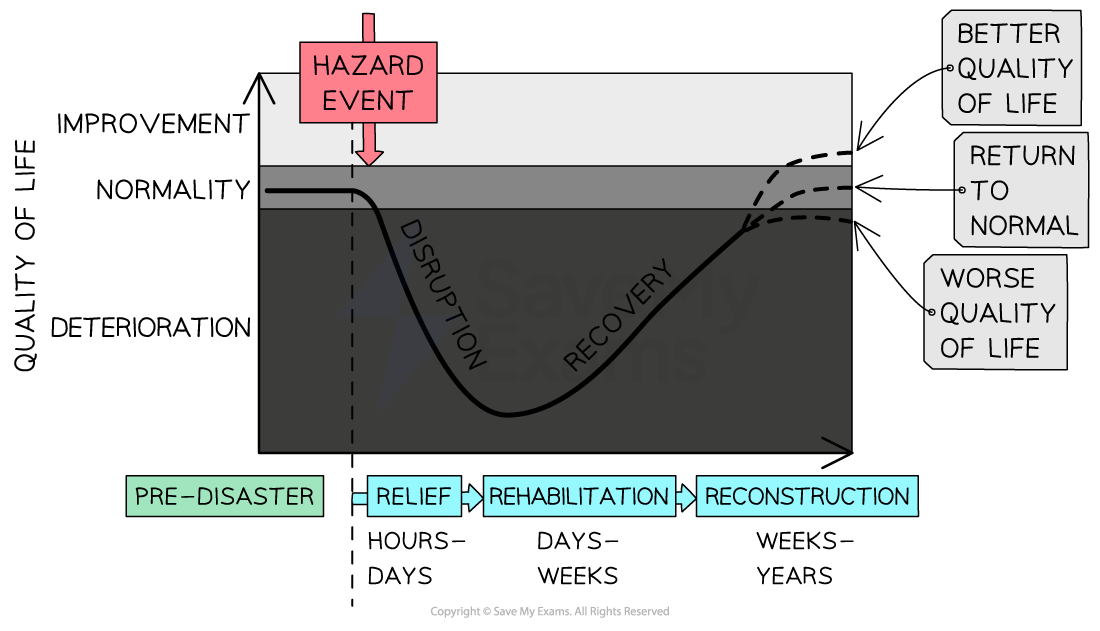
Park's hazard response curve
Case Studies: Nepal & Japan
Spec point —
4GE1-S3.044
Case Study
Nepal - A developing country
The short-term response was criticised for being too slow:
- The epicentre was not reached by rescue workers for 24 hours
- Evacuations of the critically wounded took 5 days
Over US$1 billion in international aid from India and China
The Asian Development Bank (ADB) provided a US$3 million grant for immediate relief efforts
Three Chinook helicopters; 100 search and rescue; medical workers
Use of GIS to coordinate the response
Many NGOs sent aid workers, food, water and medical supplies
Tent cities in Kathmandu provided shelter for people made homeless
Nepalese army sent to worst-hit areas
Inflatable field hospitals set up to treat the injured
Case Study
Japan - A Developed Country
- Self Defence Forces sent in immediately to organise food, water, shelter and medicines
- Within 48 hours a member of parliament was designated to coordinate the relief effort
- UK sent search and rescue teams
- NGOs provided shelter, food, water and medical aid
- A state of emergency was declared at the Fukushima nuclear power plant
- Japanese Meteorological Agency (JMA) issued warnings just before the more damaging S waves - this gave people a chance to get out of buildings
- A tsunami warning was issued giving people 20 minutes to get to safety
- Trained emergency crews and the army were on site rapidly
- Temporary shelters were set up in schools and other public buildings
Exam Hint Remember that although there is a short-term response in all countries where there is a natural hazard event, the response will be slower and often less well organised in developing countries. This delay often increases deaths and recovery time.
Was this revision note helpful?