Graphs of Polynomials (Edexcel IGCSE Further Maths)
Quadratic Functions & Graphs
Spec point —
4A
What are the key features of quadratic graphs?
-
A quadratic graph can be written in the form where
-
The shape of the graph is known as a parabola
-
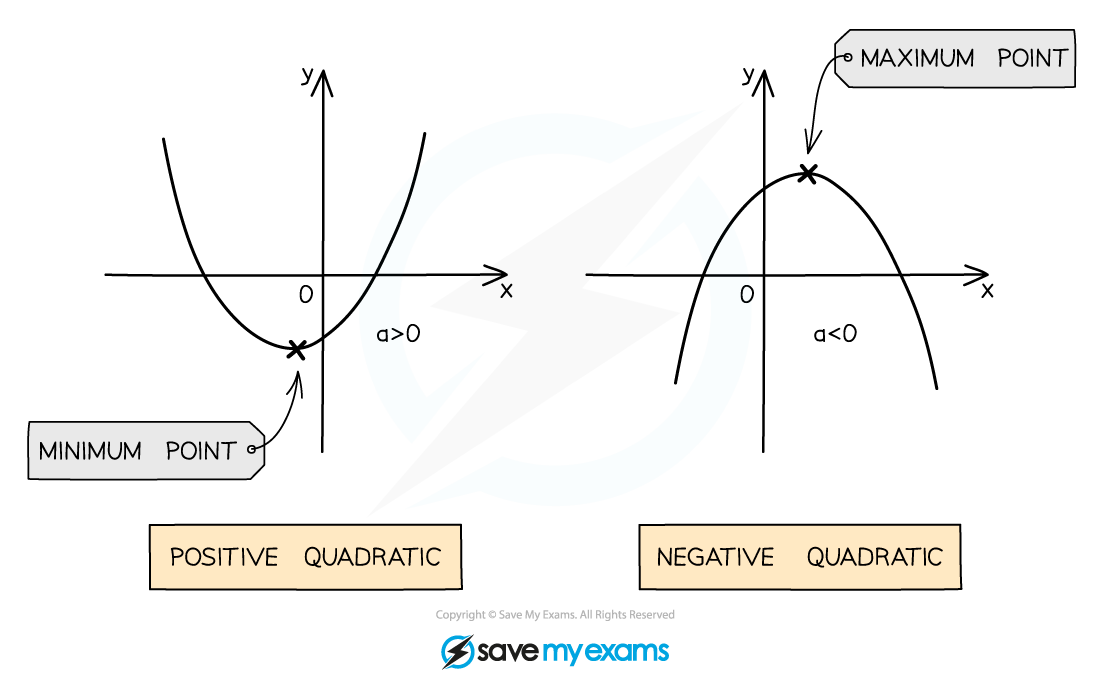
The value of a affects the shape of the curve
- If a is positive the shape is 'u-shaped' ∪
- If a is negative the shape is 'upside down u-shaped' ∩
-
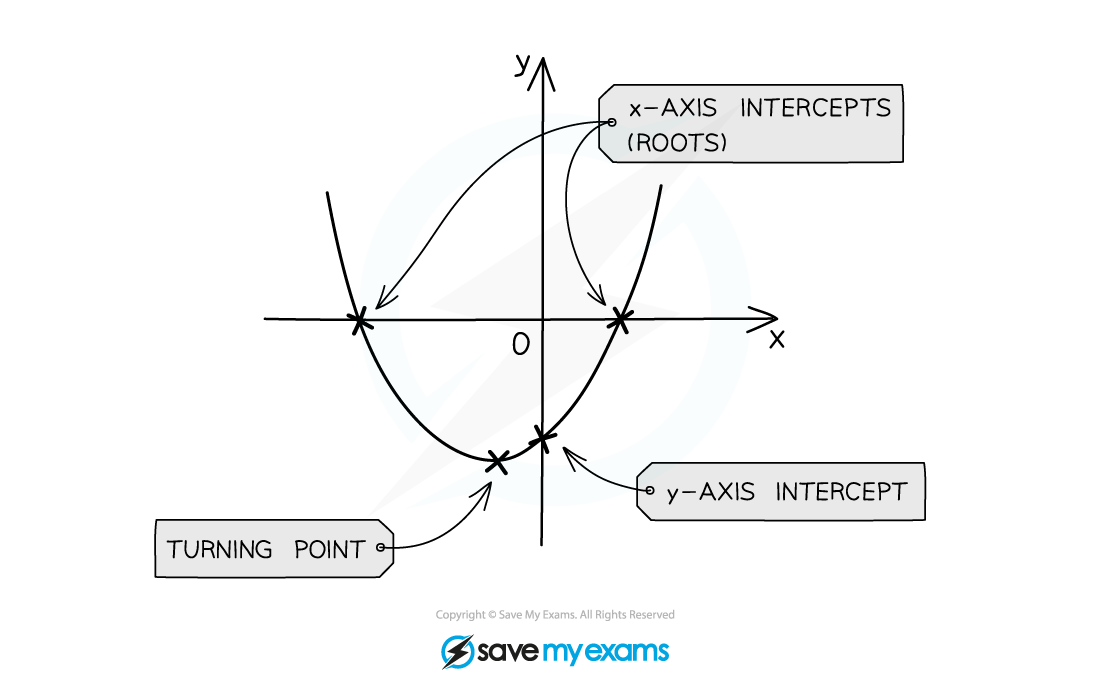
The y-intercept is at the point (0, c)
-
The roots are the solutions to
-
These are also known as the x-intercepts or zeroes
-
They can be found by
- Factorising
- Quadratic formula
- Completing the square
- Your calculator may also be able to find these for you
-
There can be 0, 1 or 2 *x-*intercepts
- This is determined by the value of the discriminant
-
-
There is an axis of symmetry at
- If there are two x-intercepts then the axis of symmetry goes through the midpoint between them
-
The vertex lies on the axis of symmetry
- It can be found by completing the square
- The x-coordinate is
- The y-coordinate can be found by calculating y when
- If a is positive then the vertex is the minimum point
- If a is negative then the vertex is the maximum point
What are the equations of a quadratic function?
-
- This is the general form
- It clearly shows the y-intercept (0, c)
- You can find the axis of symmetry by
-
- This is the factorised form
- It clearly shows the roots (p, 0) & (q, 0)
- You can find the axis of symmetry by
-
-
This is the vertex form (or completed square form)
-
It clearly shows the vertex (h, k)
-
The axis of symmetry is therefore
-
It clearly shows how the function can be transformed from the graph of
- Vertical stretch by scale factor a
- Translation by vector
-
How do I find an equation of a quadratic?
-
If you have the roots x = p and x = q...
- Write in factorised form
- You will need a third point to find the value of a
-
If you have the vertex (h, k) then...
- Write in vertex form
- You will need a second point to find the value of a
-
If you have three random points (x1, y1), (x2, y2) & (x3, y3) then...
- Write in the general form
- Substitute the three points into the equation
- Form and solve a system of three linear equations to find the values of a, b & c
Exam Hint
Your calculator may be able to find the roots and turning point of a quadratic function
- Even on a 'show that' question this can be used to check your answers
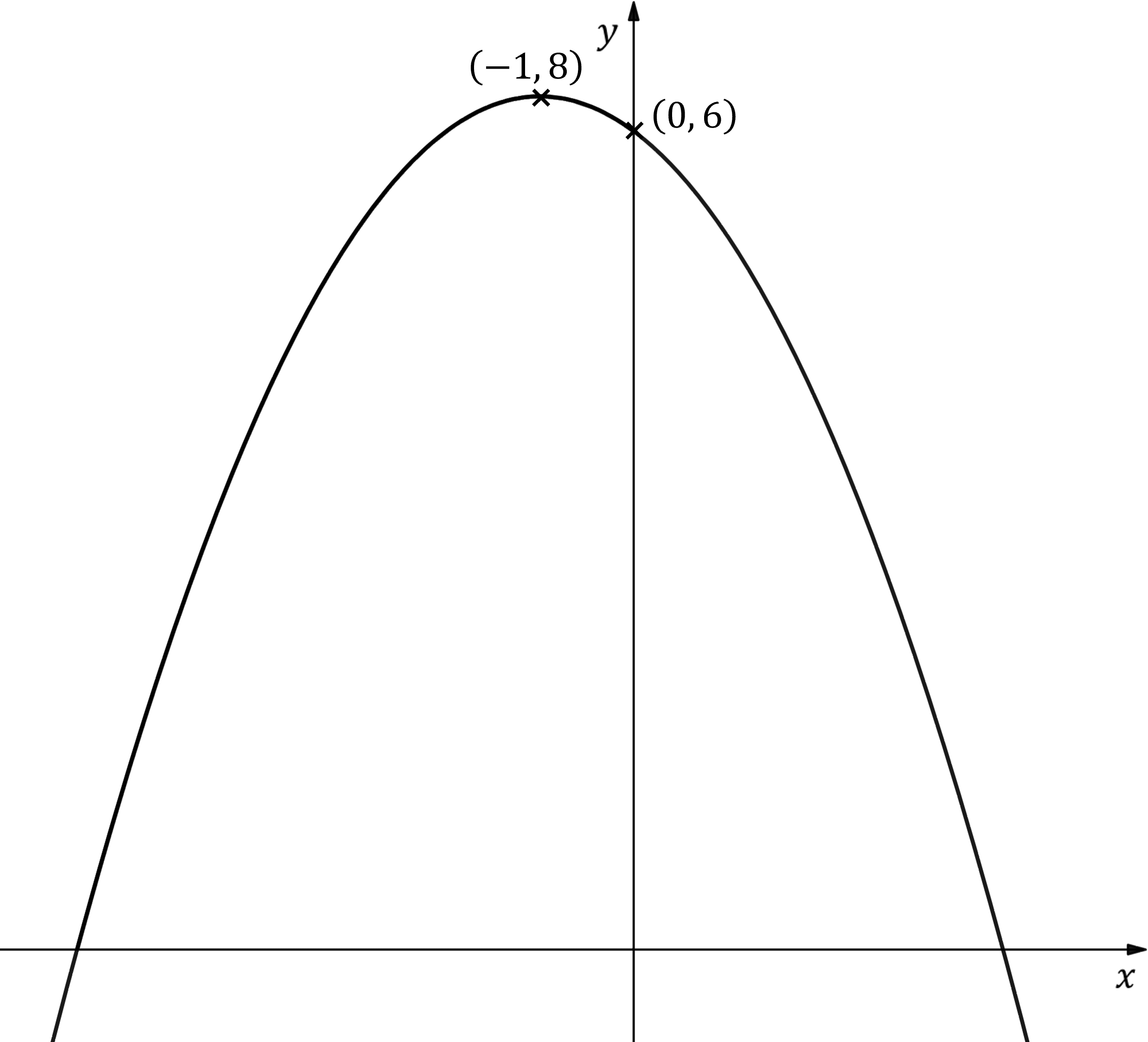
Worked Example The diagram below shows the graph of , where is a quadratic function.
The vertex and the intercept with the -axis have been labelled.
Find an expression for .
Method 1
Since we know the vertex (turning point), it will be easiest to start with the completed square version of the equation This is , where the vertex is at
We also know the curve goes through (0, 6) Put those coordinates into the equation and solve for
Substitute into the expression for Expand the brackets and rearrange into the form required
Method 2
It is also possible to start with the form *Because the y- intercept is (0, 6) we know that *
Goes through means
It also goes through (-1, 8) Substitute those coordinates into the equation of
Goes through means
We need one more piece of information You may remember that the turning point lies on the line *If not, then use the fact that the x- coordinate of the turning point satisfies *
Turning point at * means** *
Differentiate to find Then solve to find another equation with and
We now have two simultaneous equations that we can solve to find and
Add [1] and [2] together to eliminate
Substitute into [2] and solve to find
Write final answer in form requested
Cubic Functions & Graphs
Spec point —
4A
What are the key features of cubic graphs?
-
A cubic graph can be written in the form where
-
When asked to consider the equation of a cubic and its graph, think about the following
-
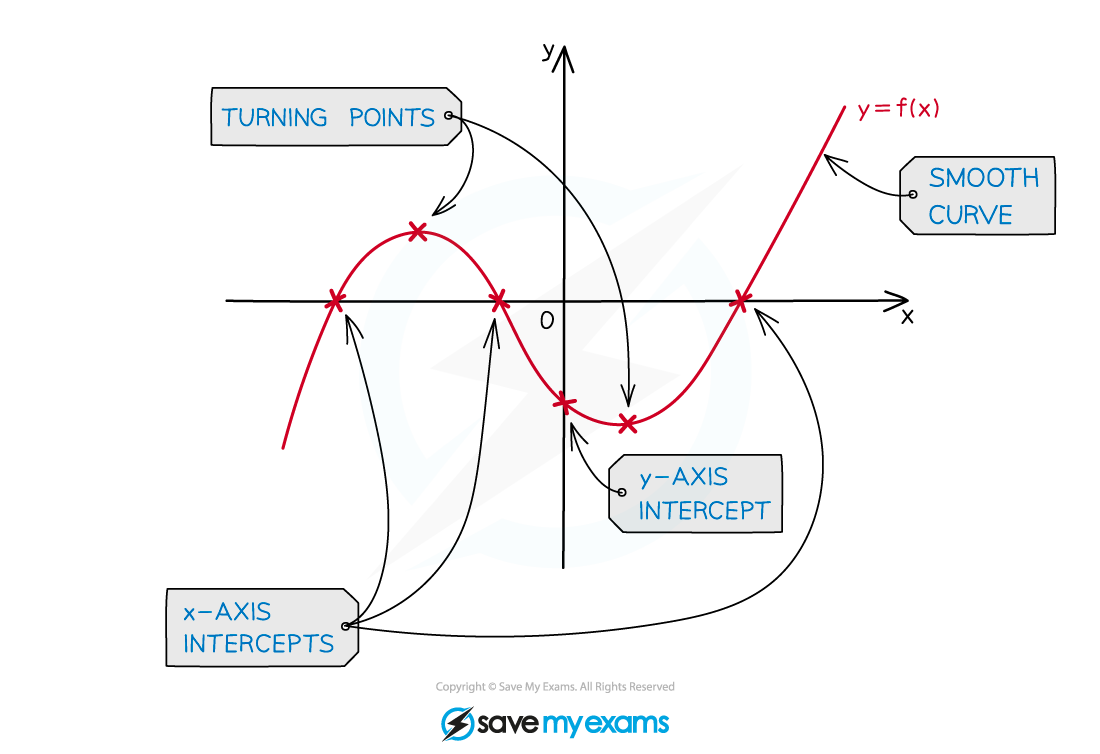
y-*axis intercept
- This occurs at
-
x-*axis intercepts (roots)
- *x-*coordinates are the solutions to
-
turning points (maximum and/or minimum)
- A cubic can have 0 or 2 turning points
- *x-*coordinates are the solutions to
- these are when the derivative of equals 0
-
The value of affects the shape of the curve
- If is positive the ends of the curve will go 'down on the left and up on the right'
- If is negative the ends of the curve will go 'up on the left and down on the right'
-
How do I sketch the graph of a cubic?
-
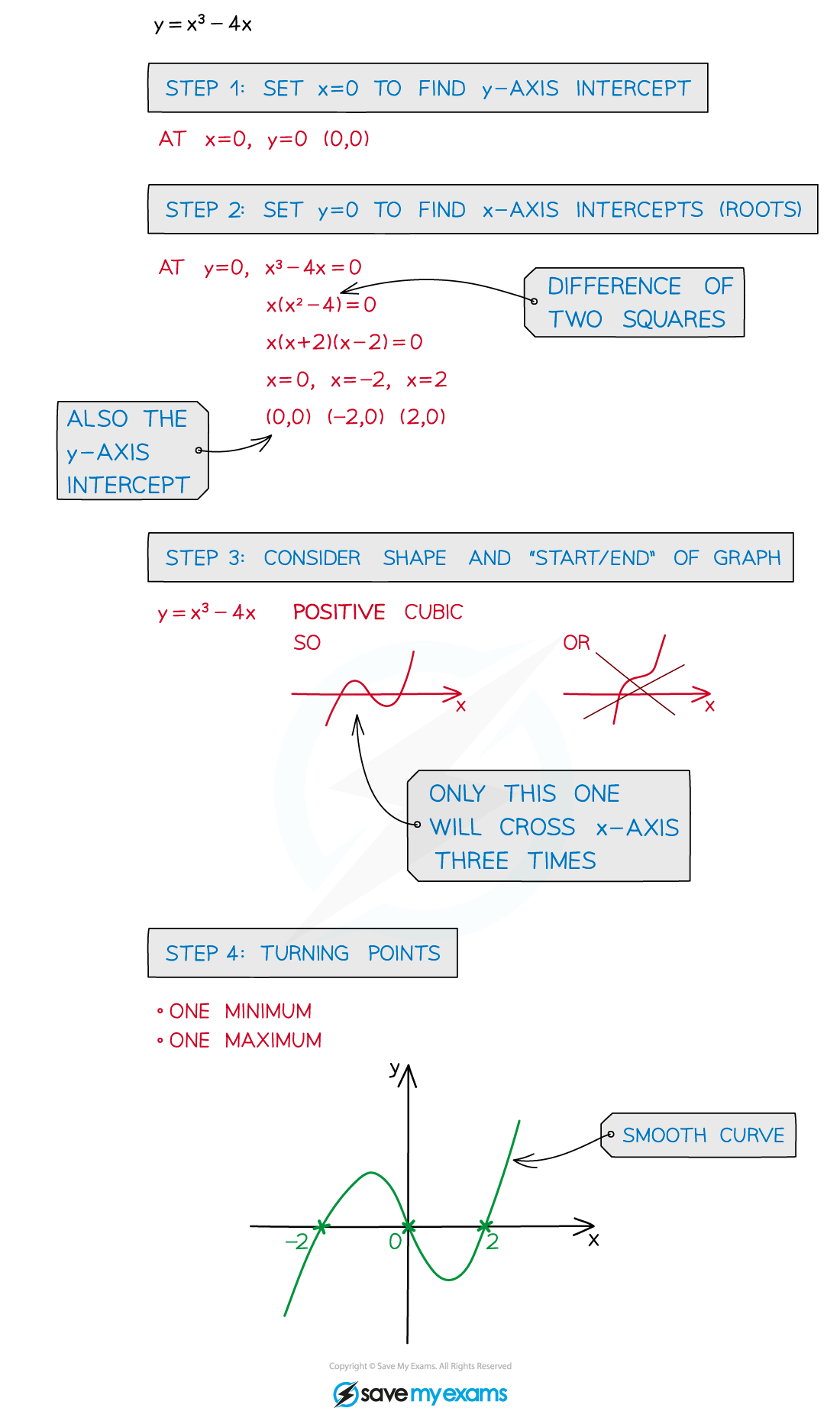
STEP 1
Find the y-*axis intercept by setting x = 0 ** -
STEP 2 Find the x-axis intercepts (roots) by setting y = 0** *
- This may require factorising the cubic
-
STEP 3 Consider the shape and “start”/”end” of the graph
- a positive cubic graph starts in third quadrant (“bottom left”) and ends in first quadrant (“top right”)
- a negative cubic graph starts in second quadrant (“top left”) and ends in fourth quadrant (“bottom right”)
-
STEP 4 Consider where any turning points should go
- Differentiate the equation of the curve and set equal to zero
-
STEP 5 Draw with a smooth curve (this takes practice!)
Worked Example Consider the function , where and are constants.
The graph of has two turning points, the -coordinates of which are and .
(a) Find the values of and .
The turning points occur when
Start by differentiating to find
That is equal to 0 when and when
Substitute those values in to find two equations in and
Those are simultaneous equations in and Subtract the first from the second to eliminate and find Then substitute that value into either equation to find
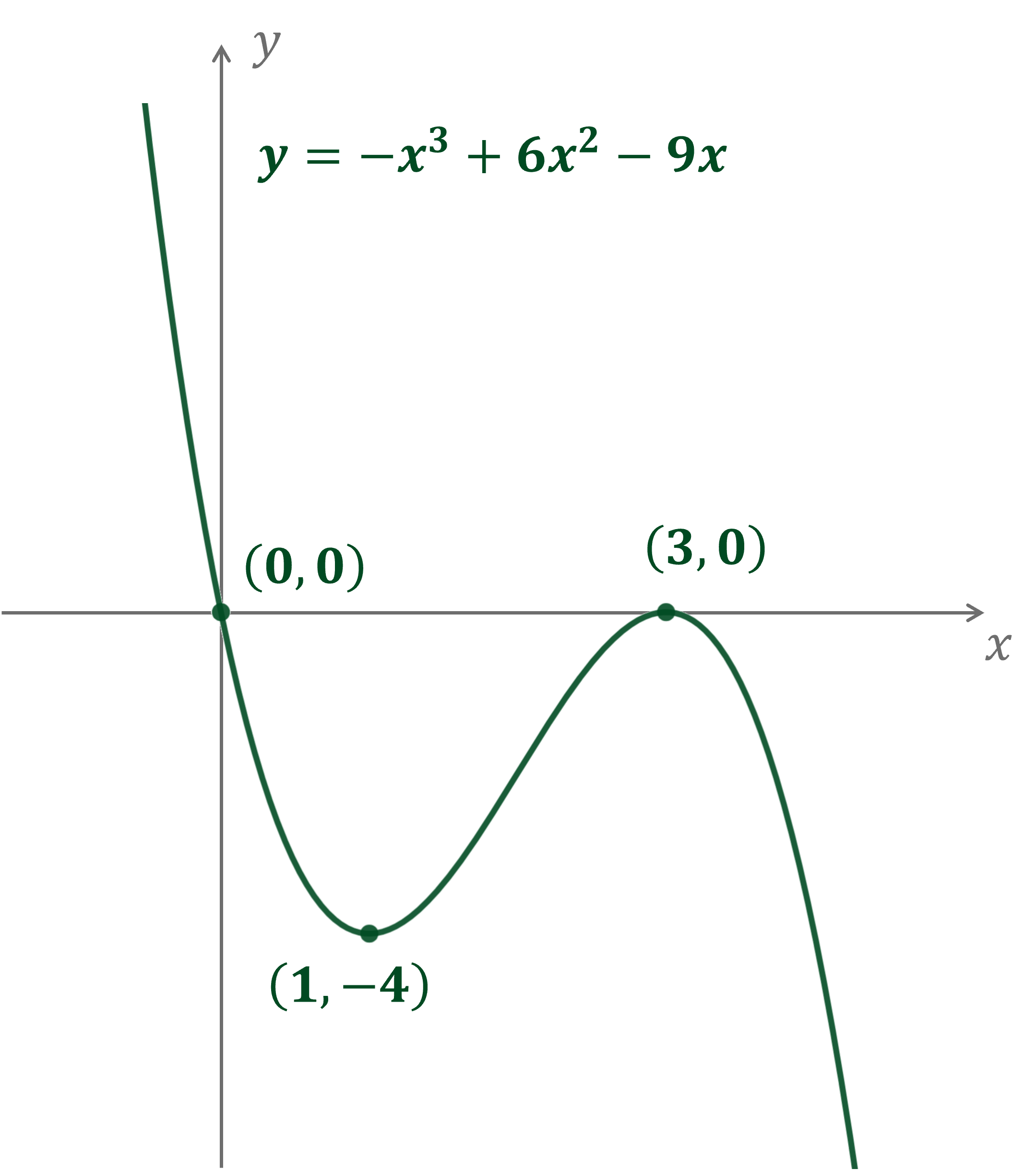
(b) Sketch the graph of .
There is no constant term in , so the y-intercept will be 0
Substitute the x-coordinates of the turning points into to find the corresponding y-coordinates
$- ( 1 )^{3} + 6 ( 1 )^{2} - 9 ( 1 ) = - 1 + 6 - 9 = - 4
( 3 )^{3} + 6 ( 3 )^{2} - 9 ( 3 ) = - 27 + 54 - 27 = 0$
So the turning points are at and
*Find the x- intercepts by solving *
*So the x- intercepts are * and Note that the first is also the y- intercept. and the second is also a turning point
Finally consider the shape of the curve It's a 'negative cubic', so it's going to be 'up on the left and down on the right' Draw a smooth curve incorporating all these features Label the turning points and intercepts
Was this revision note helpful?
Build on this topic