Calculating Areas (Edexcel IGCSE Further Maths)
Definite Integrals
Spec point —
9A
What is a definite integral?
-
A definite integral is defined by the following formula
-
- i.e. integrate as usual to find
- then substitute to find and
- and subtract from to find the value of the definite integral
-
and are numbers and are called the integration limits
- is the lower limit
- is the upper limit
- the integral is 'from to '
-
A constant of integration (“”) is not needed with definite integrals
-
-
Note that the answer to a definite integral is a number
- The answer to an indefinite integral is another function
Exam Hint
Be careful when substituting in to find
- It's quite easy to make mistakes here
- Especially when fractions and negative numbers are involved
Your calculator may be able to find the value of definite integrals
- You can use this to check your work
Look out for phrases in exam questions like "Use algebraic integration" or "Using calculus"
- These mean that full working out of the integral 'by hand' is required
- A calculator answer without working would not score marks
Worked Example Show that
Start by expanding the brackets inside the integral
Integrate as usual (here it's a 'powers of ' integration)
Write the answer in square brackets with the integration limits outside
Now substitute 4 into that function And subtract from it the function with 2 substituted in
And that's the answer we were asked to show!
Calculating Areas with Definite Integrals
Spec point —
9C
How can I calculate areas using definite integrals?
-
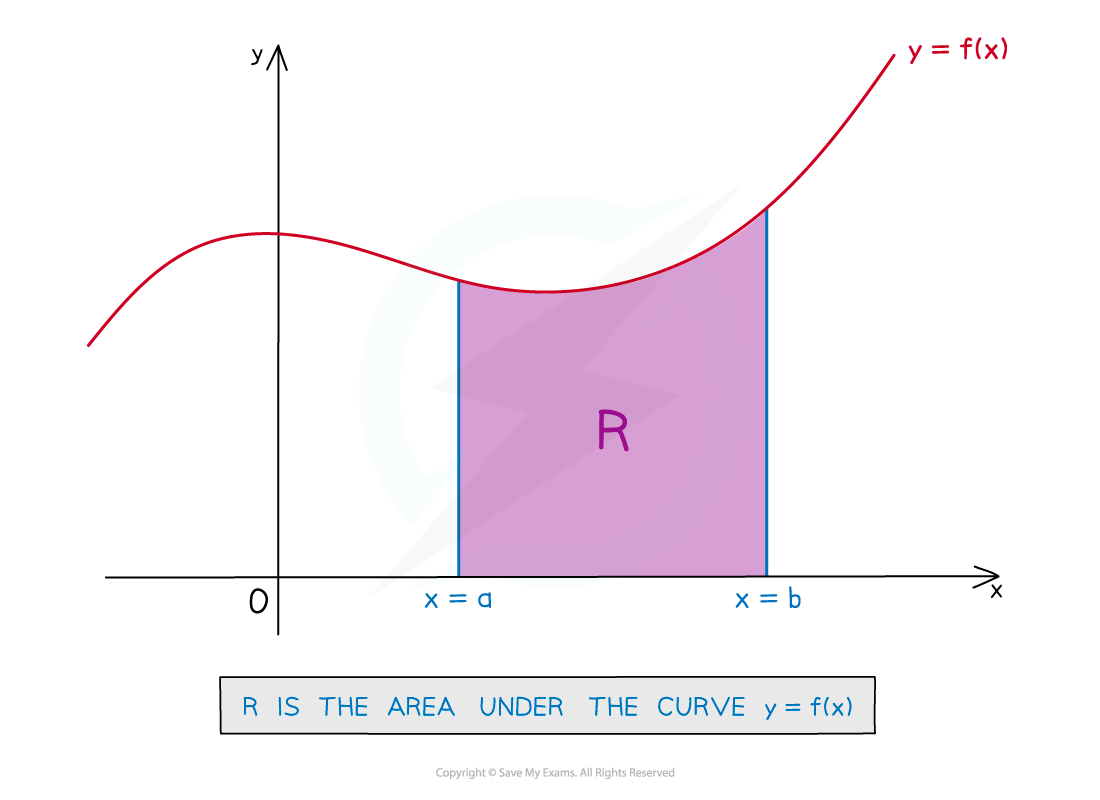
Region in the following diagram is the 'area under a curve' between and
-
It is the region bounded by
- the curve
- the -axis
- and the lines and and
-
-
The exact area of a region like region in the diagram can be found by evaluating the definite integral
-
- i.e. definite integrals can be used as area calculators!
-
Note that for this to work, must be 'on the left' and must be 'on the right'
- i.e.
-
How do I form a definite integral to find the area under a curve?
-
The curve and the -axis should be obvious boundaries
-
but the trick can be identifying and
- i.e. the lower and upper limits of the definite integral
-
-
If a diagram is given in the question, this can help locate the limits
- If a diagram is not given, then sketch one
-
The 'left' and 'right' boundaries may be vertical lines
-
In that case their equations give the integral limits
- and
-
-
The -axis may be one of the (vertical) boundaries
- in that case one of the limits will be
-
The 'left' and 'right' boundaries don't have to be vertical lines
-
One or both of them could be where intercepts the-axis
- i.e., one of the roots of the equation
-
In this case solve the equation to find the limit(s)
-
Exam Hint
Look out for questions that ask you to find an indefinite integral in one part
where '' is needed in the answer
then in a later part use the same integral as a definite integral
- where '' is not needed
Add information to any diagram provided in the question
- axes intercepts
- values of limits
- mark and shade the area you’re trying to find
If no diagram is provided, sketch one!
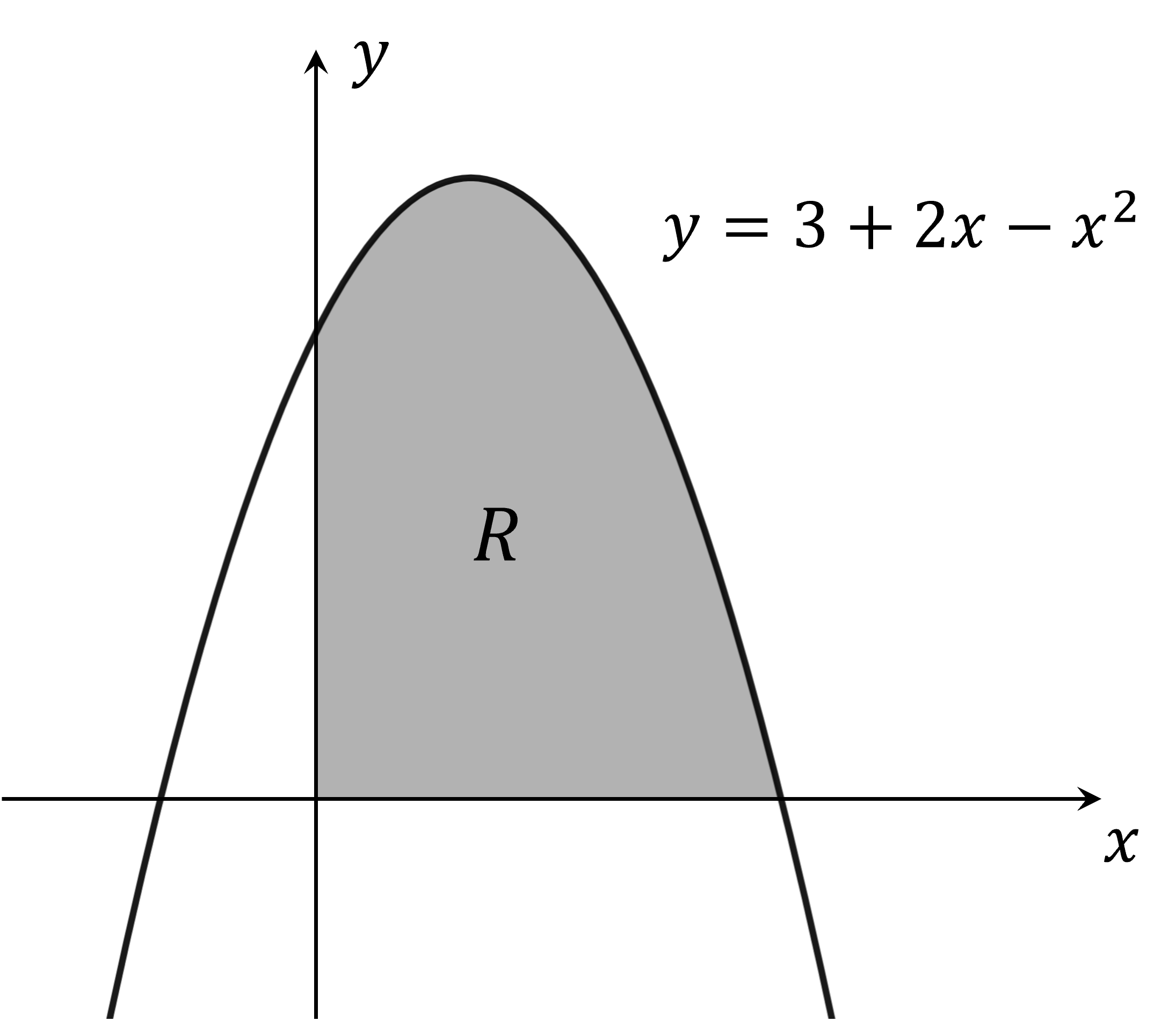
Worked Example The following diagram shows a part of the graph of the curve with equation . The region labelled is bounded by the curve, the positive -axis, and the positive -axis.
Find the exact area of region .
Start by finding the integration limits.
The -axis is the left boundary, so will be the lower integration limit
The right boundary is where the curve intercepts the -axis Solve the equation to find its -coordinate
We want the positive intercept, so the upper integral limit will be
Put all that info into the definite integral
Negative Integrals
Spec point —
9A
What do we mean by a 'negative integral'
-
The answer to a definite integral is a number
- This number can be positive or negative (or zero!)
-
The area between a curve and the-axis may lie fully or partially below the -axis
- This occurs when the function takes negative values within the boundaries of the area
-
A definite integral used to find such an area
-
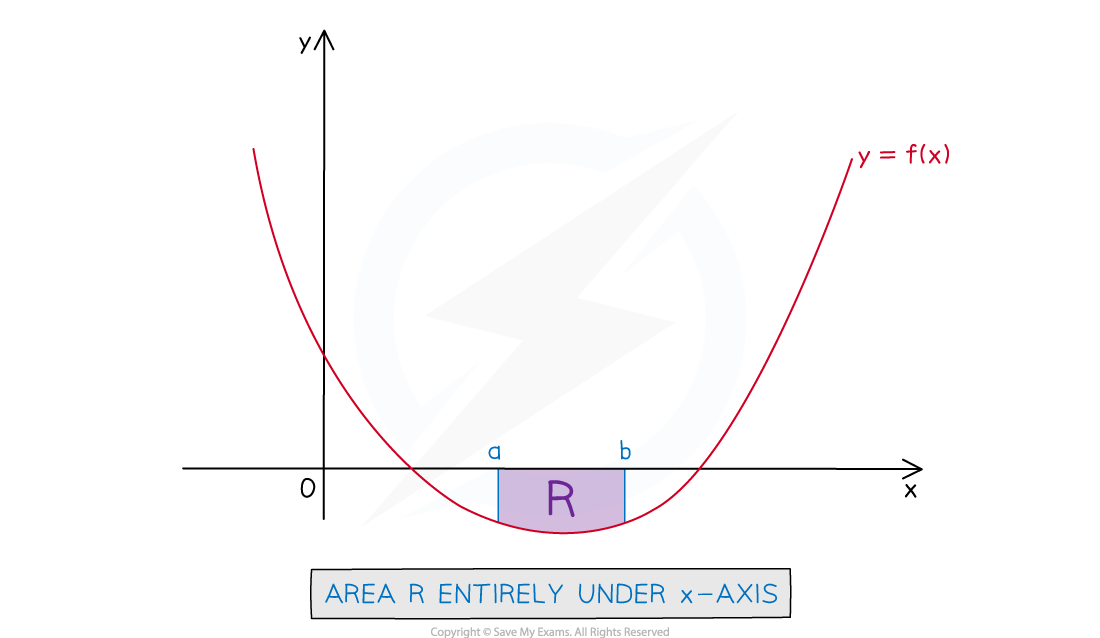
will be negative if the area is fully under the-axis
-
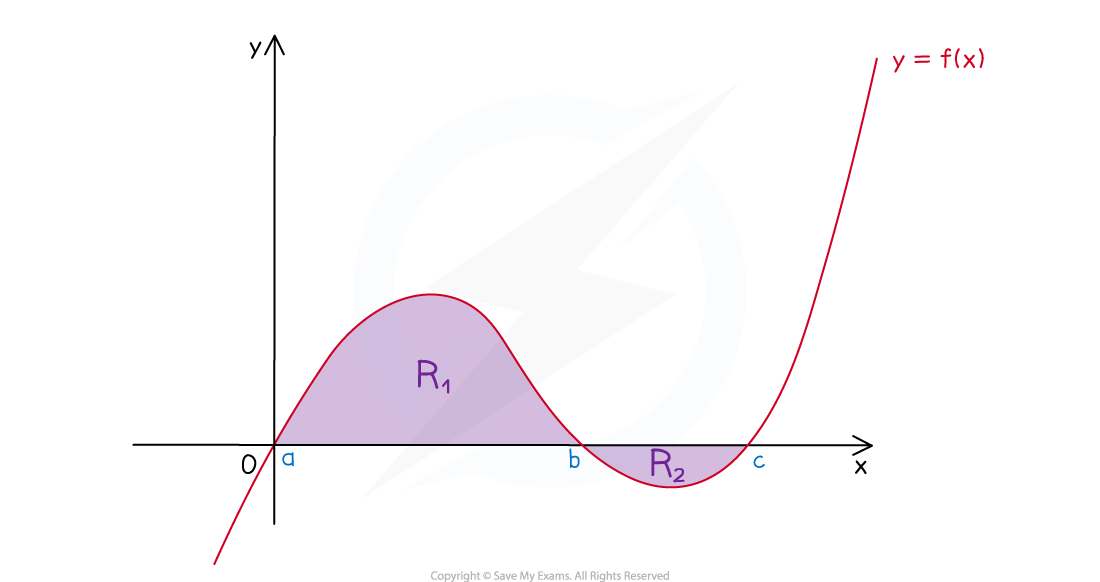
possibly negative if the area is partially under the-axis
- even if positive, the integral will not calculate the correct area in this case
- the 'negative areas' will subtract from the 'positive areas'
-
How do I find the area under a curve when the curve is fully under the x-axis?
-
STEP 1 Write the definite integral to find the area as usual
- This may involve finding the lower and upper integration limits
-
STEP 2 The answer to the definite integral will be negative
-
But the answer will have the same 'size' as the area
-
So just remove the minus sign to get the area
- e.g. if the value of the integral is
- then the area will be (square units)
-
How do I find the area under a curve when the curve is partially under the x-axis?
-
STEP 1 Split the area into parts
- the area(s) that are above the -axis
- and the area(s) that are below the -axis
-
STEP 2 Write the definite integral for each part
-
This may involve finding the lower and upper integration limits for each part
- e.g. solving to find where crosses the -axis
-
-
STEP 3 Find the value of each definite integral separately
-
STEP 4 Change the negative values to positive
- Then find the total area by summing the 'positive versions' of each integral
Exam Hint
If no diagram is provided, sketch one
- This lets you see where the curve is above and below the -axis
- Then you can split up your integrals accordingly
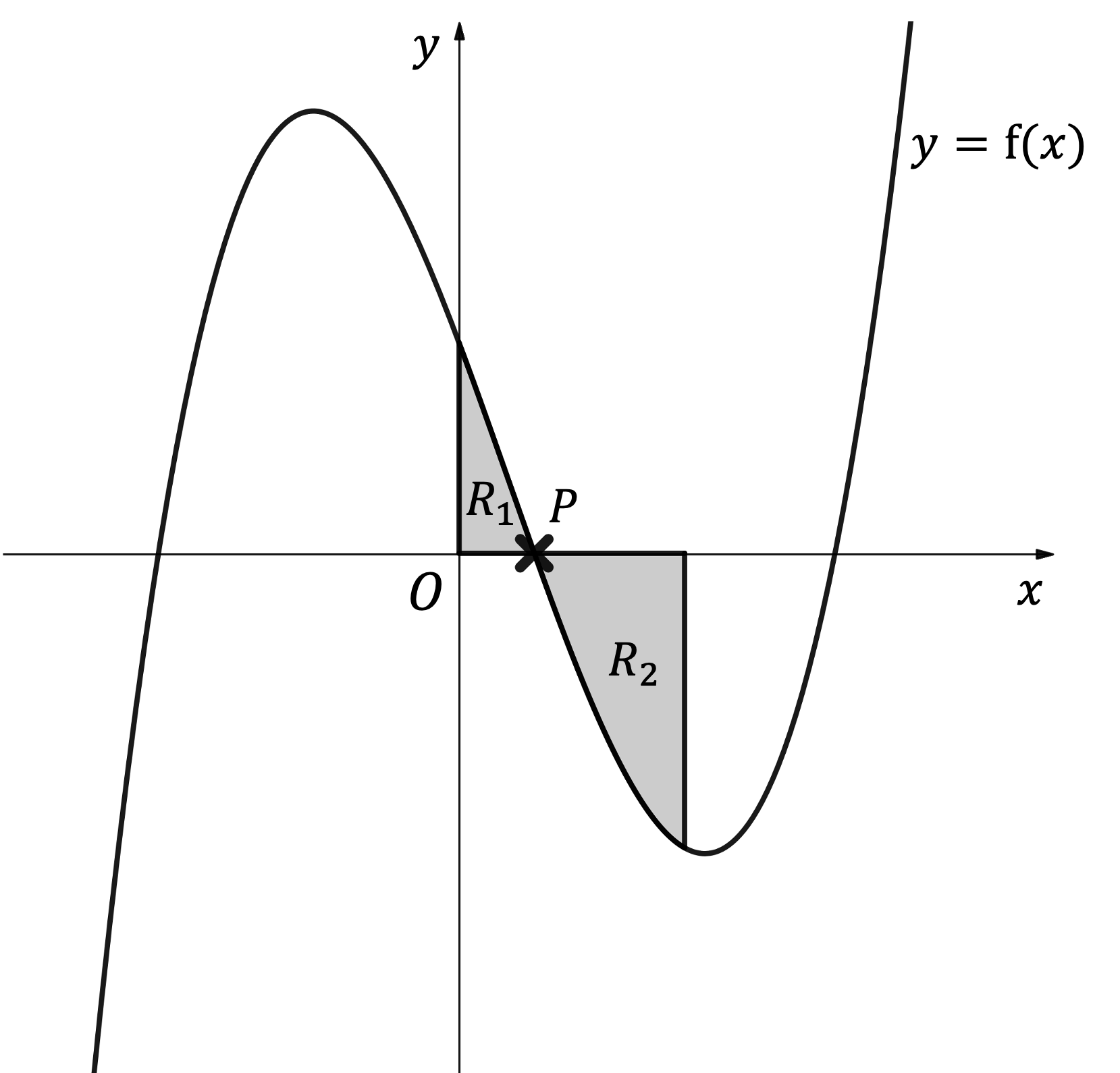
Worked Example The diagram below shows the graph of , where .
The region is bounded by the curve and the positive - and -axes.
The region is bounded by the curve , the positive -axis, and the line .
(a) Determine the coordinates of the point labelled.
That point is one of the -axis intercepts of the function
Solve to find what those area
It has to be positive, because the point is to the right of the origin And it has to be less than 3, because it's to the left of the line So it must be the intercept at
(b) Find the exact total area of the shaded regions and .
is the region between and
It lies totally above the -axis, so the definite integral will calculate the area directly
| Area of R _ 1 | = integral _ 0 ^ 1 ( x + 4 ) ( x - 1 ) ( x - 5 ) d x | | _ = integral _ 0 ^ 1 ( x ^3 - 2 x ^2 - 19 x + 20 ) d x | | _ = [ 1 fourth x ^ 4 - 2 / 3 x ^3 - 19 / 2 x ^2 + 20 x ] _ 0 ^ 1 | | _ = ( 1 fourth ( 1 ) ^ 4 - 2 / 3 ( 1 ) ^3 - 19 / 2 ( 1 ) ^2 + 20 ( 1 ) ) - ( 1 fourth ( 0 ) ^ 4 - 2 / 3 ( 0 ) ^3 - 19 / 2 ( 0 ) ^2 + 20 ( 0 ) ) | | _ = ( 1 fourth - 2 / 3 - 19 / 2 + 20 ) - ( 0 - 0 - 0 + 0 ) | | _ = 121 / 12 - 0 | | _ = 121 / 12 | |is the region between and
It lies totally below the -axis, so the integral will give us the negative version of the area
| - ( Area of R _ 2 ) | = integral _ 1 ^ 3 ( x ^3 - 2 x ^2 - 19 x + 20 ) d x | | _ = [ 1 fourth x ^ 4 - 2 / 3 x ^3 - 19 / 2 x ^2 + 20 x ] _ 1 ^ 3 | | _ = ( 1 fourth ( 3 ) ^ 4 - 2 / 3 ( 3 ) ^3 - 19 / 2 ( 3 ) ^2 + 20 ( 3 ) ) - ( 1 fourth ( 1 ) ^ 4 - 2 / 3 ( 1 ) ^3 - 19 / 2 ( 1 ) ^2 + 20 ( 1 ) ) - | | _ = ( 81 / 4 - 18 - 171 / 2 + 60 ) - ( 1 fourth - 2 / 3 - 19 / 2 + 20 ) | | _ = - 93 / 4 - 121 / 12 | | _ = - 400 / 12 | |So the area of is * *
Add the two areas together to get the total area
Final answer:
Was this revision note helpful?
Build on this topic