Geometric Proof with Vectors (Edexcel IGCSE Further Maths)
Vector Paths
Spec point —
7A
How do I use vector paths?
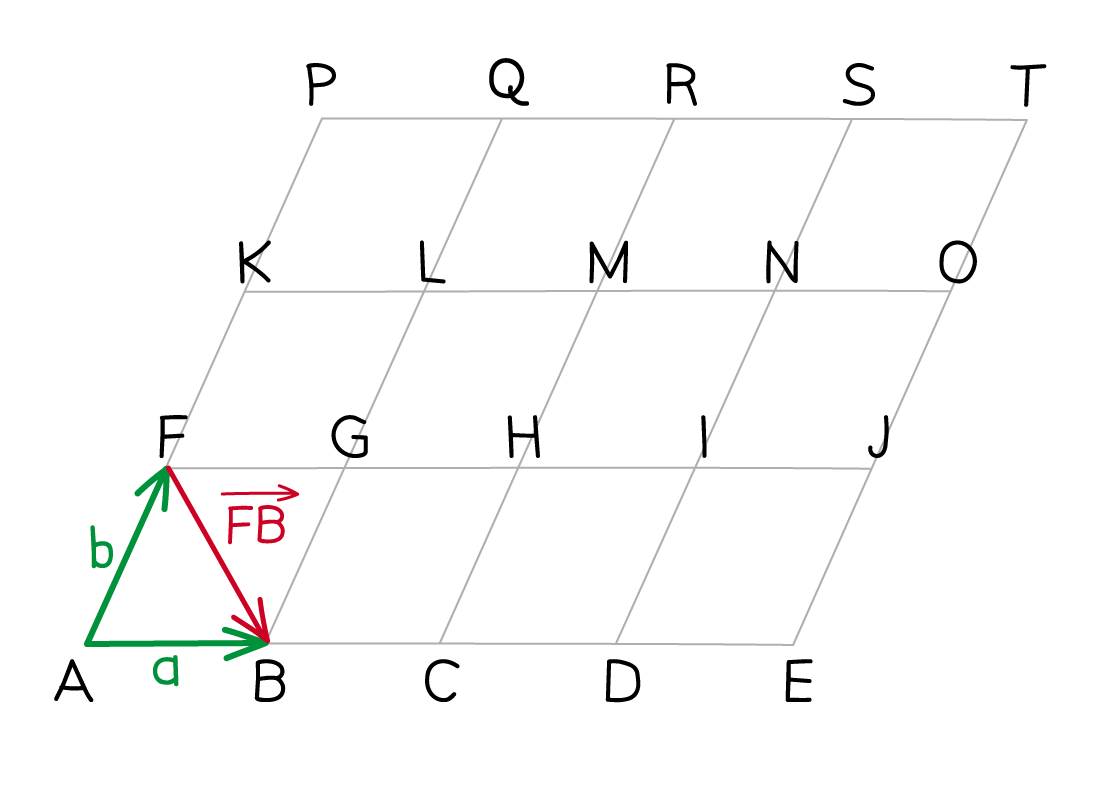
-
A vector path is a path of vectors taking you from a start point to an end point
-
On the diagram shown
-
F to B has the path F to A to B
-
There are other possible paths too
- F to G to B
-
-
You can write vector paths in terms of vectors given (a, b, ...)
-
The rule helps
-
-
Vectors given can be used to build bigger paths
-
- Different correct paths simplify to the same final answer
-
How do I use ratios in vector paths?
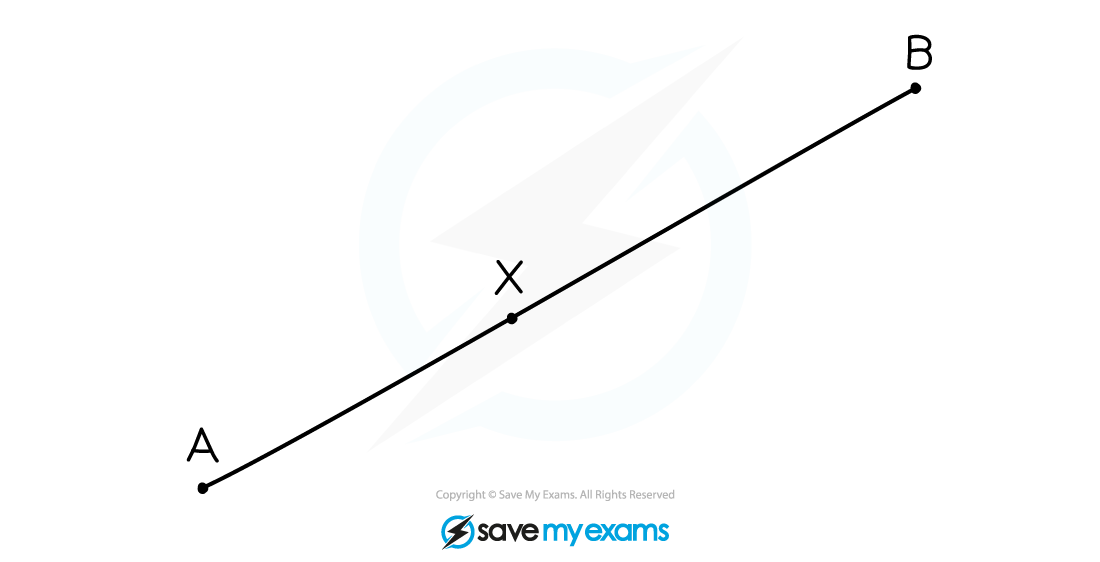
-
Convert ratios into fractions
-
In the example shown, if then
-
-
- The ratio 3:5 has 3 + 5 = 8 parts
-
-
Always check which ratio you are being asked for
Exam Hint
- Mark schemes will accept different correct paths, as long as the final answer is fully simplified.
- Check for symmetries in the diagram to see if the vectors given can be used anywhere else.
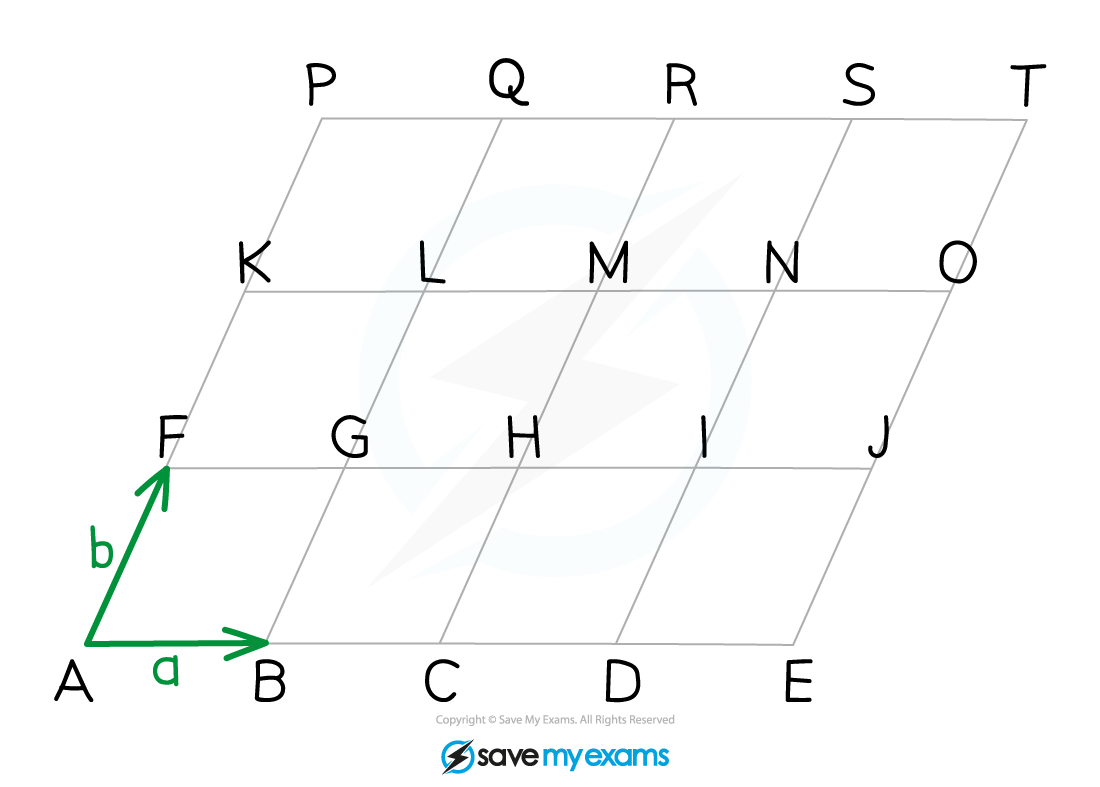
Worked Example The following diagram shows a grid formed of identical parallelograms.
Vectors * *and are given by and respectively.
Find the following vectors in terms of and , fully simplifying your answer.
(a)
*There are many ways to get from E to *K * One option is E to O (b twice) then O to K( -a four times). *
- *
-4a + 2b also accepted
(b) , where is the point on the line such that .
Start by imagining the vector *It is easy to write this vector in terms of a and b *
To find , use the given ratio to write it as a fraction of There are 1 + 3 = 4 parts
Substitute in the known expression for Expand and simplify to get the final answer
| A X -vec | = a + 3 / 4 b | |
Parallel Vectors
Spec point —
7A
How do I know if two vectors are parallel?
-
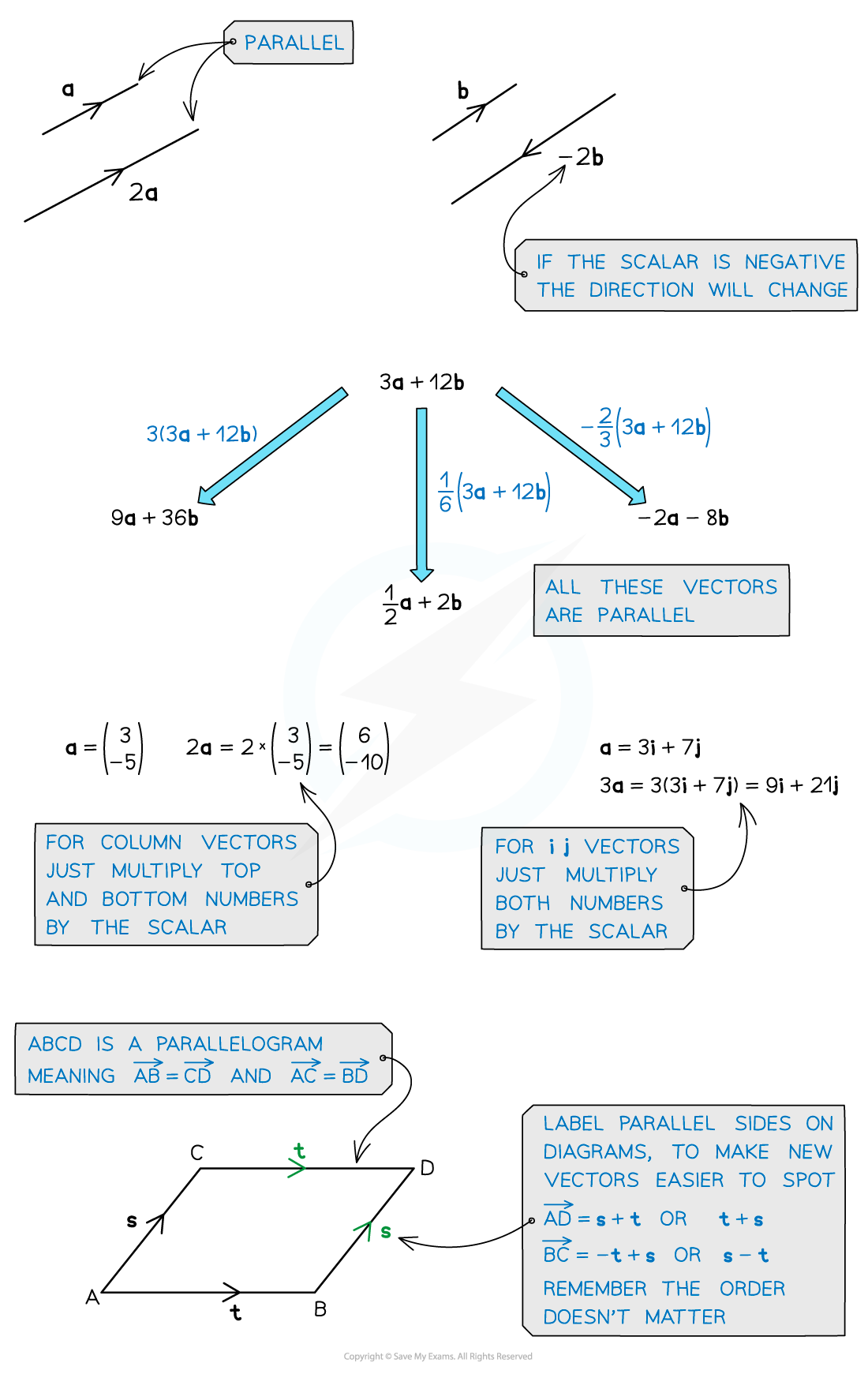
Two vectors are parallel if one is a scalar multiple of the other
-
This means if b is parallel to a, then b = *ka
- where k is a constant number(scalar)
-
-
For example, and
- so
- b is a scalar multiple of a, so b is parallel to a
-
If the scalar multiple is negative, then the vectors are parallel and in opposite directions
-
- c is parallel to a and in the opposite direction
-
How do I use factorisation to show two vectors are parallel?
-
If two vectors factorise with a common bracket, then they are parallel
- They can be written as scalar multiples
-
For example
-
9a + 6b factorises to 3(3a + 2b)
-
12a + 8b factorises to 4(3a + 2b)
-
This means
- so they are scalar multiples of each other
- and therefore parallel
-
Exam Hint
If a question asks you to show that two vectors are parallel
- Don't stop after showing two vectors are scalar multiples of each other
- You must conclude with "therefore a and b are parallel" to get all the marks!
Worked Example Show that the vectors and are parallel.
It helps to write b in the same order as a
Factorise both vectors to form a common bracket
Write b in terms of a It can help to make the brackets the subject of the first equation, i.e. *Then substitute that into the equation for *b
Write a conclusion showing the scalar multiple State that this shows they are parallel
therefore b is parallel to a
You could also use
Collinearity
Spec point —
7F
What does collinear mean?
-
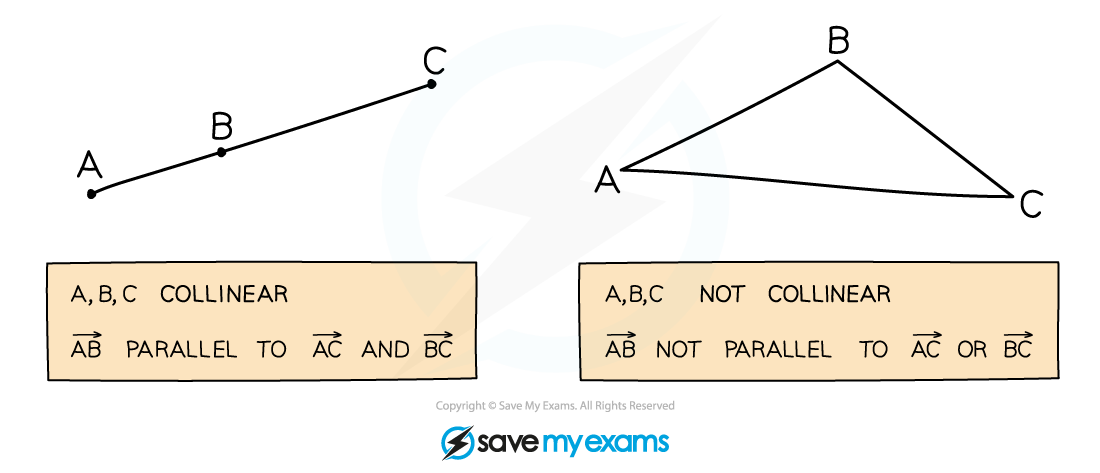
The points A, B and C are collinear if they all lie along the same straight line
-
In the image on the left in the diagram below, the following vectors are all parallel:
How do I use vectors to show that three points are collinear?
-
To show the points A, B and C are collinear
-
prove that two line segments are parallel
-
and show that there is at least one point that lies on both segments
- This makes them parallel and connected(not side-by-side)
-
-
For example, if you show that then
-
the line segments AB and BC are parallel
-
and they have a common point, B
- So A, B and C must be collinear
-
-
Similarly, means AC and AB are parallel
-
and they have a common point, A
- so A, B and C must be collinear
-
How can collinearity be used when extend lines?
-
Extending the line segment OA means continuing the straight line beyond A*
-
If the extended line passes through the point X
- then O , A and X are collinear
-
-
To test whether another point, Y, is on OA extended*
- test whether O , A and Y are collinear
Exam Hint
- Even though it's 'obvious' that and have a common point at A, you should still write this fact in your answer to complete a collinearity proof.
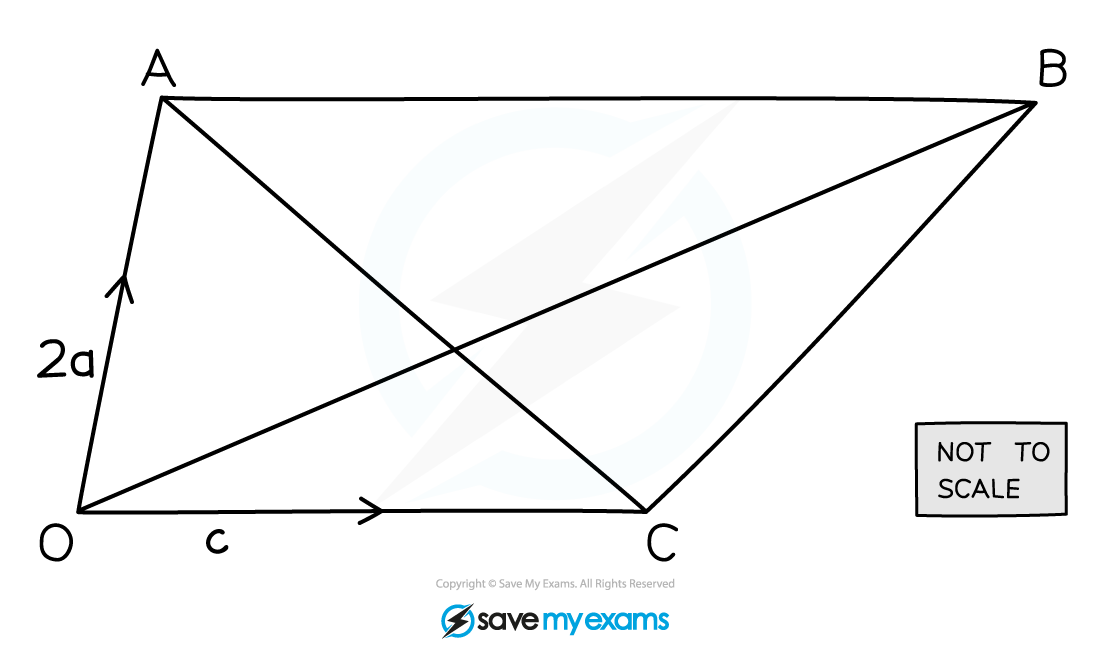
Worked Example The diagram shows a quadrilateral, , where
It is also know that
(a) Juan believe that the point , which is halfway along , lies on the line .
Show that , and are not collinear.
O , X and B are collinear if two line segments are parallel and share a common point Consider the vectors and *They have a common point, *O Check if they are parallel by first finding
Expand and simplify
Now compare it to (given in the question) Try factorisation to write in terms of
The inside the brackets matches the in But the inside the brackets does not match the in Therefore you cannot write and as scalar multiples of each other
Final answer: is not a scalar multiple of Therefore OX and OB are not parallel O, X and B cannot be collinear
(b) Maria believes that the point , which is three quarters along from , lies on the line .
Show that , and are collinear.* *
Similarly to part (a), find and see if it is parallel to * *
Use factorisation to write in terms of * *
*So OB is parallel to OY * They also have a common point, O
Final answer: Therefore OY and OB are parallel They also have a common point, O Therefore O, Y and B are collinear
Equating Coefficients of Vectors
Spec point —
7B
How do I equate coefficients of vectors?
-
In the vector
- the coefficient of a is
- the coefficient of b is
-
Two vectors can only be equal if all their coefficients are equal
-
So if the vectors and are both equal
- then (by equating coefficients of a)
- and (by equating coefficients of b)
How do I use equating coefficients to find points of intersection?
-
Some diagrams have vectors that meet at a point
- These are called concurrent vectors
-
To find this point, create two different vector paths that approach the point from different directions
- Then set them equal and equate coefficients
-
For example, if the lines AB and CD intersect at the point P,* *find
-
One path is along the line AB
- A , P and B are collinear
- so (they are parallel)
-
Another path is along the line CD
- For example,
- C , P and D are also collinear so
- is a different scalar to
-
Set both paths equal and equate coefficients
- This forms simultaneous equations in and
- Solve these and substitute their values back in to find
-
Exam Hint
The method of equating two different paths is really useful for other hard situations.
- For example, extending lines out of a diagram, or continuing lines within a diagram.
Worked Example The diagram shows the diagonals of quadrilateral , where
You are also given that
The diagonals and intersect at the point .
Find the vector , giving your answer fully simplified in terms of and .
Find two different paths from O to P that come in along different diagonals The first path is along OB itself *Although the length OP is unknown, * is definitely a scalar multiple of (they are parallel)
Use * to write this first path in terms of a and c*
The second path needs to come in along the AC diagonal
* *
*Although the length AP is unknown, * is definitely a scalar multiple of (they are parallel) Give the scalar a letter different to used above
- *
Use * to write this second path in terms of a and c *
* *
Set the first path equal to the second path
*Collect the terms into their a and c components on each side *
*Equate (and simplify) the a coefficients *
*Equate the c coefficients *
This gives two simultaneous equations in and Solve these simultaneously
*and ** *
*
Go back to either of the two paths for * * Substitute in or Simplify to get the final answer
| O P -vec | = 1 / 2 a + 3 / 4 c | |
Was this revision note helpful?