11 markeasy
Air is a mixture of gases.
What is the approximate percentage of nitrogen in air?
Choose your answer
1
20
25
78
14 questions · 62 marks · ≈ 62 min · spans 14 of 14 topics
Assembled from the topic question banks — not an official Edexcel paperAir is a mixture of gases.
What is the approximate percentage of nitrogen in air?
Choose your answer
1
20
25
78
A student adds a few drops of dilute nitric acid followed by a few drops of silver nitrate solution to a test tube containing an unknown colourless solution. A white precipitate is seen.
What ions could be present in the solution?
Choose your answer
Ammonium ions
Chloride ions
Sulfate ions
Magnesium ions
This question is about the reaction between sodium and water.
Which statement about this reaction is correct?
Choose your answer
Sodium sinks to the bottom of the water
A lilac flame is seen
A solution of sodium oxide is produced
Bubbles of hydrogen gas are produced
The ionic equation for the reaction between chlorine and sodium bromide is:
Cl2 (g) + 2Br– (aq) → 2Cl– (aq) + Br2 (aq)
This reaction occurs because chlorine is more reactive than bromine.
Which of the statements explaining why chlorine is more reactive than bromine is not true?
Choose your answer
chlorine has smaller atoms than bromine
chlorine atoms gain electrons more easily
chlorine atoms lose electrons more easily
chlorine atoms have fewer electron shells than bromine atoms
This question is about alcohols.
Alcohols have the general formula CnH2n+1OH.
Draw the displayed formula of propanol.
Deduce the molecular formula of the alcohol that has a relatvie molecular mass of 102.
Alcohols undergo combustion reactions.
Write a balanced symbol equation for the complete combustion of butanol.
Describe the conditions needed to convert ethene to ethanol.
This question is about carboxylic acids and esters.
A carboxylic acid has the empirical formula C2H4O.
The relative formula mass of the acid is M*r *= 88.
i) Determine the molecular formula of the acid.
(2 marks)
ii) Draw the displayed formula of the carboxylic acid.
(1 mark)
iii) Name the acid.
(1 mark)
iii) Draw a ring around the functional group.
(1 mark)
i) Describe what you would see when a small piece of magnesium ribbon is added to a solution of the carboxylic acid.
(2 marks)
ii) Describe how you would identify any gaseous products.
(2 marks)
Ethanol, C2H5OH, can be oxidised to produce ethanoic acid, CH3COOH, by heating it with potassium dichromate(VI).
i) Name one other reactant needed for this reaction to occur.
(1 mark)
ii) Which colour change occurs during this reaction?
(1 mark)
| ☐ | A | colourless to green |
|---|---|---|
| ☐ | B | green to orange |
| ☐ | C | orange to colourless |
| ☐ | D | orange to green |
When ethanol is burned in air, complete combustion can occur. The equation for this reaction is:
C2H5OH + 3O2 → 2CO2 + 3H2O
This equation can also be written using displayed formulae to show all the covalent bonds in the molecules.
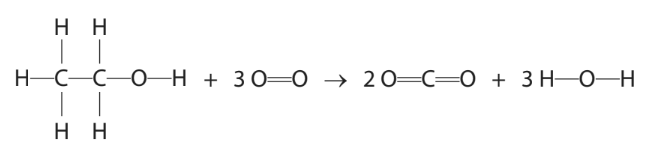
The table gives the bond energies for these bonds.
| Bond | C-C | C-H | C-O | O-H | O=O | C=O |
|---|---|---|---|---|---|---|
| Bond energy in kJ / mol | 346 | 412 | 358 | 463 | 496 | 743 |
i) Use values from the table to calculate the energy needed to break all the bonds in the reactants.
(2 marks)
energy needed .............................................................. kJ
ii) Use values from the table to calculate the energy released when all the bonds in the products are formed.
(2 marks)
energy released .............................................................. kJ
iii) Calculate the molar enthalpy change (ΔH) in kJ / mol, for the complete combustion of ethanol. Include a sign in your answer.
(1 mark)
ΔH = .............................................................. kJ / mol
Ethanol reacts with methanoic acid, HCOOH, in the presence of an acid catalyst to form an ester.
The equation for the reaction is:
C2H5OH + HCOOH HCOOC2H5 + H2O
i) Give the name of the ester that forms.
(1 mark)
ii) Draw the displayed formula for this ester.
(2 marks)
iii) When this reaction takes place in a sealed container, the reaction can reach dynamic equilibrium.
Give two characteristics of a reaction at dynamic equilibrium.
(2 marks)
Methanoic acid reacts with sodium carbonate to form sodium methanoate, carbon dioxide and water.
The equation for the reaction is:
2HCOOH + Na2CO3 → 2HCOONa + CO2 + H2O
Calculate the volume, in cm3 , of carbon dioxide gas produced when 2.3 g of methanoic acid reacts completely with sodium carbonate.
[Mr of HCOOH = 46]
[Molar volume of carbon dioxide at rtp = 24 dm3]
volume of carbon dioxide = .............................................................. cm3
Which statement is the correct description of a polymer?
Choose your answer
The atoms within a monomer
A large saturated hydrocarbon
A large molecule made from many small molecules
A large unsaturated molecule
Which of these statements about catalysts is not correct?
Choose your answer
The mass of the catalyst at the start of the reaction is the same at the end of the reaction
Catalysts increase the rate of reaction but do not increase the yield
Catalysts are not chemically changed during the course of the reaction
Catalysts provide an alternative reaction pathway which has a lower activation energy
Ammonia is manufactured on a large scale and is used to make fertilisers such as ammonium nitrate (NH4NO3).
The first stage in the manufacture of ammonium nitrate is to react ammonia gas with oxygen gas.
4NH3 (g) + 5O2 (g) 4NO (g) + 6H2O (g) ΔH = −907 kJ/mol
The reaction is carried out at a pressure of about 10 atm and at a temperature of 800 °C, in the presence of a catalyst.
If the mixture is left for long enough in a sealed container, the reaction reaches a position of dynamic equilibrium.
Graph A shows how the percentage of nitrogen monoxide (NO) in the equilibrium mixture varies with temperature at constant pressure.
Graph B shows how the percentage of nitrogen monoxide (NO) in the equilibrium mixture varies with pressure at a constant temperature.
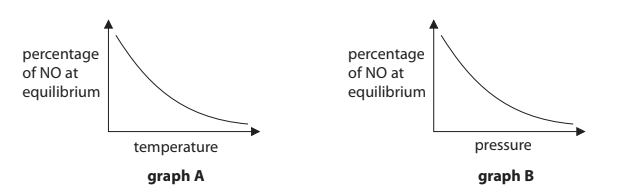
i) Explain why the percentage of NO at equilibrium decreases in each case.
Graph A:
Graph B:
(4 marks)
ii) Explain why the use of a catalyst has no effect on the position of equilibrium in a reversible reaction.
(2 marks)
The second stage in the manufacture of ammonium nitrate is to convert the nitrogen monoxide into nitric acid. The nitric acid is then reacted with concentrated aqueous ammonia as shown in this equation.
HNO3 (aq) + NH3 (aq) → NH4NO3 (aq)
i) State, in terms of proton transfer, why this reaction is classified as an acid-base reaction.
(1 mark)
ii) Calculate the volume of 14.8 mol/dm3 aqueous ammonia that is required to exactly neutralise 150 dm3 of a solution of nitric acid of concentration 15.8 mol/dm3.
(2 marks)
Carbon dioxide contains covalent bonds.
The covalent bonds in a molecule of carbon dioxide can be represented by a dot-and-cross diagram.
Which is the correct dot-and-cross diagram for carbon dioxide?
Choose your answer
A student uses the apparatus to electrolyse an aqueous solution of copper(II) sulfate.
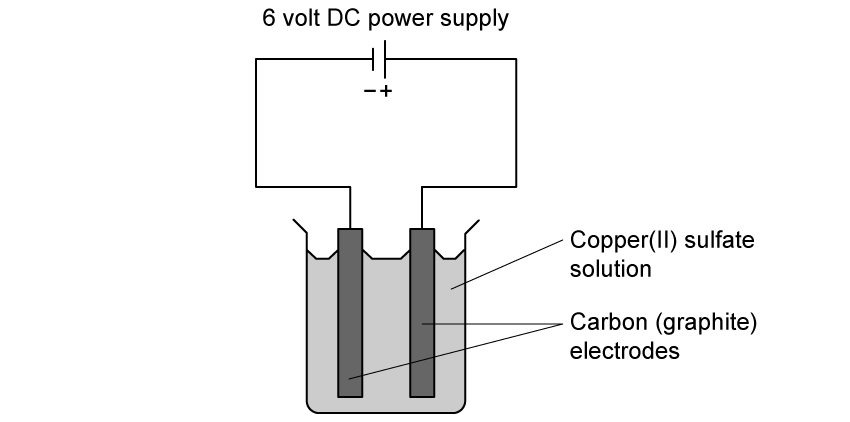
Which substances are formed at the negative electrode (cathode) and the positive electrode (anode)?
Choose your answer
Negative electrode: hydrogen Positive electrode: sulfur
Negative electrode: copperPositive electrode: oxygen
Negative electrode: sulfur Positive electrode: hydrogen
Negative electrode: oxygen Positive electrode: copper
Sodium chloride is an ionic compound which is soluble in water. Sodium ions and chloride ions bond together forming an ionic lattice.
i) Explain how a sodium atom becomes a sodium ion.
(2 marks)
ii) Explain how a chlorine atom becomes a chloride ion.
(2 marks)
Which of the following explains why sodium fluoride is soluble in water.
Tick (✓) one box.
| Both ionic compounds and water are polar substances | |
|---|---|
| Ionic compounds have weak bonds | |
| Water has weak bonds |
Sodium fluoride has a melting point 993 °C. Why does sodium fluoride have a high melting point.
Tick (✓) one box.
| The electrons and positive ions attract strongly | |
|---|---|
| The covalent bonds between the ions are strong | |
| There are strong bonds between the positively and negatively charged ions |
Sodium fluoride can conduct electricity when either molten or in solution. Why can sodium fluoride only conduct electricity when molten or in solution.
Tick (✓) one box.
| Electrons can move and carry a charge | |
|---|---|
| Ions can move and carry a charge | |
| Electrons can flow throughout the ionic lattice |
Aluminium is an element found in Group 3 of the Periodic Table.
Use your Periodic Table to deduce the number of protons, neutrons and electrons found in an atom of aluminium.
| protons | neutrons | electrons | ||
|---|---|---|---|---|
| ☐ | A | 13 | 27 | 13 |
| ☐ | B | 13 | 27 | 14 |
| ☐ | C | 27 | 14 | 14 |
| ☐ | D | 13 | 14 | 13 |
Choose your answer
Option A
Option B
Option C
Option D
Give two physical properties of aluminium.
Duralumin is an alloy of aluminium and copper. What type of substance is an alloy?
Choose your answer
Atom
Element
Compound
Mixture
Aluminium is extracted from bauxite, a mixture containing aluminium oxide.
One sample of bauxite contains 17% aluminium. Calculate the percentage of substances other than aluminium found in bauxite.