Experiment: Finding Formulae of Simple Compounds (Edexcel IGCSE Chemistry)
Exam board Pearson Edexcel · IGCSEUpdated 2026-02-10
Formulae of Simple Compounds by Experiment
Formulae of a simple compound by experiment
- The formulae of simple compounds can be found by careful experimentation and accurate measurements of mass changes
- The principle is to use mass measurements before and after a reaction and then convert masses into moles
- Using the moles of reactants and products it is possible to deduce molar ratios and hence an empirical formula
- Experiments which are easier to do using this process involve gases being lost or gained
- In this example a hydrated salt is heated to drive off the water as water vapour
The formula of a hydrated salt
Aim:
- To determine the formula of hydrated copper sulfate, CuSO4. xH2O
Diagram:
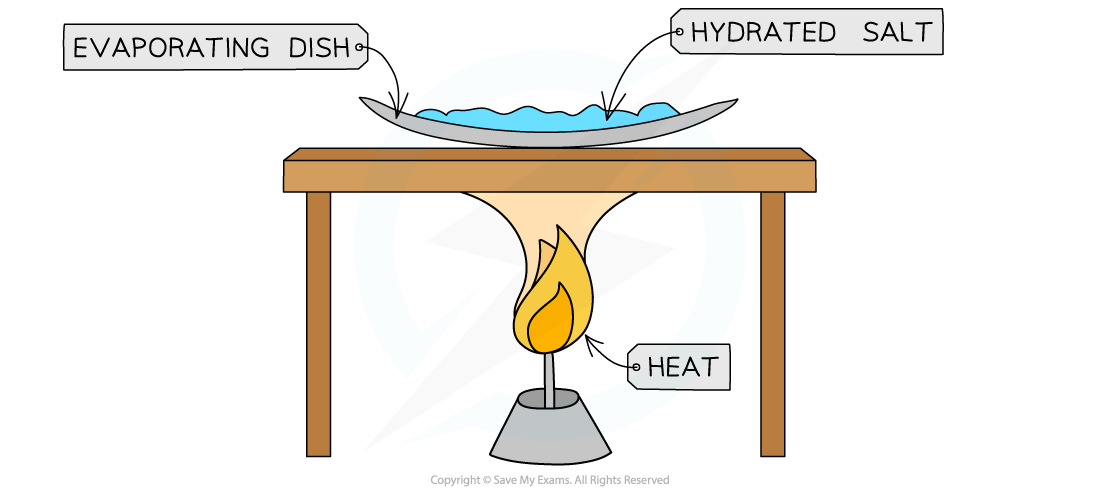
Heating a hydrated salt to remove the water of crystallisation
Method
- Measure the mass of evaporating dish
- Add a known mass of hydrated salt
- Heat over a Bunsen burner, gently stirring, until the blue salt turns completely white, indicating that all the water has been lost
- Record the mass of the evaporating dish and its contents
Practical tip:
- Avoid overheating the salt as it could decompose and give you a larger mass change
Results:
-
Mass of the white anhydrous salt
- Measure the mass of white anhydrous salt remaining
-
Mass of water
- Subtract the mass of the white anhydrous salt remaining from the mass of known hydrated salt
- Step 1 – Divide the mass of the copper sulfate and the water by their respective molar masses
- Step 2 – Simplify the ratio of water to copper sulfate: | | anhydrous salt | water |
|---|---|---|
| Mass | a | b |
| Moles (Step 1) | a / Mr
= y | b / Mr
=x | | Ratio (Step 2) | 1 : | x | - Step 3 – Represent the ratio in the form ‘salt.xH2O’
Exam Hint It is unlikely that you will get a whole number for the number of moles of water in the ratio, so you will need to round up or down to the nearest whole number.
Was this revision note helpful?
Build on this topic