Practical: Investigate The Solubility of a Solid In Water at a Specific Temperature (Edexcel IGCSE Chemistry)
Exam board Pearson Edexcel · IGCSEUpdated 2025-05-01
Spec point —
1.7C
Practical: Investigate the solubility of a solid in water at a specific temperature
Aim
- To measure the solubility of a salt at different temperatures
Method
- Prepare two beakers, one as a hot water bath and one as an ice bath
- Using a small measuring cylinder, measure out 4 cm3 of distilled water into a boiling tube.
- On a balance weigh out 2.6 g of ammonium chloride and add it to the boiling tube
- Place the boiling tube into the hot water bath and stir until the solid dissolves
- Transfer the boiling tube to the ice bath and allow it to cool while stirring
- Note the temperature at which crystals first appear and record it in a table of results
- Add 1 cm3 of distilled water to the same boiling tube, then warm the solution again to dissolve the crystals
- Repeat the cooling process again noting the temperature at which crystals first appear
- Continue the steps until a total of 10 cm3 of water has been added
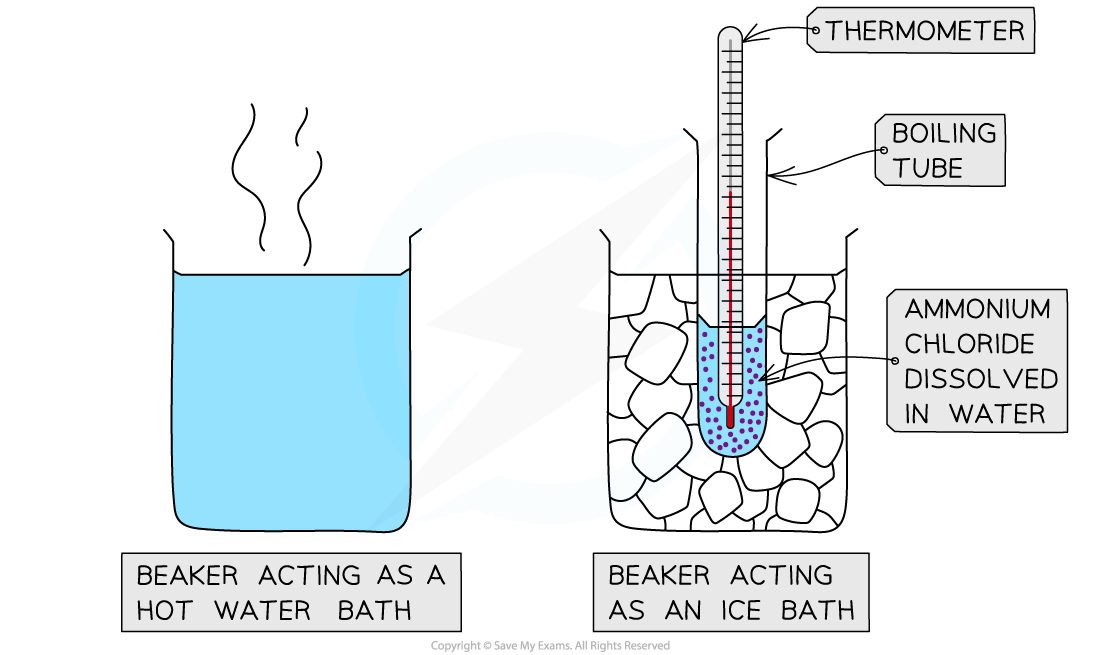
Apparatus for investigating the solubility of a salt with temperature
Results
- The results can be recorded in a table
- The solubility in g / 100g is calculated by dividing the mass of the solute by the volume and multiplying by 100
Example results table
| Volume of water in boiling tube / cm3 | Solubility in g per 100 g | Temperature at which crystals appear /oC |
|---|---|---|
| 4 | 65 | |
| 5 | 52 | |
| 6 | 43 | |
| 7 | 37 | |
| 8 | 32 | |
| 9 | 29 | |
| 10 | 26 |
Graph
-
The results can be used to plot a solubility curve for ammonium chloride at different temperatures
- Solubility is on the y-axis and temperature is on the x-axis
Conclusion
- The shape of the graph will allow us to state how the solubility varies with temperature
Was this revision note helpful?
Build on this topic