11 markeasy
Methyl orange is used as an indicator.
What is the colour of it in an alkaline solution?
Choose your answer
Yellow
Orange
Red
Blue
17 questions · 81 marks · ≈ 1 hour · spans 13 of 14 topics
Assembled from the topic question banks — not an official Edexcel paperMethyl orange is used as an indicator.
What is the colour of it in an alkaline solution?
Choose your answer
Yellow
Orange
Red
Blue
Steel is formed from iron and carbon and is widely used in the construction industry.
i) Explain why steel alloys are used in preference to iron.
(1 mark)
ii) State a use of stainless steel.
(1 mark)
Both iron and steel have typical metallic structures - a lattice of positive ions and a sea of electrons.
i) Explain why iron and steel have high melting points.
(2 marks)
ii) Explain why, when a force is applied to a piece of steel, it does not break but changes its shape.
(2 marks)
Brass is an alloy of two metals, copper and zinc.
Which statement is correct, tick (✔) one box.
| Brass dissolves fully in hydrochloric acid | |
|---|---|
| Brass has a chemical formula of CuZn | |
| Brass is formed by a chemical reaction between two metals | |
| One of the metals in the alloy will dissolve in dilute hydrochloric acid |
This question is about salts.
Soluble salts can be prepared by the reaction between a metal oxide and an acid.
The equation for this type of reaction is:
metal oxide + acid → salt + water
i) State the name given to this type of reaction.
(1 mark)
ii) State, in terms of protons, what happens in this reaction.
(1 mark)
A student is given 50 cm3 of dilute sulfuric acid and a bottle of solid copper(II) carbonate.
i) Describe the method that the student should use to prepare a saturated solution of copper(II) sulfate.
In your answer, refer to the pieces of apparatus that the student should use.
(5 marks)
ii) The student produces dry crystals of hydrated copper(II) sulfate from the saturated solution.
He calculates that 6.40 g of dry crystals should be formed.
The mass of dry crystals he actually obtains is 1.80 g less than he calculated.
Calculate the student’s percentage yield.
Give your answer to one decimal place.
percentage yield = .............................................. %
(3 marks)
i) Gypsum is hydrated calcium sulfate.
A sample of gypsum contains 79% of calcium sulfate by mass.
Calculate the value of x in CaSO4.xH2O
[Mr of CaSO4 = 136 Mr of H2O = 18]
x = ..............................................
(3 marks)
ii) Describe a test for calcium ions in the sample of gypsum.
(2 marks)
Methane and bromine react to form bromomethane and hydrogen bromide.
What does this reaction occur in the presence of?
Choose your answer
Infrared radiation
Visible light
Untraviolet radiation
Ozone
This question is about alkenes and polymers.
Propene can be represented by different types of formulae.
Complete the table about propene by giving the missing information.
| Molecular Formula | Empirical Formula | General Formula |
|---|---|---|
| C3H6 |
Butene reacts with bromine in an addition reaction.
Complete the missing information in the symbol and word equations.
C4H8 + Br2 → ....................
butene + bromine → ..........................
i) Complete the equation for the polymerisation of propene.
(2 marks)
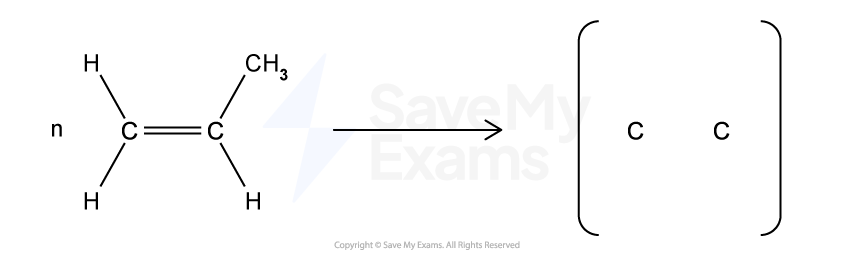
ii) Name the product of the reaction.
(1 mark)
iii) State the type of polymerisation taking place.
(1 mark)
The repeat unit of another polymer has the following structure:

Draw the displayed formula of the monomer used to make this polymer.
Fractional distillation is the process by which crude oil is separated into simpler, more useful fractions.
Which of the following statements about the process of fractional distillation is correct?
Choose your answer
The fractionating column is cooler at the bottom than at the top
The fractions collected at the top of the fractionating column have a high boiling point
The molecules in each fraction have a similar boiling point and carbon chain length
The fractions collected at the bottom of the fractionating column have a low viscosity
The actual molar enthalpy change, ΔH, for the reaction of sodium oxide with water, is -238 kJ/mol.
Experimental results from calorimetry in labs give less exothermic results.
Which of the following does not explain this difference?
Choose your answer
The reaction may have been incomplete
Heat energy also transfers to the surroundings
The calorimetry equipment also has a specific heat capacity, and so affects the final temperature reading
The student measured the initial temperature of the water as lower than the actual value.
The diagram shows the structure of an atom.
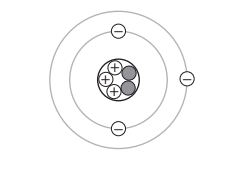
Name the central part of an atom.
Name the positively charged particles in an atom.
State how the diagram in part a) shows that this atom is neutral.
Give the mass number of the atom in part a).
Give the name of the element containing this atom. Use the Periodic Table to help you.
How many moles are present in 9 kg of glucose, C6H12O6?
[M*r *of C6H12O6 = 180 ]
Choose your answer
0.02 mol
0.05 mol
20 mol
50 mol
A student uses this apparatus to investigate the colours in four different inks, A, B, C and D.
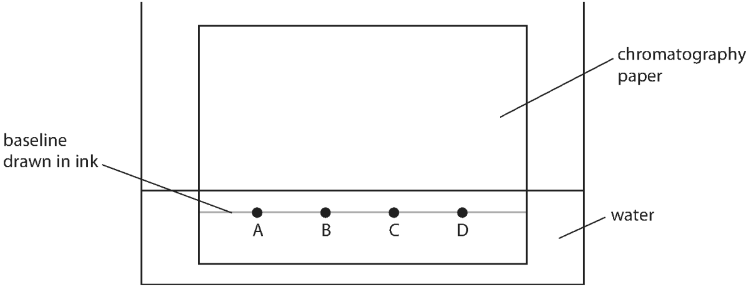
Explain two mistakes the student made when setting up the experiment.
Another student does the experiment but does not make any mistakes.
The diagram shows her results.
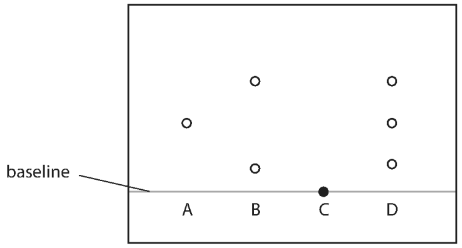
i) State how many colours ink D contains.
(1 mark)
ii) State which of the inks tested could be mixed together to make ink D.
(1 mark)
iii) Explain which of the inks tested is insoluble in water.
(2 marks)
The following elements are found in group 0 of the periodic table.
He Ne Ar Kr Xe Rn
What explains their similar chemical and physical properties?
Choose your answer
They have the same number of valence electrons
They are all gases
They have the same number of protons and electrons
They have full outer shells
Ammonium chloride decomposes in a reversible reaction. The equation for this reaction is
NH4Cl (s) NH3 (g) + HCl (g)
State how the equation shows that the reaction is reversible.
Some ammonium chloride is heated gently in a test tube.
The diagram shows the test tube after it has been heated gently for a short time.
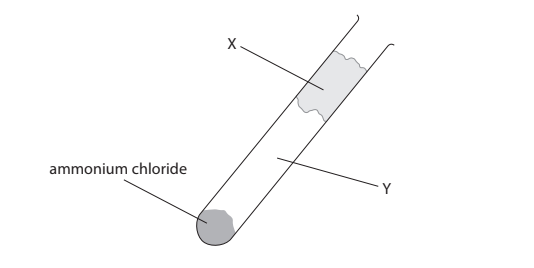
i) Identify solid X and the two gases formed in region Y of the test tube.
Solid X ................................................................................................
Gases at Y ..................................................................................................
(2 marks)
ii) Which change of state occurs in the test tube during heating?
(1 mark)
| ☐ | A | condensing |
|---|---|---|
| ☐ | B | evaporating |
| ☐ | C | melting |
| ☐ | D | subliming |
An experiment involving ammonium chloride can be used to show the process of diffusion.
The diagram shows the apparatus at the start of the experiment.
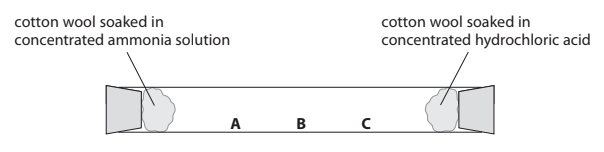
At the end of the experiment, a white solid forms in the test tube. Explain which position, A, B or C, shows where the white solid forms.
Carbonic acid is found in fizzy drinks and has the formula, H2CO3.
Which ion causes the drink to be acidic?
Choose your answer
OH-
CO32-
H+
O2-
Why are alloys harder than the pure metals from which they are made?
Choose your answer
There are stronger bonds between the atoms
The atoms are all the same size
The layers of atoms are distorted
The properties of each element have combined
What type of reaction occurs when iron rusts?
Choose your answer
Oxidation
Neutralisation
Combustion
Displacement
A student makes some magnesium nitrate crystals from magnesium oxide and dilute nitric acid. The equation for the reaction is
MgO (s) + 2HNO3 (aq) → Mg(NO3)2 (aq) + H2O (l)
i) Give the formula of each ion in magnesium nitrate.
......................................... and ......................................
(2 marks)
ii) A student has a beaker containing dilute nitric acid. Describe a method that she could use to prepare a pure, dry sample of magnesium nitrate crystals from magnesium oxide.
(6 marks)
Magnesium nitrate crystals contain water of crystallisation with the formula Mg(NO3)2.6H2O
i) Show by calculation that the relative formula mass of Mg(NO3)2.6H2O is 256.
(1 mark)
ii) Show that the maximum mass of Mg(NO3)2.6H2O that could be made from 0.050 mol of nitric acid is about 6 g.
(3 marks)
iii) The actual mass of crystals that the student obtains is 4.8 g. Calculate the percentage yield of Mg(NO3)2.6H2O in this experiment.
(2 marks)
The structure of a molecule of propane is shown as
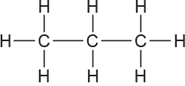
Give the names of the elements combined together in propane.
Propane can burn completely in oxygen to form carbon dioxide and water.
i) Write the word equation for this reaction.
(2 marks)
ii) Propane is a fuel. Give the reason why fuels are burned.
(1 mark)
Which product is formed when there is incomplete combustion of propane?
Choose your answer
sulfur dioxide
oxygen
hydrogen
carbon monoxide
Which of the following is the formula of an alkane?
Choose your answer
C6H5OH
CH3CH2CH2CH3
H2C=CHCH2CH3
C6H12