The diagram shows the sub‑atomic particles in an atom of an element
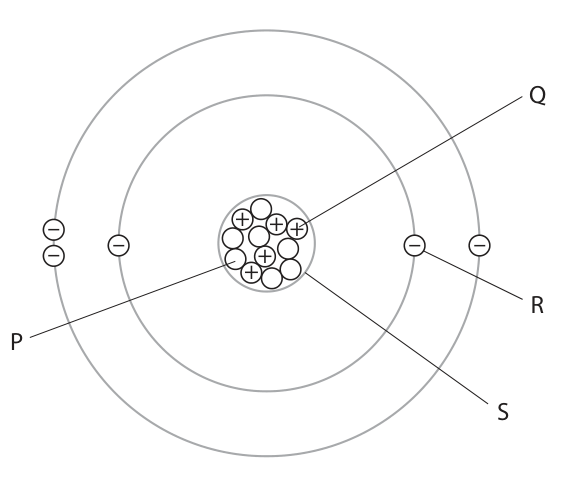
Give the name of each of the sub‑atomic particles labelled P, Q and R. P Q R
Give the name of the part of the atom labelled S.
Give the name of this element.
7 questions · 70 marks · ≈ 70 min
The diagram shows the sub‑atomic particles in an atom of an element

Give the name of each of the sub‑atomic particles labelled P, Q and R. P Q R
Give the name of the part of the atom labelled S.
Give the name of this element.
A potassium permanganate crystal is placed in a beaker of water. potassium permanganate crystal After several days a coloured solution forms.
Give the names of the two processes that cause the coloured solution to form. 1 2
The formula of potassium permanganate is KMnO₄
How many different types of atom are in KMnO₄?
Choose your answer
3
4
6
7
Calculate the relative formula mass (Mr) of KMnO₄ Mr =
Potassium permanganate can be used as an oxidising agent. State what is meant by the term oxidising agent.
This question is about alkanes.
Which of these is the molecular formula of an alkane?
Choose your answer
C₂H₅
C₄H₁₀
CH₂CH₂
CH₃CH₂CH₃
Which of these has the same empirical formula and molecular formula?
Choose your answer
CH₂
C₂H₆
C₃H₈
C₄H₁₀
In the presence of ultraviolet radiation, methane reacts with bromine to form bromomethane and hydrogen bromide.
State the name of this type of reaction.
Give a chemical equation for this reaction.
One mole of an alkane burns completely in oxygen. The equation represents the reaction. alkane + xO₂ → yCO2 + zH₂O The numbers x, y and z are used to balance the equation.
The complete combustion of one mole of the alkane produces 220 g of carbon dioxide and 108 g of water. Calculate the values of y and z. [Mr of CO₂ = 44 Mr of H₂O = 18] y = z =
Determine the molecular formula of the alkane and the value of x. molecular formula = x =
When an alkane burns in a limited supply of air, incomplete combustion occurs. Explain why incomplete combustion of an alkane could be harmful to humans.
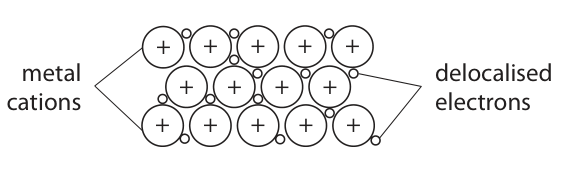
The diagram represents the structure of copper metal. + + + + + metal delocalised + + + + cations electrons + + + + + Explain three properties of copper that make it a suitable metal to use in electrical wiring.

The diagram shows the electrolysis of copper(II) sulfate solution, using graphite electrodes. power supply + – lamp positive electrode negative electrode copper(II) sulfate solution Copper forms at the negative electrode and oxygen forms at the positive electrode.
Give the formula of the copper ion and the formula of the sulfate ion in copper(II) sulfate. copper ion sulfate ion
State what would be seen at the positive electrode.
Give a test for oxygen.
Give an ionic half‑equation for the formation of oxygen at the positive electrode. .
Suggest why the copper(II) sulfate solution contains some OH– ions.
This question is about alcohols, carboxylic acids and esters.
Ethanol can be manufactured by the fermentation of a solution of glucose.
Write a word equation for this reaction.
State the substance that needs to be added for the reaction to occur.
State two conditions needed for this reaction. 1 2
In the presence of an acid catalyst, ethanoic acid is heated with butanol to form an ester.
Which of these is the formula of the ester?
Choose your answer
CH₃COOC₃H₇
CH₃COOC₄H₉
C₂H₅COOC₄H₉
C₃H₇COOC₂H₅
State how you would know that an ester has formed.
Give one use of an ester.
Aspirin is a compound used to reduce pain. Aspirin contains a carboxylic acid functional group and an ester functional group.
State what is meant by the term functional group.
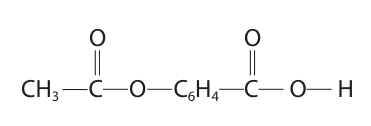
This is the structural formula of aspirin. Draw a circle around the carboxylic acid functional group.

Aspirin has this percentage composition by mass. C = 60.00 % H = 4.44 % O = 35.56 % Show by calculation that the empirical formula of aspirin is C₉H₈O₄
A student uses this method to do a titration.
State what is meant by concordant results.
Explain two improvements to the student’s method so that more accurate results are obtained.
The student makes the improvements and repeats the titration. The sulfuric acid has a concentration of 0.600 mol/dm³. The sodium hydroxide solution has a concentration of 1.50 mol/dm³. This is the equation for the reaction. 2NaOH + H₂SO₄ → Na₂SO₄ + 2H₂O Calculate the volume, in cm³, of sulfuric acid that the student needs to completely react with 25.0 cm³ of the sodium hydroxide solution. volume of sulfuric acid = cm³
The student plans to obtain pure dry crystals of hydrated sodium sulfate. They add the calculated volume of sulfuric acid to 25.0 cm³ of the sodium hydroxide solution to form sodium sulfate solution. Describe what the student should do to obtain pure dry crystals of hydrated sodium sulfate from the solution.
In the presence of an iron catalyst, nitrogen reacts with hydrogen to form ammonia. The reaction conditions used are a temperature of 450 °C and a pressure of 200 atmospheres. This is the equation for the reaction. N₂ + 3H₂ ⇌ 2NH₃ ΔH = –92 kJ/mol
State what the symbol ⇌ represents.
Give the reason for using a catalyst.
The reaction mixture is kept at a pressure of 200 atmospheres, but the temperature is increased to 550 °C. Explain the effect of this change on the yield of ammonia at equilibrium.
The reaction mixture is kept at a temperature of 450 °C, but the pressure is increased to 300 atmospheres. Explain the effect of this change on the yield of ammonia at equilibrium.
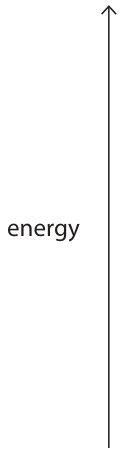
Draw an energy level diagram for the reaction between nitrogen and hydrogen. Include the reactants, products and ΔH in your diagram. energy

At the start of the reaction, 48 dm³ of nitrogen is added to 120 dm³ of hydrogen at rtp. N₂ + 3H₂ ⇌ 2NH₃ [molar volume of any gas at rtp = 24 dm³ ]
Show by calculation that the nitrogen is in excess.
The yield of ammonia at equilibrium is 20 %. Calculate the volume, in dm³, of ammonia formed from 120 dm³ of hydrogen. volume of ammonia = dm³