Practical: The Effect of Light on Gas Exchange in Plants (Edexcel IGCSE Biology)
Spec point —
2.45B· practical: investigate the effect of light on net gas exchange from a leaf, using hydrogen-carbonate indicator
Practical: The Effect of Light on Gas Exchange in Plants
-
This experiment investigates how light affects photosynthesis and respiration by showing changes in carbon dioxide levels around a leaf:
- Plants photosynthesise in light, using carbon dioxide
- Plants respire all the time, producing carbon dioxide
- By comparing leaves in different light conditions, we can see the net gas exchange
-
Hydrogen-carbonate indicator changes colour depending on CO₂ concentration:
- Yellow → high CO₂ (more acidic)
- Orange/red → normal CO₂
- Purple → low CO₂ (less acidic)
Apparatus
- Boiling tubes
- Cotton wool
- Aluminium foil
- Muslin (thin cotton cloth)
- Rubber bungs
- Hydrogen-carbonate indicator
- Leaves
Method
-
Measure out 20 cm3 hydrogen-carbonate indicator into each of 4 boiling tubes
-
Put some cotton wool into each boiling tube
-
Label the boiling tubes A-D and set them up as follows:
- Tube A - No leaf (control tube) left in bright light
- Tube B - Place a leaf in the tube and leave in bright light
- Tube C - Place a leaf in the tube and wrap the tube in aluminium foil to block out light (leaf will be in the dark)
- Tube D - Place a leaf in the tube and wrap it in muslin (thin cotton cloth) to allow some light through
-
Put a bung into the top of each tube
-
Leave all 4 tubes in the light for several hours/overnight
-
Observe any colour changes in the hydrogen-carbonate indicator
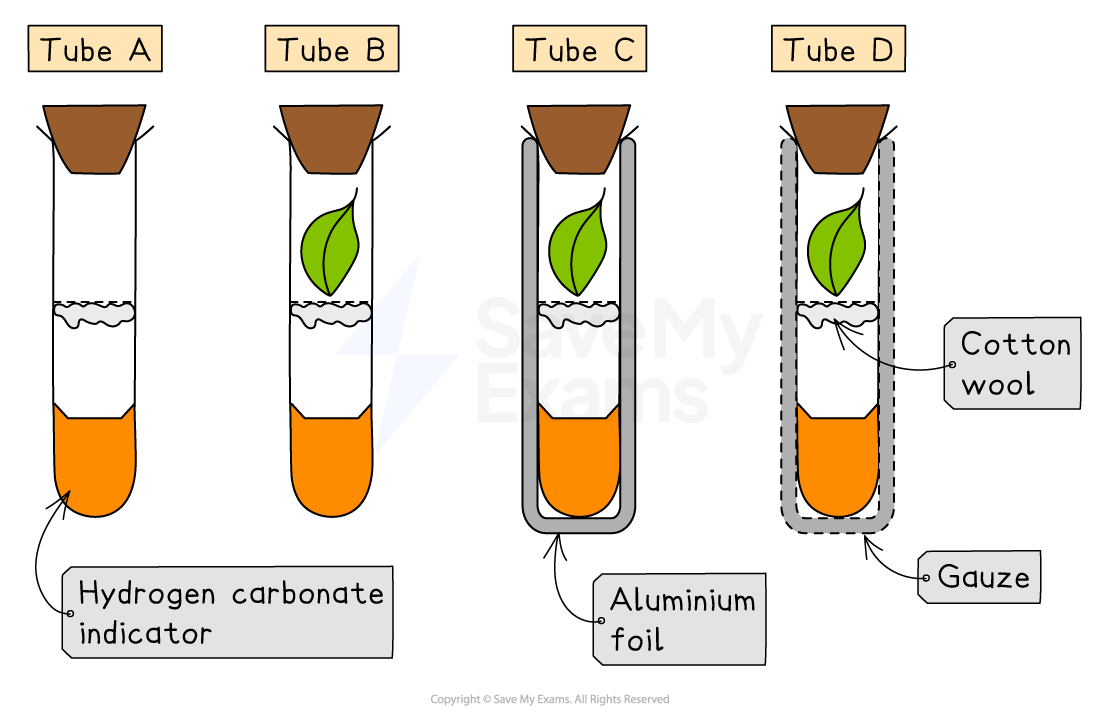
Hydrogen-carbonate indicator can be used to study gas exchange in different light conditions - it is usually orange in normal atmospheric conditions
Results
-
After several hours/overnight, we would expect the following results:
-
Tube A - The control tube should remain an orange colour to show that the carbon dioxide is at atmospheric levels
- There has been no net movement of carbon dioxide
-
Tube B - This tube was placed in the light with a leaf which is photosynthesising and respiring
- Because the rate of photosynthesis is greater than the rate of respiration, the hydrogen-carbonate indicator will turn purple as there is less carbon dioxide than atmospheric levels
-
Tube C - This tube had a leaf inside, but was wrapped in aluminium foil meaning that no sunlight could reach the leaf
- No light means that this leaf will not photosynthesise but will still be respiring, producing carbon dioxide. The indicator will turn yellow as carbon dioxide levels increase above atmospheric levels
-
Tube D - This tube had a leaf inside and was wrapped in muslin (cotton cloth) allowing some light through
- This means that the rate of photosynthesis is roughly balanced with the rate of respiration, although usually the rate of photosynthesis is slightly greater so there may be a very small net change in carbon dioxide levels and the indicator either remains orange, but it could turn slightly purple.
- Any colour change will be much less dramatic than the tube in bright light
-
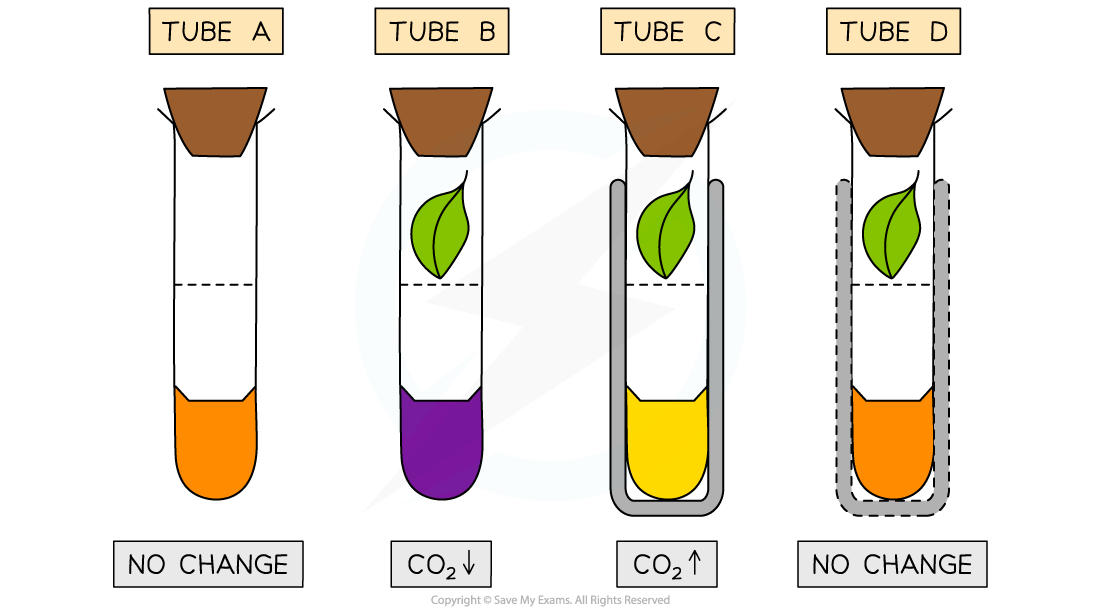
Hydrogen-carbonate indicator will change from orange to yellow with increasing carbon dioxide or purple with decreasing carbon dioxide
The Effect of Light on Net Gas Exchange in Plants Table
| Boiling tube label | Conditions | Initial colour of hydrogen-carbonate indicator | Final colour of hydrogen-carbonate indicator | Conclusion |
|---|---|---|---|---|
| Tube A | No leaf (control) | Orange | Orange | No respiration or photosynthesis so no net movement of CO2 |
| Tube B | Leaf in sunlight | Orange | Purple | Photosynthesis > respiration. There is a net intake of CO2 . The level of CO2 decreases. |
| Tube C | Leaf wrapped in aluminium foil | Orange | Yellow | No photosynthesis due to lack of light, only respiration occurs. There is a net release of CO2. The level of CO2 increases. |
| Tube D | Leaf wrapped in muslin (cotton cloth) | Orange | Orange/slightly purple | Photosynthesis and respiration are relatively balanced. Net exchange of gas is small, although photosynthesis may exceed respiration so a small net update of CO2 may happen (level of CO2 decreases) |
Applying CORMS evaluation to practical work
- When designing or reviewing practical investigations, remember to consider the CORMS prompt
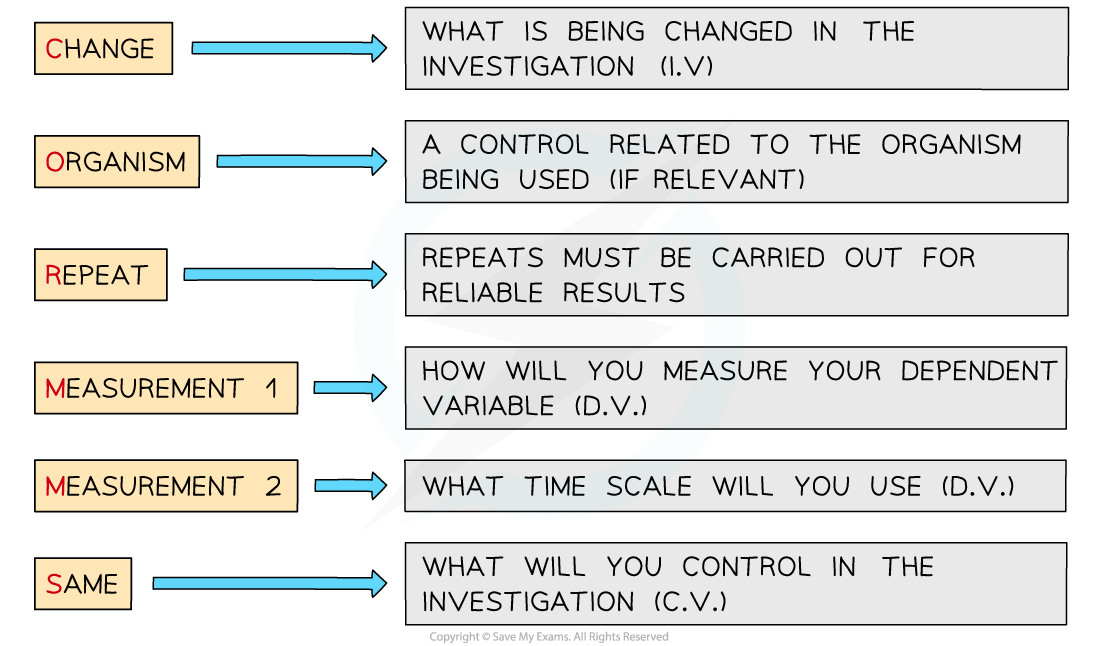
The CORMS prompt
-
For this investigation into the effect of light on net gas exchange from a leaf using hydrogen-carbonate indicator, the following would apply:
- Change - change the availability of light for each boiling tube (not wrapped, wrapped in foil, wrapped in muslin)
- Organisms - the leaves should be from the same species/age of the plant, they should be approximately the same size
- Repeat - repeat the investigation several times to ensure results are reliable
- Measurement 1 - observe the change in the hydrogen-carbonate indicator
- Measurement 2 - after several hours/overnight
- Same - control the volume of hydrogen-carbonate indicator, the number of leaves, the temperature of the environment
Was this revision note helpful?
Build on this topic