Approximating the Poisson Distribution (Edexcel IAL Maths)
Calculating probabilities using a binomial or Poisson distribution can take a while. Under certain conditions we can use a normal distribution to approximate these probabilities. As we are going from a discrete distribution (binomial or Poisson) to a continuous distribution (normal) we need to apply continuity corrections.
Continuity Corrections
Spec point —
3.2
What are continuity corrections?
-
The binomial and Poisson distribution are discrete and the normal distribution is continuous
-
A continuity correction takes this into account when using a normal approximation
-
The probability being found will need to be changed from a discrete variable, X to a continuous variable, XN
- For example, X = 4 for Poisson can be thought of as for normal as every number within this interval rounds to 4
- Remember that for a normal distribution the probability of a single value is zero so
How do I apply continuity corrections?
-
Think about what is largest/smallest integer that can be included in the inequality for the discrete distribution and then find its upper/lower bound
-
-
- You add 0.5 as you want to include in the inequality
-
- You subtract 0.5 as you don't want to include in the inequality
-
- You subtract 0.5 as you want to include in the inequality
-
- You add 0.5 as you don't want to include in the inequality
-
For a closed inequality such as
- Think about each inequality separately and use above
- Combine to give
Normal Approximation of Poisson
Spec point —
3.2
When can I use a normal distribution to approximate a Poisson distribution?
-
A Poisson distribution can be approximated by a normal distribution provided
- is large
-
Remember that the mean and variance of a Poisson distribution are approximately equal, therefore the parameters of the approximating distribution will be:
-
The greater the value of λ in a Poisson distribution, the more symmetrical the distribution becomes and the closer it resembles the bell-shaped curve of a normal distribution
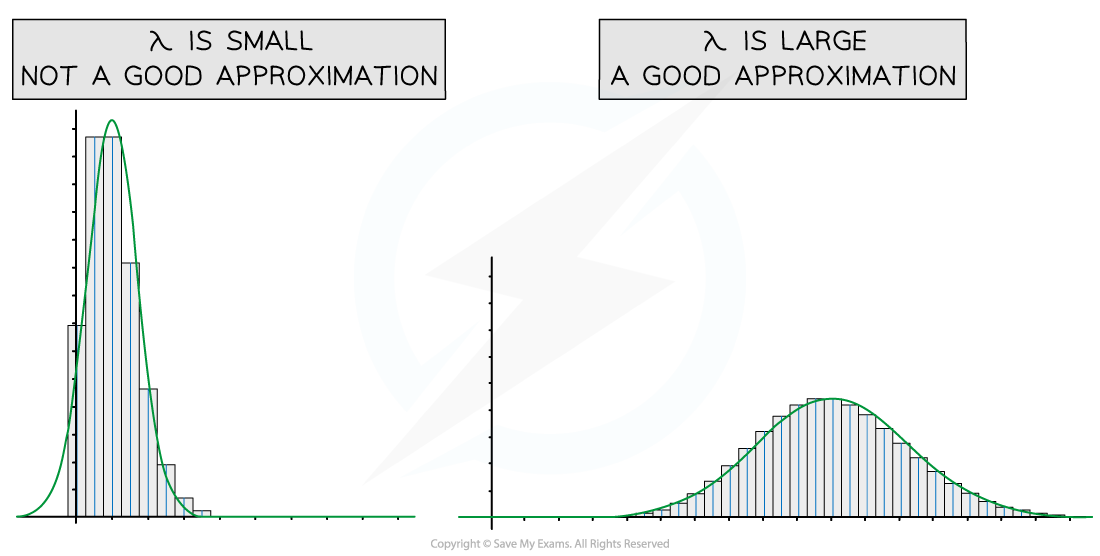
Why do we use approximations?
-
If there are a large number of values for a Poisson distribution there could be a lot of calculations involved and it is inefficient to work with the Poisson distribution
-
These days calculators can find Poisson probabilities so approximations are no longer necessary
-
However it can still be easier to work with a normal distribution
- You can calculate the probability of a range of values quickly
- You can use the inverse normal distribution function (most calculators don't have an inverse Poisson distribution function)
-
How do I approximate a probability?
-
STEP 1: Find the mean and variance of the approximating distribution
-
STEP 2: Apply continuity corrections to the inequality
-
STEP 3: Find the probability of the new corrected inequality
- Find the standard normal probability and use the table of the normal distribution
-
The probability will not be exact as it is an approximation but provided λ is large enough then it will be a close approximation
Worked Example The number of hits on a revision web page per hour can be modelled by the Poisson distribution with a mean of 40. Use a normal approximation to find the probability that there are more than 50 hits on the webpage in a given hour.
Answer:
Exam Hint
- The question will make it clear if an approximation is to be used, λ will be bigger than the values in the formula booklet.
Was this revision note helpful?
Build on this topic