Conditional Probability (Edexcel IAL Maths)
Set Notation
Spec point —
3.2
What is set notation?
-
Set notation is a formal way of writing groups of numbers (or other mathematical entities such as shapes) that share a common feature – each number in a set is called an element of the set
- You should have come across common sets of numbers such as the natural numbers, denoted by , or the set of real numbers, denoted by
-
In probability, set notation allows us to talk about the sample space and events within in it
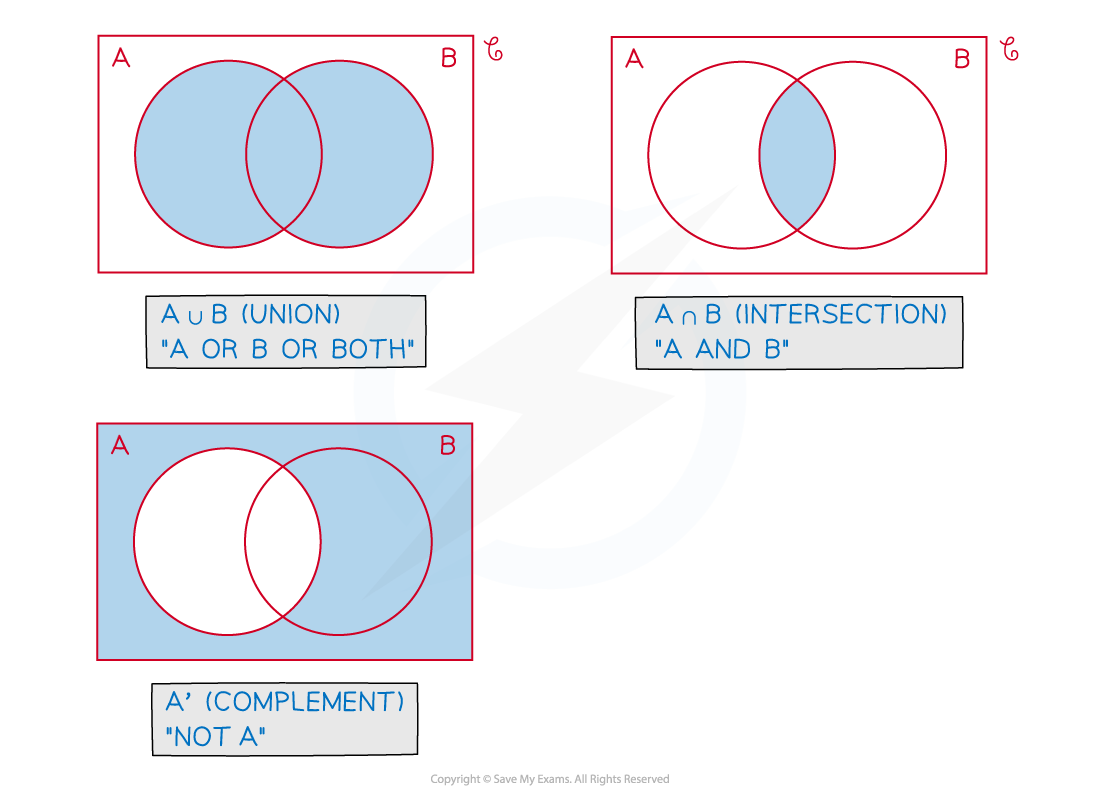
- S, U, , are common symbols used for the Universal set In probability this is the entire sample space, or the rectangle in a Venn diagram
- Events are denoted by capital letters, A, B, C etc
- The events“ ”, “”, “” are denoted by etc (Strictly pronounced “A prime” but often called “A dash”) is called the complement of A
-
In probability we are often looking at combined events
-
The event A and B is called the intersection of events A and B , and the symbol ∩ is used i.e. A and B is written as
- On a Venn diagram this would be the overlap between the bubble for event A and the bubble for event
- From Basic Probability, for independent events
-
-
The event A or B is called the union of events A and B , and the symbol is used i.e. A or B is written as
- On a Venn diagram this would be both the bubbles for event A and event B including their overlap (intersection)
- From Basic Probability, for mutually exclusive events
-
The other set you may come across in probability is the empty set The empty set has no elements and is denoted by
-
The intersection of mutually exclusive events is the empty set,
-
And finally,
How do I find probabilities from sets?
-
Recognise the notation and symbols used and then interpret them in terms of AND (), OR () and/or NOT (‘) statements
-
Venn diagrams lend themselves particularly well to deducing which sets or parts of sets are involved- draw mini-Venn diagrams and shade them
-
Practice shading various parts of Venn diagrams and then writing what you have shaded in set notation
-
With combinations of union, intersection and complement there may be more than one way to write the set required
- e.g. Not convinced? Sketch a Venn diagram and shade it in!
- In such questions it can be the unshaded part that represents the solution
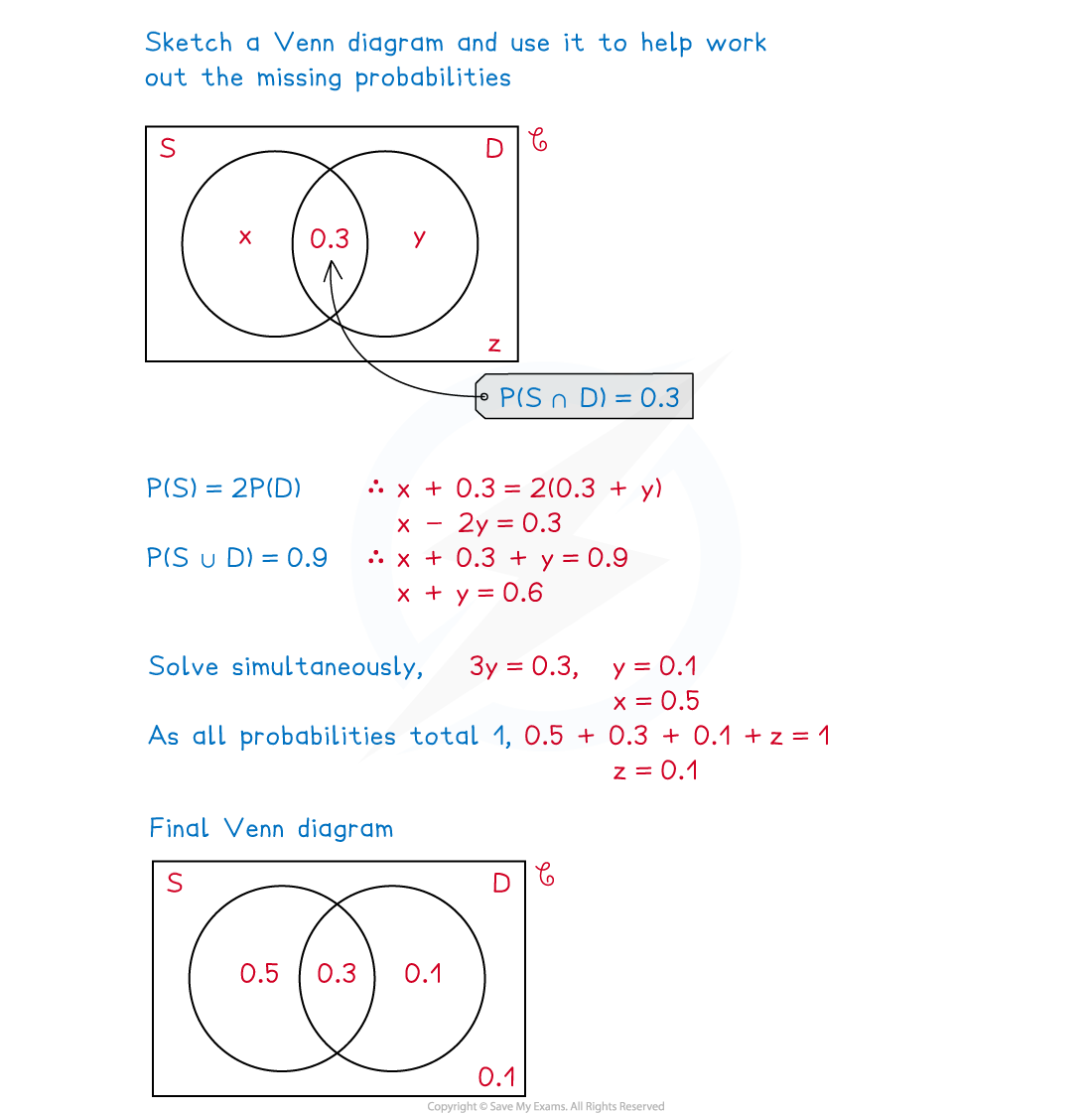
Worked Example The members of a local tennis club can decide whether to play in a singles competition, a doubles competition, both or neither.
Once all members have made their choice the chairman of the club selects, at random, one member to interview about their decision.
is the event a member selected the singles competition.
is the event a member selected the doubles competition.
Given that and , find
(i)
(ii)
(iii)
(iv)
Answer:
Exam Hint
- Do not try to do everything using a single diagram – whether given one in the question or using your own; use mini-Venn diagrams and shading for each part of a question
- Do double check whether you are dealing with union () or intersection () (or both) – when these symbols are used several times near each other in a question, it is easy to get them muddled up or misread them
Conditional Probability
Spec point —
3.2
What is conditional probability?
-
Conditional probability is where the probability of an event happening can vary depending on the outcome of a prior event
-
You have already been using conditional probability e.g. drawing more than one counter/bead/etc from a bag without replacement
- Note that, mathematically, that drawing one, not replacing then drawing another is the same as drawing two at the same time.
-
Consider the following example
- e.g. Bag with 6 white and 3 red buttons. One is drawn at random and not replaced. A second button is drawn. The probability that the second button is white given that the first button is white is .
-
The key phrase here is “given that” – it essentially means something has already happened.
- In set notation, “given that” is indicated by a vertical line ( |) so the above example would be written
text P( end text right 2 ^ nd is white 1 ^ st is white ) = 5 / 8 - There are other phrases that imply or mean the same things as “given that”
- In set notation, “given that” is indicated by a vertical line ( |) so the above example would be written
-
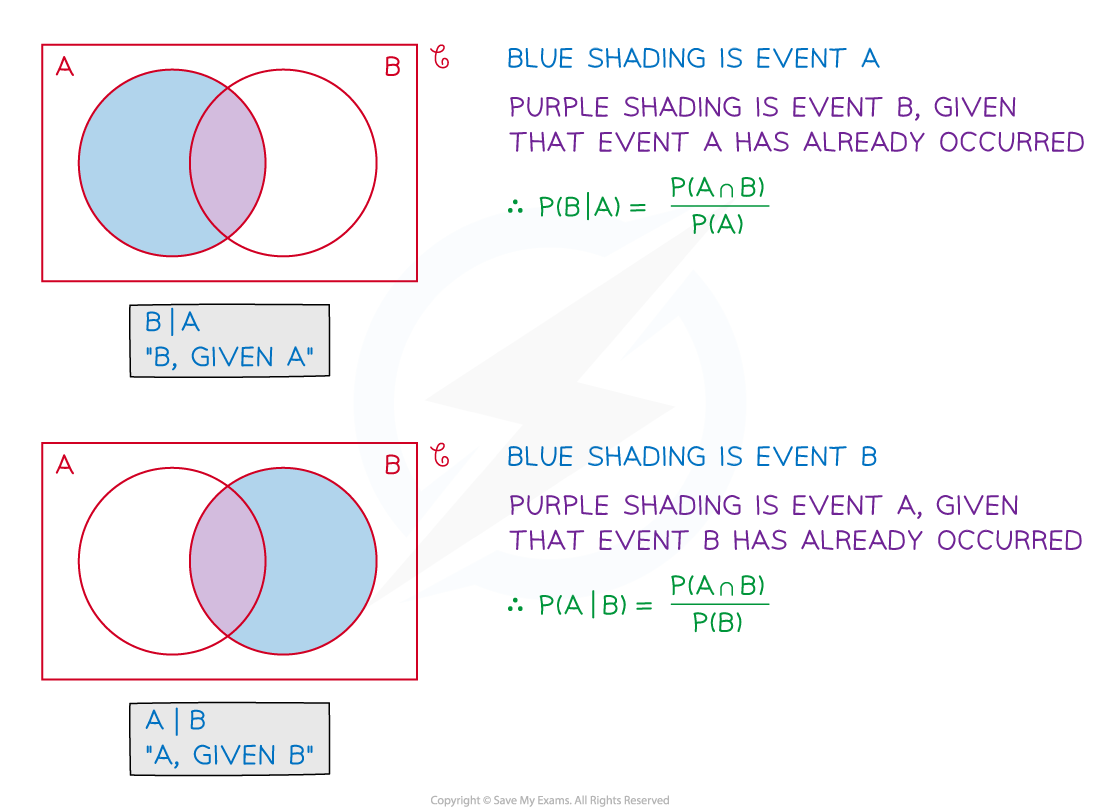
Venn diagrams are helpful again but beware – the denominator of fractional probabilities will no longer be the total of all the frequencies or probabilities shown
- “given that” questions usually reduce the sample space as an event (a subset of the outcomes of the first event) has already occurred
-
The diagrams above also show two more conditional probability results
- These are essentially the same as letters are interchangeable
-
For independent events we know so
P ( B | A ) = (-- P ( A ) x P ( B ))/(-- P ( A ) ) = text P end text ( B )
-
and similarly
-
The independent result should make sense logically – if events A and B are independent then the fact that event B has already occurred has no effect on the probability of event A happening
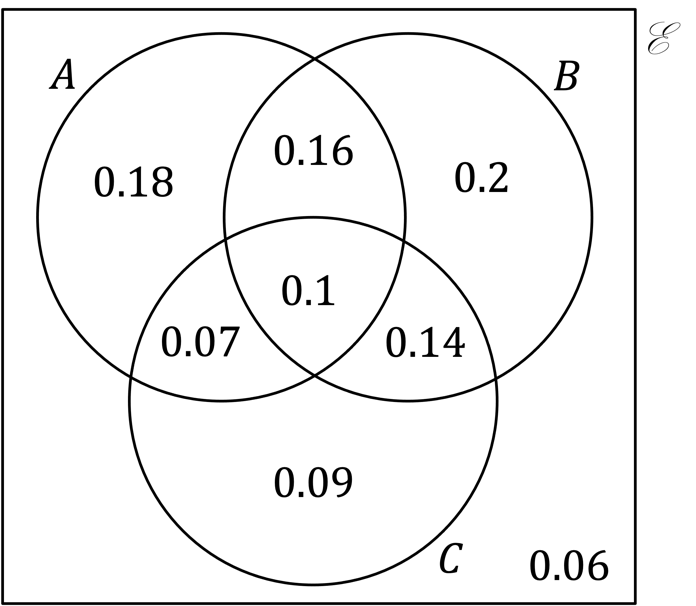
Worked Example The Venn diagram below illustrates the probabilities of three events, .
(a) Find
(i)
(ii)
(iii)
(b) Show, in two different ways, that the events and are independent.
Answer:

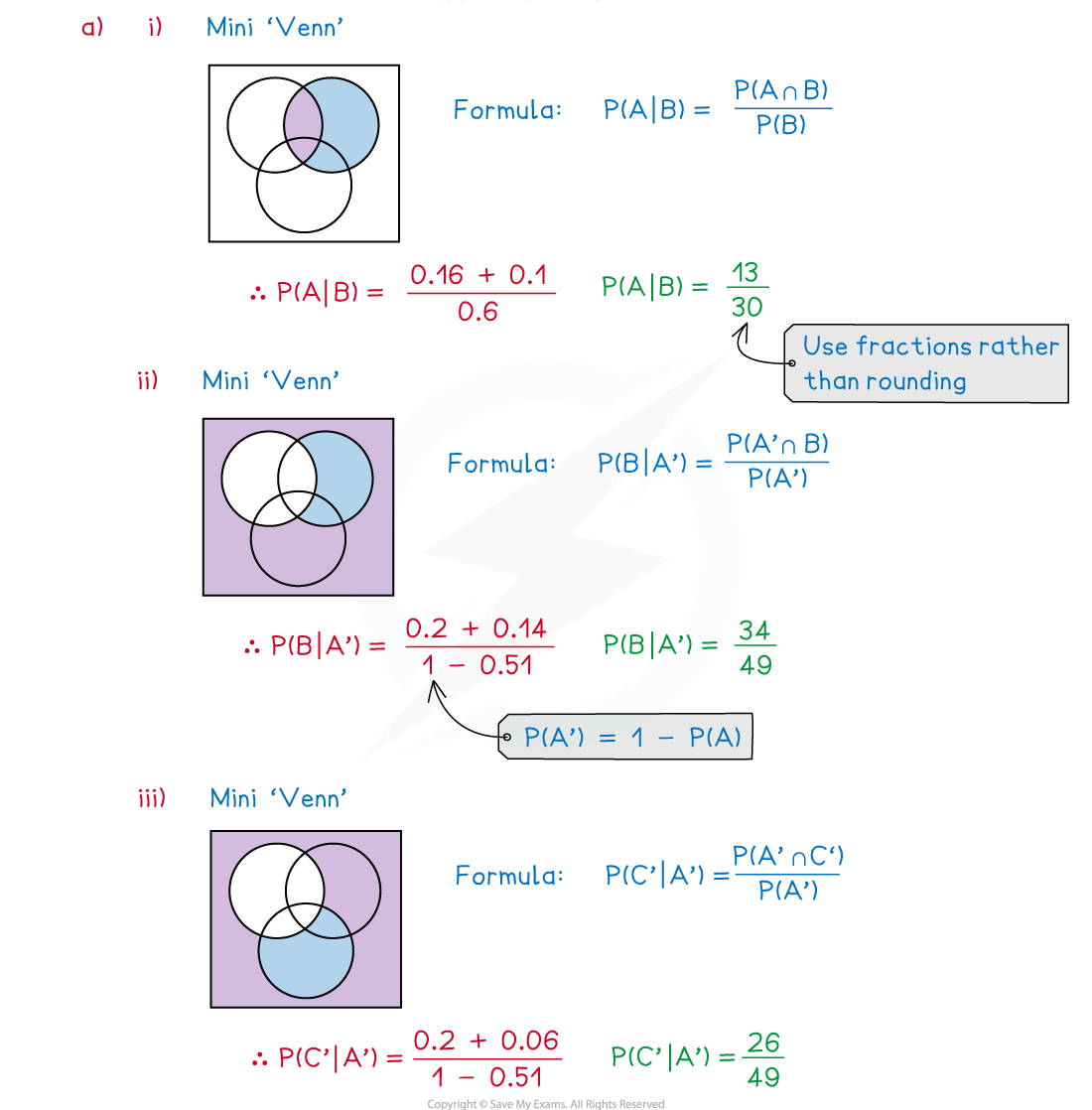
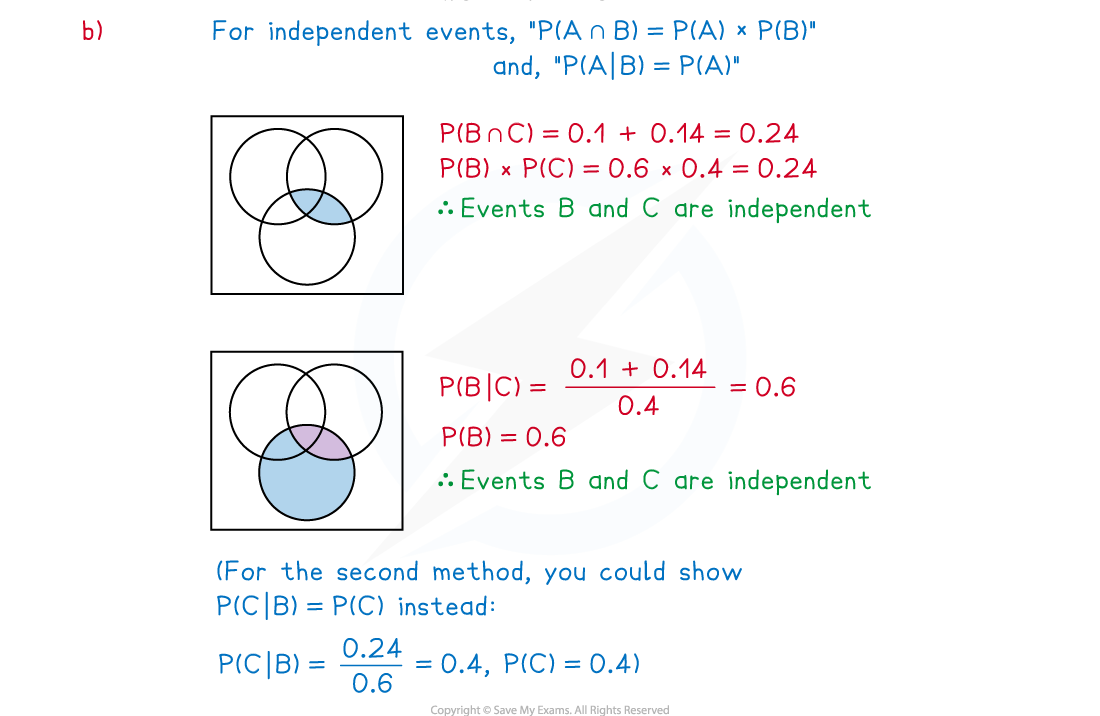
Exam Hint
There are now several symbols used from set notation in probability – make sure you are familiar with them
- union ()
- intersection ( )
- not(‘)
- given that( | )
If given a Venn diagram with all the separate probabilities you may find it easier to work out P(A), P(B) etc first
Two-Way Tables
Spec point —
3.2
What are two-way tables?
- In probability, two-way tables list the frequencies for the outcomes of two events – one event along the top (columns), one event down the side (rows)
- The frequencies, along with a “Total” row and “Total” column instantly show the values involved in finding probabilities
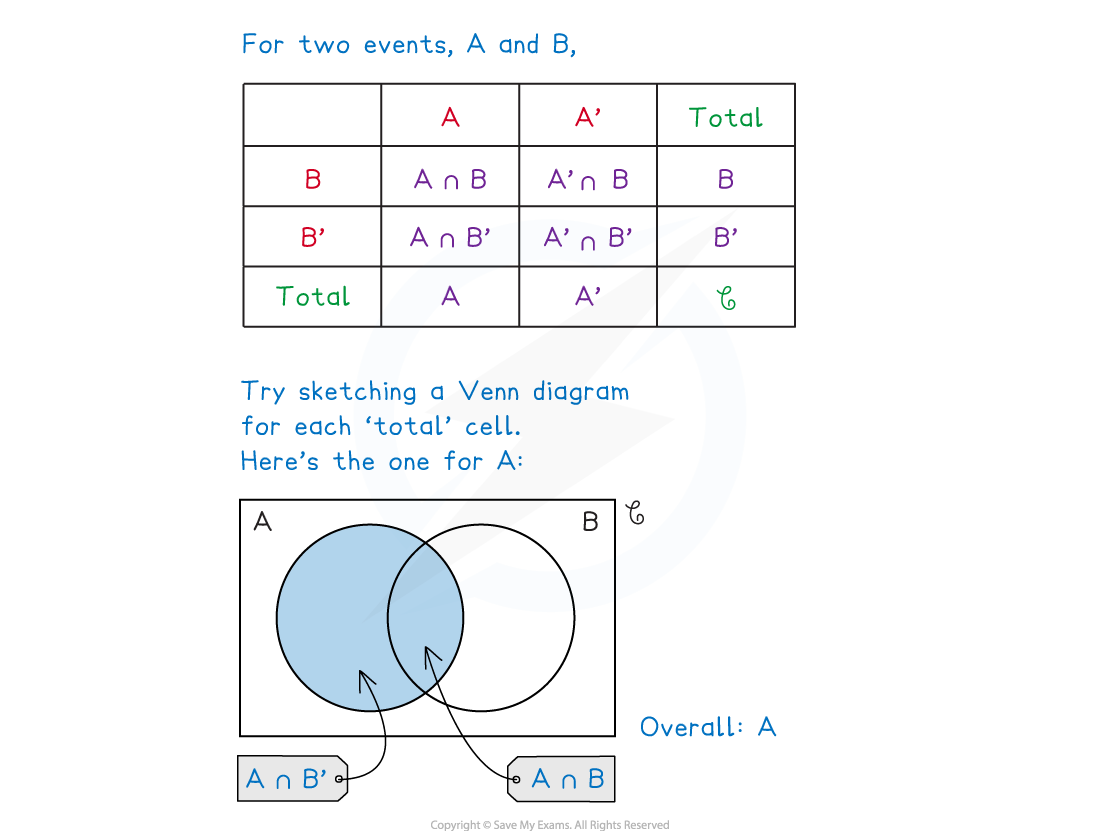
How do I find probabilities from two-way tables?
-
Questions will usually be wordy – and may not even mention two-way tables
- Questions will need to be interpreted in terms of AND ( , intersection), OR (, union), NOT (‘) and GIVEN THAT ( | )
-
Complete as much of the table as possible from the information given in the question
- If any empty cells remain, see if they can be calculated by looking for a row or column with just one missing value
-
Each cell in the table is similar to a region in a Venn diagram
-
With event A outcomes on columns and event B outcomes on rows
- (intersection, AND) will be the cell where outcome meets outcome
- (union, OR) will be all the cells for outcomes and including the cell for both
-
Beware! As union includes the cell for both outcomes, avoid counting this cell twice when calculating frequencies or probabilities
-
(see Worked Example Q(b)(ii))
-
-
You may need to use the results
- (for independent events)
Worked Example The incomplete two-way table below shows the type of main meal provided by 80 owners to their cat(s) or dog(s).
Dry Food Wet Food Raw Food Total Dog 11 8 Cat 19 33 Total 21 (a) Complete the two-way table
(b) One of the 80 owners is selected at random. Find the probability
(i) the selected owner has a cat and feeds it raw food for its main meal.
(ii) the selected owner has a dog or feeds it wet food for its main meal.
(iii) the owner feeds raw food to its pet, given it is a dog.
(iv) the owner has a cat, given that they feed it dry food.
Answer:
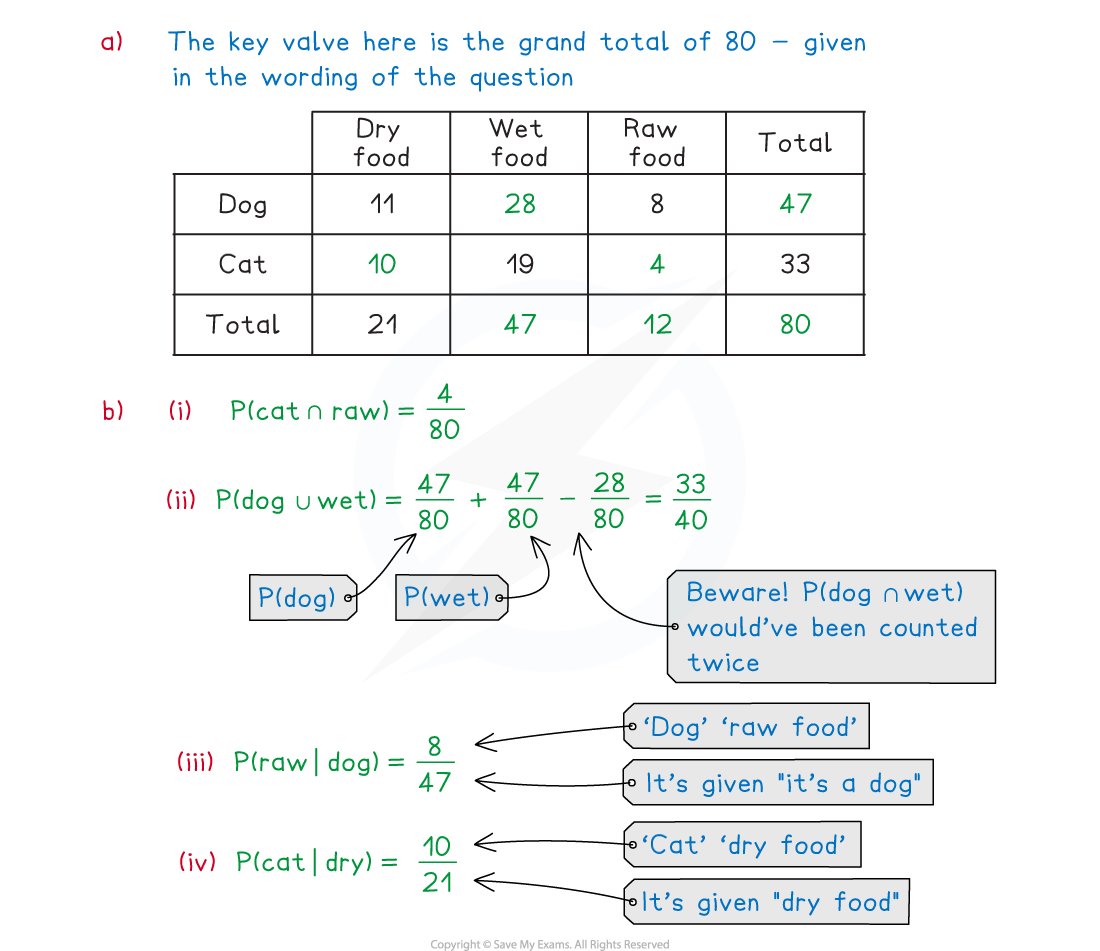
Exam Hint
- Ensure any table – given or drawn - has a “Total” row and a “Total” column
- Do not confuse a two-way table with a sample space diagram – a two-way table does not necessarily display all outcomes from an experiment, just those (events) we are interested in
Was this revision note helpful?
Build on this topic