17 marksvery_hard
Given that , express as partial fractions.
14 questions · 82 marks · ≈ 1 hour · spans 12 of 12 topics
Assembled from the topic question banks — not an official Edexcel paperGiven that , express as partial fractions.
Find, in ascending powers of , the binomial expansion of
up to and including the term in .
A cone, stood on its vertex, of radius 3 cm and height 9 cm, is being filled with sand at a constant rate of 0.2 cm3s-1.
Find the rate of change of the depth of sand in the cone at the instant the radius of the sand is 1.2 cm.
An ellipse has equation
Find an expression for and hence show that the gradient of the ellipse at any point where it meets a line of the form is independent of x and y.
Show that the general solution to the differential equation
is
where A and *k *are constants.
On separate diagrams sketch a graph of the solution for in the instances when
(i) the constant k is greater than 0,
(ii) the constant k is less than 0.
On both diagrams state where the graph intercepts the y-axis.
You may assume in both cases.
The diagram below shows the region R, bounded by the straight lines with equations y = 2x + 1, x =2, x =4 and the x-axis.
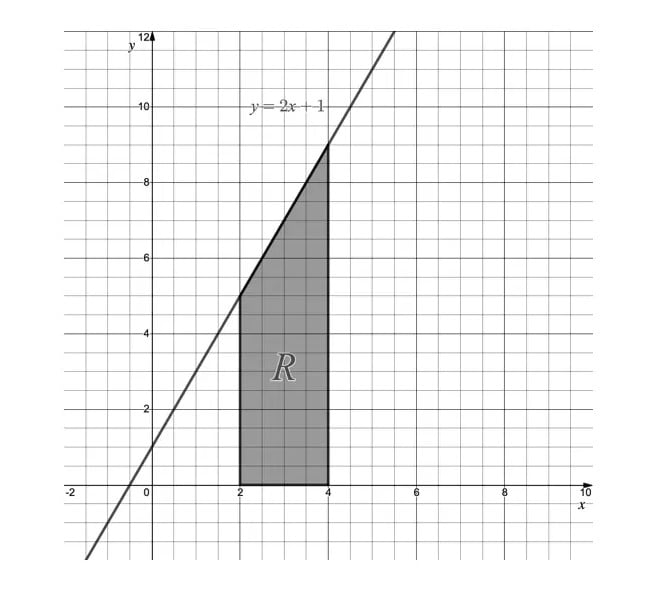
(i) For y = 2x + 1, show that y2 = 4x2 + 4x + 1.
(ii) Find the volume of the solid formed when the region R is rotated 360° around the x-axis.
The graph of the curve C shown below is defined by the parametric equations
x = 2 cos 3 y = 5 sin 0 ≤ ≤ 2
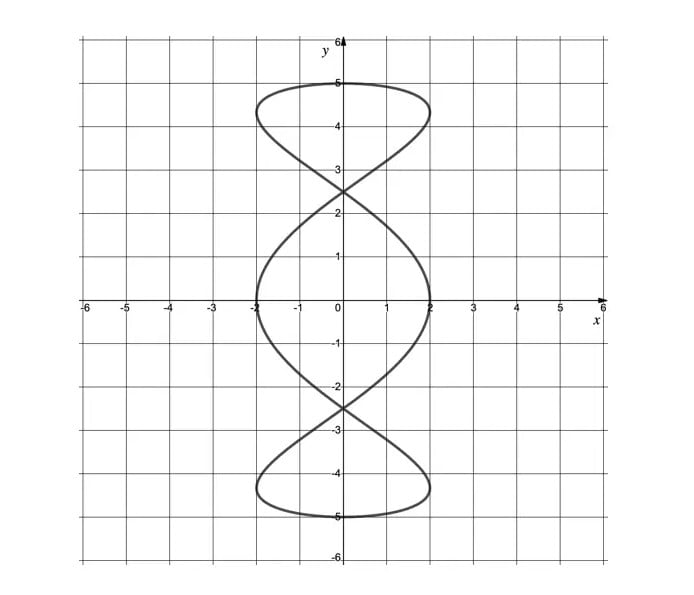
Find an expression for in terms of .
(i) Show that the gradient of the tangent to C, at the point where , is .
(ii) Hence find the equation of the tangent to C at the point where .
A company’s logo is created using an arc of a circle as shown in the diagram below.
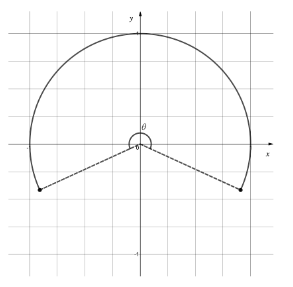
When the end points of the arc are joined to the origin, they form the major sector of a circle with angle radians at the centre.
The arc is formed using the parametric equations
with domain
Find the size of the angle , as well as the length of the arc used in the logo.
Prove that the difference between two rational numbers is rational.
and are the points on the line with and respectively.
(i) Find the position vectors and .
(ii) By first finding the vector , calculate the modulus .
A ship is searching for a radio buoy whose transmitter has ceased functioning. The ship sets out from point O and heads in the approximate direction of the buoy, travelling at a constant speed of 40 km/h in a direction parallel to the vector . After travelling for ninety minutes the ship has reached point P. At that time, the ship receives a brief transmission from the buoy indicating that the buoy is at a bearing of 210° from the ship. The ship heads on that bearing at the same constant speed, and reaches the buoy at point Q in another 45 minutes. Given that vector , find the exact values of *x *and y.
Given that vector , find the exact values of x and y.
How far was the buoy from the ship, and at what bearing, at the time the ship initially left point O? Give the distance in kilometers, and give your answers correct to 1 decimal place.
Vectors p and q are defined by
Given that p = 2q, find the values of a, b and c.
Write in the form , where and are integers to be found.
Express in partial fractions.
Use the binomial expansion to find the first three terms, in ascending powers of , in each of , , and .
Hence express as the first three terms of a binomial expansion in ascending powers of .
Write down the values of for which your expansion in part (c) converges.