14 markseasy
(i) Factorise .
(ii) Hence, or otherwise, express
as partial fractions.
10 questions · 64 marks · ≈ 64 min · spans 10 of 12 topics
Assembled from the topic question banks — not an official Edexcel paper(i) Factorise .
(ii) Hence, or otherwise, express
as partial fractions.
In the binomial expansion of where , the coefficient of the term is equal to the coefficient of the term.
Show that .
Given further that find the values of and .
The side length, x cm, of a cube increases at a constant rate of 0.1 cm s-1.
(i) Write down the value of , where t is time and measured in seconds.
(ii) Write down a formula for the volume, V cm3, of the cube and hence find.
Use the chain rule to find an expression for in terms of x and hence find the rate at which the volume is increasing when the side length of the cube is 4 cm.
Show that if, then
Find particular solutions to the following differential equations, using the given boundary conditions.
Show that
can be written in the form
Hence find
writing your answer as a single logarithm.
The curve has parametric equations
Find the equation of the normal to at the point where intersects the line
equationequation
A company’s logo is created using an arc of a circle as shown in the diagram below.
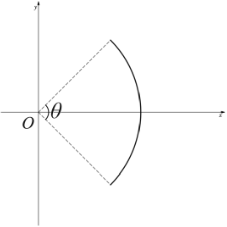
When the end points of the arc are joined to the origin, they form the minor sector of a circle with angle θ radians at the centre.
The arc is formed using the parametric equations and , with domain .
Write down the size of the angle θ.
(i) By finding both and show that .
(ii) Hence write down the radius of the sector.
Use the formula “l = r θ” to find the length of the arc.
Prove by contradiction that the sum of two consecutive integers is odd.
Determine whether each of the following pairs of lines intersect, are parallel, or are skew. If the lines intersect, find the coordinates of the point of intersection.
(i) and
(ii) and .