Name that graph again
Excerpt: Students think about different ways in which they can determine the equation of a parabola given the coordinates of three points on the curve.
Problem
In how many ways can you identify an equation for this parabola?
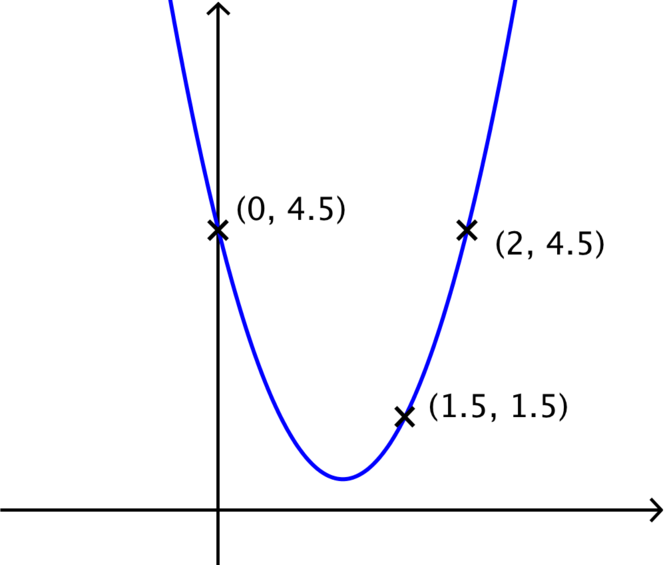
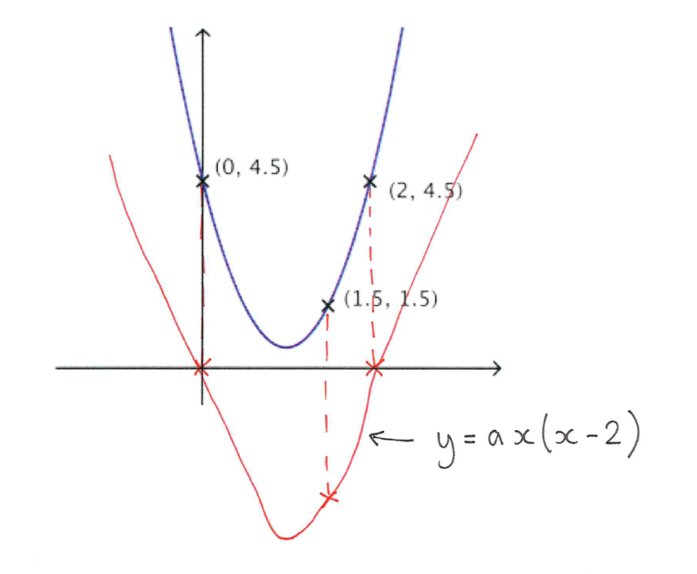
How might considering this diagram help?
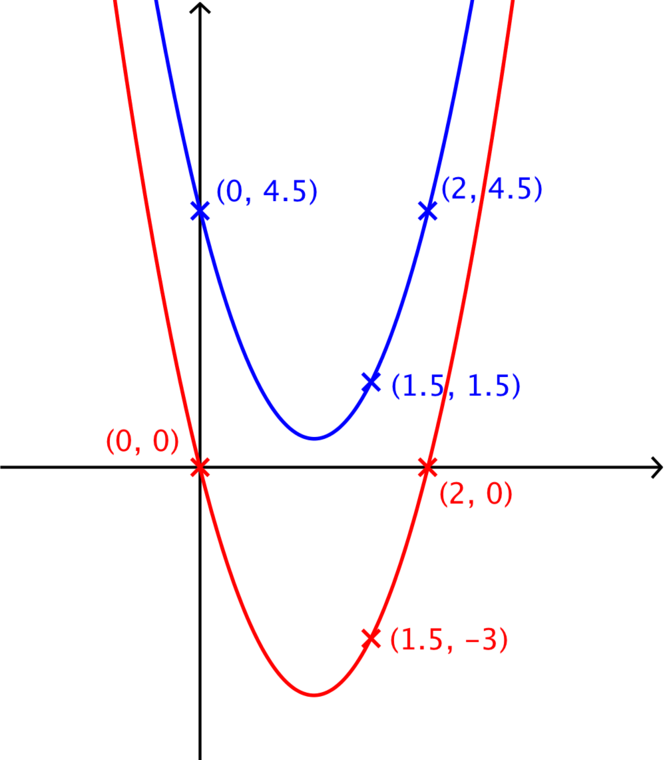
What do you know about the red parabola?
What has the red parabola got to do with the blue one?
Have you thought about…?
Student starting points
In how many ways can you identify an equation for this parabola?
Below you will find four ways in which students have started to tackle this problem. For each approach, try to work out what they were doing and attempt to continue their work to reach a solution.
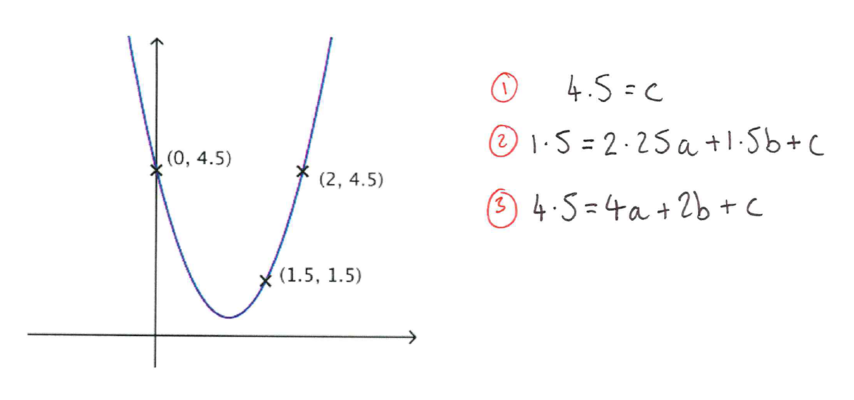
- What is this student doing?
- Why are they doing that?
- What could they do next?
Student 1
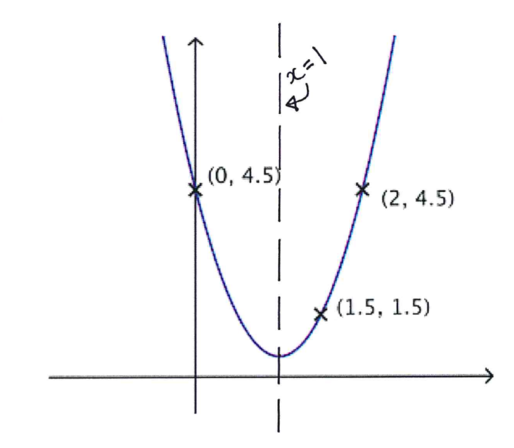
- What is this student doing?
- Why are they doing that?
- What could they do next?
Student 2
- What is this student doing?
- Why are they doing that?
- What could they do next?
Student 3
Student 4 has taken a more unusual approach. This approach is better considered after having explored one or more of the first three starting points.
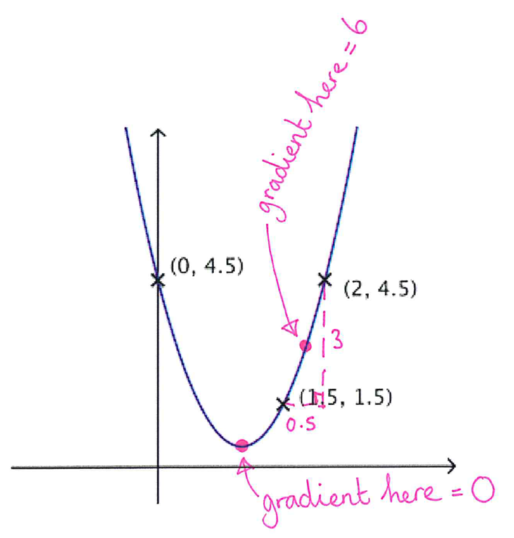
- What is this student doing?
- Why are they doing that?
- What could they do next?
You might like to think about how the approach taken by this student is connected to the ideas in Parabella.
Student 4
Solution
In how many ways can you identify the equation of this parabola?
In Name that graph we thought about the three formats in which we can write a quadratic equation. We explored some of the ways in which the equation of a parabola could be determined in each of these three forms and the relative efficiency of each.
Here we have three coordinates specified on the parabola, but because the graph is not plotted accurately with a background grid, we cannot read any additional points from the diagram.
We could of course go through the laborious process of forming three equations, one from each of the specified points on the parabola, in and solve them simultaneously. This will give an equation in the form .
We can eliminate by doing - so that we have, giving
Substituting the value of back into equation we have and so
The equation of the parabola is therefore
Using each of the three specified coordinates in turn we obtain three equations:
Substituting the value of
from equation
into equations
and
and simplifying we have
Approach 1
We could instead locate the line of symmetry and use this to find the equation of the parabola in completed square form.
We are given two horizontally aligned points on the parabola, and . The line of symmetry will therefore be a vertical line located midway between these two points, i.e. the line .
This means that the parabola can be written in the form
Solving simultaneously, by first eliminating from equation , we have and so
Notice that converting the decimal into a fraction makes it easier to see the solution.
Substituting the value of back into equation we find that .
So we now know that the equation of the parabola is
It is sensible to check that this agrees with the equation obtained from approach .
Expanding we have which simplifies to as expected.
Substituting the points
and
into this equation we have the two equations:
Approach 2
Making use of the diagram in “Have you thought about…” we could find the equation by considering a translation of the original parabola.
We can find the equation of the red parabola in factorised form because we can see the location of the two -intercepts:
Substituting the third point on this translated parabola, into the equation we can find the value of : and so
So the equation of the red, translated parabola is If we call the original blue parabola then the red parabola is .
We now have that Rearranging we have that and then expanding we get So the equation of the blue parabola is as before.
Approach 3