14 markseasy
State whether the following mappings are one-to-one, many-to-one, one-to-many or many-to-many.
(i)
(ii)
(iii)
(iv)
37 questions · 202 marks · ≈ 3 hours
State whether the following mappings are one-to-one, many-to-one, one-to-many or many-to-many.
(i)
(ii)
(iii)
(iv)
State the largest possible domains for the following functions.
(i)
(ii)
(iii)
State the range for the following functions based on the given domains.
(i) f colon x -> from bar e ^ x x in real numbers
(ii)
(iii)
The function is defined as
Sketch the graph of , giving the coordinates of any points where the graph intersects the coordinate axes.
The minimum point on the graph of has -coordinate 4. Find the range of .
The functions and are defined as follows
Find
(i)
(ii)
Solve the equation .
The function is defined as
Find the inverse of , .
Find the domain and range for .
Solve the equation .
On the same diagram, sketch the graphs of and . Label the coordinates of the points where the two graphs intersect each other and the coordinate axes.
Consider the graphs of and , where is a constant.
For which values of …
(i) ... will the two graphs have no points of intersection?
(ii) ... will the two graphs have one point of intersection?
(iii) ... will the two graphs have two points of intersection?
State whether the following mappings are one-to-one, many-to-one, one-to-many or many-to-many.
(i)
(ii)
(iii)
(iv)
The function f(x) is defined as
Sketch the graph of y = f(x) , giving the coordinates of any points where the graph intercepts the coordinate axes and the coordinates of the turning point.
Write down the range of f(x) .
The function f(x) is defined as
Work out the range of f(x) .
If the domain of f(x) is changed to what is the range of f(x)?
The functions f(x) and g(x) are defined as follows
Write down the range of f(x) .
Find
(i)
(ii)
Solve the equation f(x) = g(x).
The graph of y = f(x) is shown below.
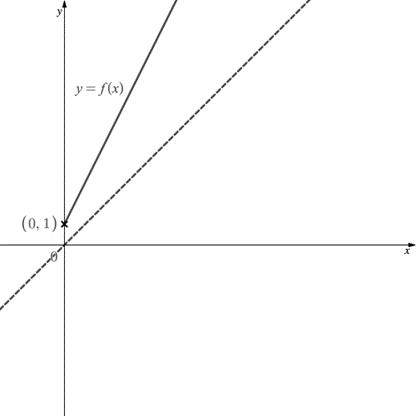
(i) Use the graph to write down the domain and range of f(x).
(ii) Given that the point (1, 1) lies on the dotted line, write down the equation of the line.
On the diagram above sketch the graph of y = f −1(x).
On the same axes, sketch the graphs of y = f(x) and where
Label the points at which the graphs intersect the coordinate axes.
Solve the equation .
The function f(x) is defined as
Show that f(x) can be written in the form
Explain why the inverse of f(x) does not exist and suggest an adaption to its domain so the inverse does exist.
The domain of f(x) is changed to *x > *0. Find an expression for f−1(x) and state its domain and range.
Solve the equation .
The functions f(x) and g(x) are defined as follows
Find
(i)
(ii)
Write down f−1(x) and state its domain and range.
The functions f(x), g(x) are defined as follows
Sketch the graph of y = fg(x) , stating the coordinates of all points where the graph intercepts the coordinate axes.
How many solutions are there to the equation fg(x) = 5 ? How many solutions are there to the equation fg(x) = 9 ?
Write down the solutions to the equation fg(x) = 0.
State whether the following mappings are one-to-one, many-to-one, one-to-many or many-to-many.
(i)
(ii)
(iii)
(iv)
It is given
Write down the domain of the function f(x)
Sketch the graph of* y* = f(x), stating the coordinates of any intersections with the coordinate axes and the equations of any asymptotes.
Write down the range of f(x).
The function f(x) is defined as
Work out the range of f(x) .
If the domain of f(x) is changed to , what is the range of f(x)?
The functions f(x) and g(x) are defined as follows
Write down the range of f(x).
Find
(i) fg(x)
(ii) gf(x)
Solve the equation f(x) = g(x) + 1
The graph of y = f(x) is shown below.
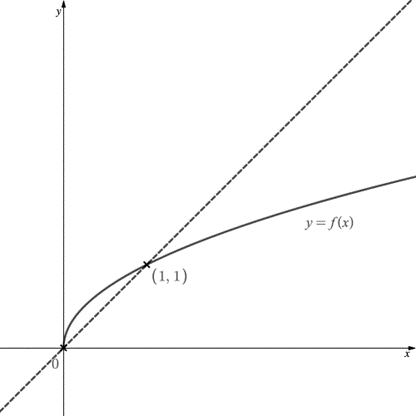
(i) Use the graph to write down the domain and range of f(x) .
(ii) Write down the equation of the dotted line on the graph.
On the diagram above sketch the graph of y = f−1(x) .
On the same axes, sketch the graphs of and where
Label the points at which the graphs intersect the coordinate axes.
Solve the equation .
Which of the solutions to is also a solution to ?
The functions f(x) and g(x) are defined as follows
Find
(i)
(ii)
Write down f−1(x) and state its domain and range.
The graphs of f(x) and f−1(x) are drawn on the same axes. Describe the transformation that would map one graph onto the other.
The functions f(x), g(x) are defined as follows
Sketch the graph of y = gf(x), stating the coordinates of all points where the graph intercepts the coordinate axes.
(i)
How many solutions are there to the equation gf(x) = 1?
(ii) How many solutions are there to the equation gf(x) = 10?
Solve the equation gf(x) = 2.
Solve the equation , giving your answers in exact form.
State whether the following mappings are one-to-one, many-to-one, one-to-many or many-to-many.
(i)
(ii)
(iii)
(iv)
It is given
Write down the domain and range of the function f(x).
Sketch the graph of y = f(x), stating the coordinates of any intersections with the coordinate axes. (You do not need to give the coordinates of any turning points.)
The function f(x) is defined as
Work out the range of f(x).
If the domain of f(x) is changed to , what is the range of f(x)?
State another domain for f(x) that would have the same effect as that in part (b).
The functions f(x) and g(x) are defined as follows
Write down the range of f(x).
Leaving your answers as single fractions, find
(i) fg(x)
(ii) gf(x)
Solve the equation f(x) = g(x)
The graphs of *y *= f(x) and y = x (dotted line) are shown in the diagram below.
has rotational symmetry about the origin and for ,there is a vertical line line of symmetry at .
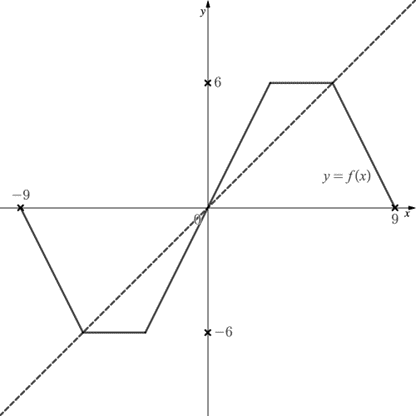
(i) Use the graph to write down the domain and range of .
(ii) On the diagram above sketch the reflection of in the line and explain why this cannot be the graph of .
(i) Given that the maximum solution to . is state the restriction on the domain of such that exists.
(ii) Hence, or otherwise, write down the domain and range of .
On the same axes, sketch the graphs of y = f(x) and where
Label the points at which the graphs intersect the coordinate axes.
Solve the equation
Which of the solutions to is not a solution to f(x) = g(x) ?
The function f(x) is defined as
Explain why the inverse of f(x) does not exist.
Suggest an adaption to the domain of f(x) so the following conditions are met:
State the range for your adapted f(x).
The domain of f(x) is changed to . Find an expression for and state its domain and range.
The functions f(x) and g(x) are defined as follows
Find
(i) fg(x)
(ii) gf(x)
Write down and state its domain and range.
The graphs of f(x) and are drawn on the same axes. Describe the transformation that would map one graph onto the other.
Find the coordinates of the point where the graphs of y = f(x) and meet.
The graph of the function is shown below, where . The graph has a local maximum at the point A(3, 5) and intersects the -axis at (0,-7).
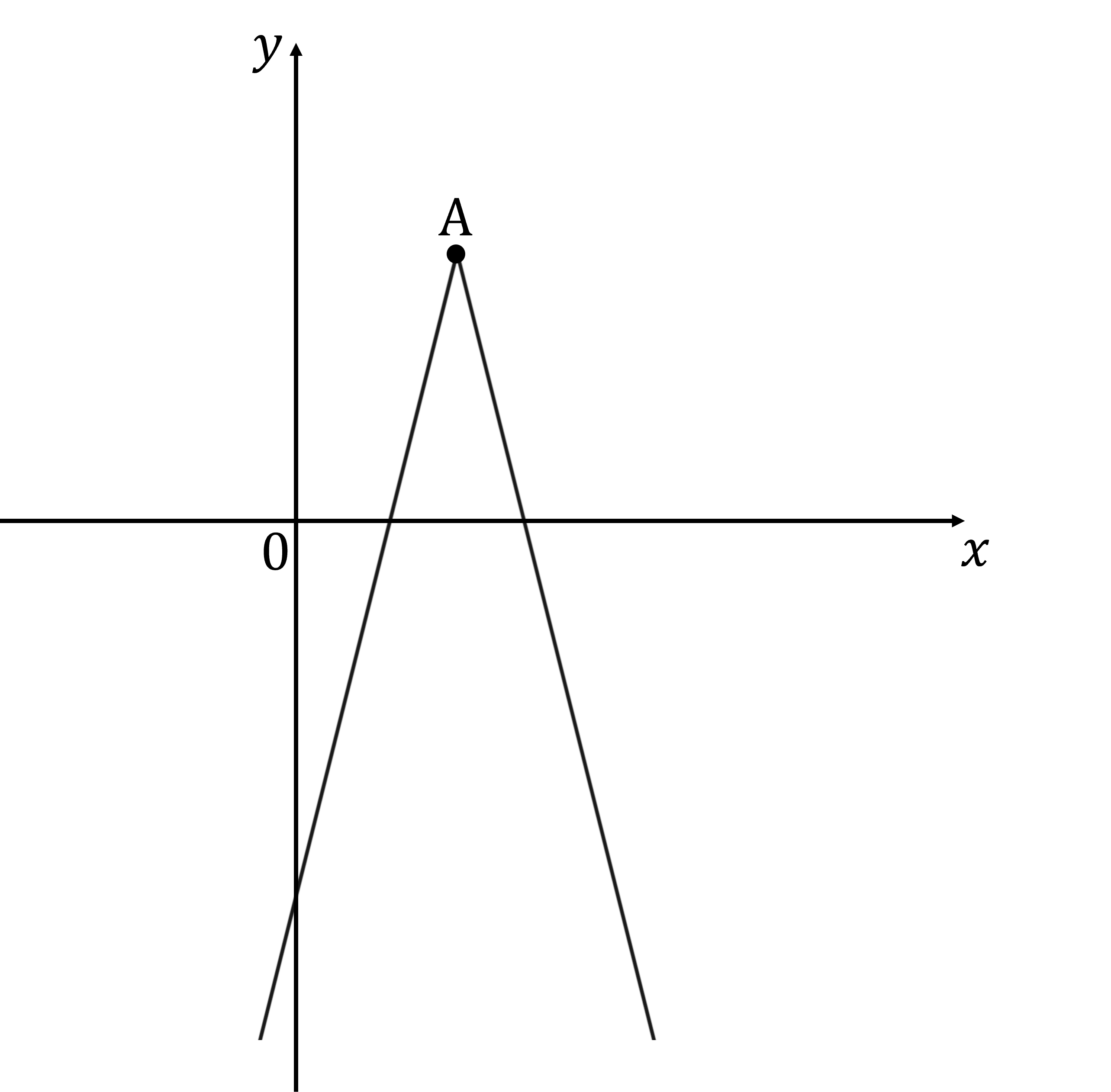
Find the values of and Hence solve .
Find the solutions to the equation .
The functions f(x), g(x) are defined as follows
Sketch the graph of y = fg(x), stating the coordinates of all points where the graph intercepts the coordinate axes.
There are between 0 and 4 solutions to the equation fg(x) = c , where c is a real number. Determine the values of c that produce each number of solutions.
Solve the equation , giving your answers in exact form.