13 markseasy
Sketch the graph with equation , stating the coordinates of the point where the graph intersects the -axis and the equation of any asymptotes.
Also state whether this equation would represent exponential growth or decay.
52 questions · 216 marks · ≈ 4 hours
Sketch the graph with equation , stating the coordinates of the point where the graph intersects the -axis and the equation of any asymptotes.
Also state whether this equation would represent exponential growth or decay.
The following equations can be used for exponential models.
State whether each one would represent exponential growth or exponential decay.
(i)
(ii)
(iii) where
Sketch the graph of , clearly showing the coordinates of the point where the graph intercepts the -axis and stating the equations of any asymptotes.
Given :
(i) Write down an expression for .
(ii) Find the gradient of at the point where .
Solve the equation , giving your answer in the form where is an integer.
Write the following in the form where and are integers to be found.
(i)
(ii)
(iii)
(iv)
Solve the following equations, giving your answer in exact form.
(i)
(ii)
A square has side length .
Show that the perimeter of the square is .
Write the following in the form , where and are integers to be found.
Write down the value of
(i)
(ii)
(iii)
(iv)
Express 42 as a product of its prime factors.
Hence, or otherwise, show that
Sketch the graph of marking clearly the coordinates of any points where the graph intersects the coordinate axes ans stating the equation of any asymptotes.
Sketch the graph of , stating whether this graph indicates exponential growth or exponential decay.
Find the exact value of when .
Write down the value of in the following statements.
(i)
(ii)
(iii)
(iv)
On the same axes, sketch the graphs of and . Label any points where the graphs intersect the coordinate axes.
Write down the equations of any asymptotes.
Write down the gradient of at the point .
Given write down an expression for .
Given write down an expression for .
Find the gradient of at the point where . Give your answer in the form , where and are integers to be found.
(i) Write down the gradient of .
(ii) Find the gradient of at the point where .
(i) In terms of , write down the gradient of at the point where .
(ii) Find the value for for which the gradient of is .
The function is defined by for
(i) Find .
(ii) On the same axes, sketch the graphs of and .
Label any points where the graphs intersect the coordinate axes.
Describe the transformation from to .
Solve , giving your answers to 3 significant figures.
Evaluate
Evaluate
giving your answer in the form where is an integer to be found.
Solve the following equations, giving your answers in exact form.
Write the following as a single algorithm
Write the following in the form where and are integers to be found.
The diagram below shows the length of three sides of a triangle, with each side measured in centimetres.
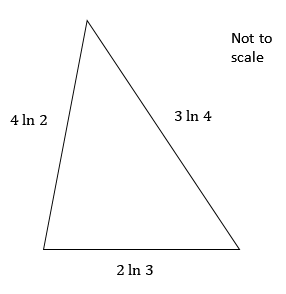
Work out the perimeter of the triangle, giving your answer in the form 2, where is an integer to be found.
Show that
(i) On the same axes, sketch the graphs of and .
Label any points of intersection between each graph and the coordinates axes.
Write down the equations of any asymptotes.
(ii) Write down the equation of the line of reflection between the graphs of and .
(i) Sketch the graph of .
(ii) State whether this graph indicates exponential growth or exponential decay.
Find the value of when .
Sketch the graph of for . Label any points of intersection with the coordinate axes. Write down the equations of any asymptotes.
Write down the gradient of at the point where .
The function is defined by for .
Find .
Find .
Solve , giving your answer to 3 significant figures.
Find the gradient of the curve , where and and are constants.
At the point the gradient is 12, find in terms of .
Hence write down y in terms of (and ) only.
Show that the equation has only one real solution.
Explain why the equation has no real solutions.
Evaluate
Evaluate
giving your answer in the form
Solve the following equations, giving your answers in exact form.
Simplify
giving your answer in the form , where and are integers to be found.
Write
as a single algorithm.
(i) On the same axes, sketch the graphs of and
On each graph, label any points where the graph intersects the coordinate axes.
Write down the equations of any asymptotes for each graph.
(ii) Write down the line of reflection between the graphs and
Solve the equations
giving your answer in the form where and are integers to be found.
A ship sets from a harbour.
After some time, the ship's position is east of the harbour and north of the harbour.
Find the direct distance between the ship and the harbour at this time giving your answer in the form .
By writing as show that
can be written as .
Sketch the graph of , stating whether this graph indicates exponential growth or exponential decay.
Find the value of when .
Without using a calculator, evaluate . Show each stage of your solution carefully.
Evaluate .
Sketch the graph of for .
Label any points of intersection with the coordinate axes. Write down the equations of any asymptotes.
Find the gradient of at the point where , giving your answer correct to 3 significant figures.
The population growth of population, , at time, t years, is modelled by the equation .
. Write down the initial population.
The function is defined by for .
Find .
Find .
Find the gradient of the curve where and are constants.
State a condition on to ensure represents exponential decay.
At the point the gradient is 10. Find in terms of (and ) only.
A particle is travelling with velocity, ms-1, at time seconds. The velocity of the particle is modelled , where is a constant.
Write down the initial velocity of the particle.
Find an expression (in terms of and ) for the acceleration of the particle.
After 12 seconds the velocity of the particle is 0.9 ms-1. Find the value of , giving your answer to 3 significant figures.
State a problem with the model for large values of
Solve .
Solve the equation , giving answers to 3 significant figures where appropriate.
Evaluate
Evaluate
giving your answer in the form .
Solve the following equations, giving your answers correct to 3 significant figures.
On the same axes, sketch the graphs of and
On each graph, label any point where intersects the coordinate axes.
Write down the equations of any asymptotes for each graph.
Explain the significance of the line
Show that can be written in the form ().
A triangle is drawn inside a circle such that one side of the triangle is the diameter and all three vertices of the triangle lie on the circumference.
The radius of the circle is .
The two smallest angles in the triangle are and respectively where .
Find all three sides of the triangle, giving your answers in the form
How many real solutions does the equations have? Justify your answer.