Quadratic Trigonometric Equations (Edexcel IAL Maths)
Exam board Pearson Edexcel · IALUpdated 2026-07-02
Spec point —
6.2
Quadratic trigonometric equations
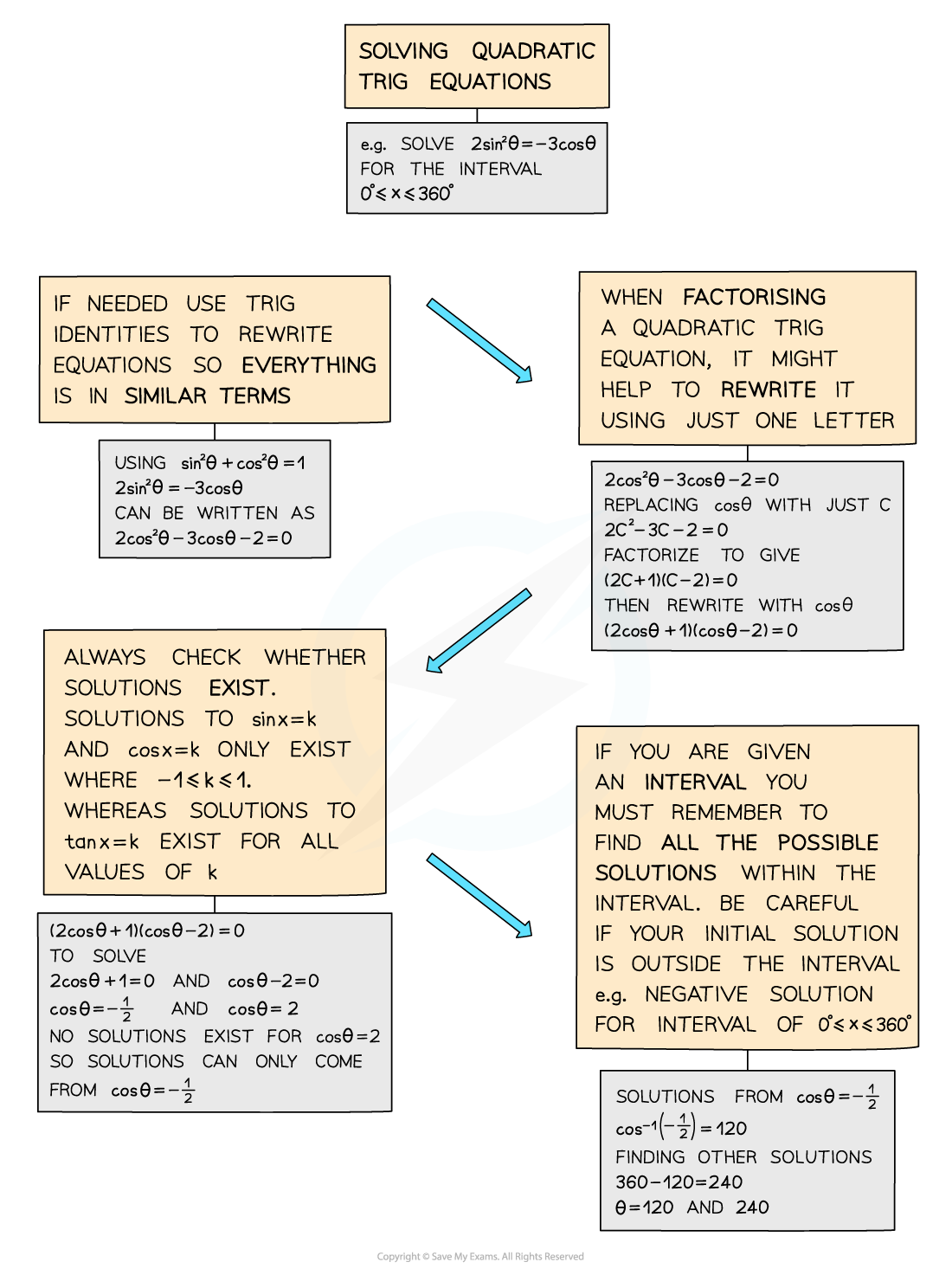
How do I solve quadratic trigonometric equations?
-
If an equation involves sin2θ or cos2θ then it is a quadratic trigonometric equation
-
These can be solved by factorising and/or using trigonometric identities(see Trigonometry – Simple Identities)
-
As a quadratic can result in two solutions, you will need to consider whether each solution exists and then find all solutions within a given interval for each
-
You may be asked to use degrees or radians to solve trigonometric equations
-
Make sure your calculator is in the correct mode
-
Remember common angles
- 90° is ½π radians
- 180° is π radians
- 270° is 3π/2 radians
- 360° is 2π radians
-
Exam Hint
- Sketch the appropriate sin, cos, tan graph to ensure you find ALL solutions within the given interval, and be super-careful if you get a negative solution but have a positive interval.
- For example, for an equation, in the interval 0° ≤ x ≤ 360°, with solution sin x = ‑¼ then sin‑1(‑¼) = -14.5 (to 1d.p.), which is not between 0 and 360 – by sketching the graph you’ll be able to spot the two solutions will be 180 + 14.5 and 360 ‑ 14.5.
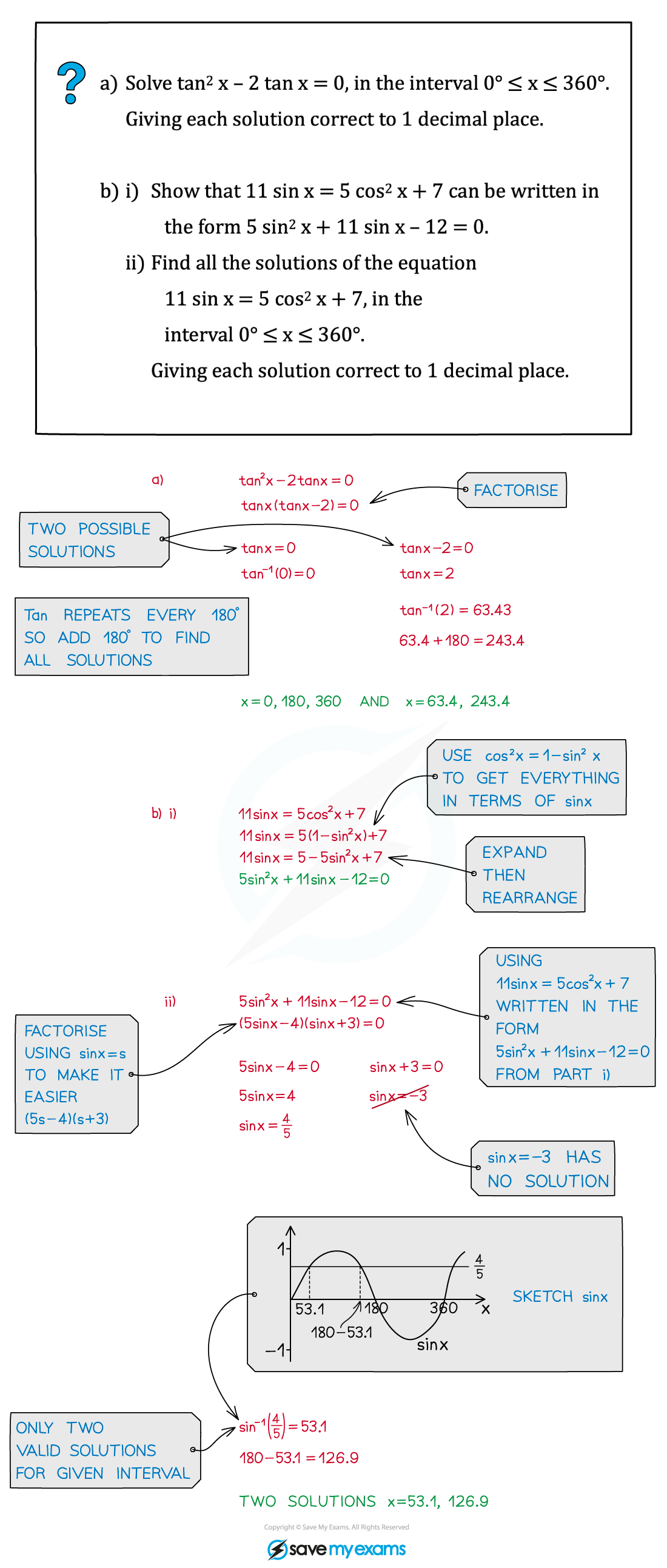
Worked Example
Was this revision note helpful?
Build on this topic