Increasing & Decreasing Functions (Edexcel IAL Maths)
Exam board Pearson Edexcel · IALUpdated 2026-07-02
Spec point —
4.3
Increasing & decreasing functions
What are increasing and decreasing functions?
-
A function f(x) is increasing on an interval [a, b] if f'(x) ≥ 0 for all values of x such that a< x< b.
- If f'(x) > 0 for all x values in the interval then the function is said to be strictly increasing
- In most cases, on an increasing interval the graph of a function goes up as x increases
-
A function f(x) is decreasing on an interval [a, b] if f'(x) ≤ 0 for all values of x such that a< x< b
- If f'(x) < 0 for all x values in the interval then the function is said to be strictly decreasing
- In most cases, on a decreasing interval the graph of a function goes down as x increases
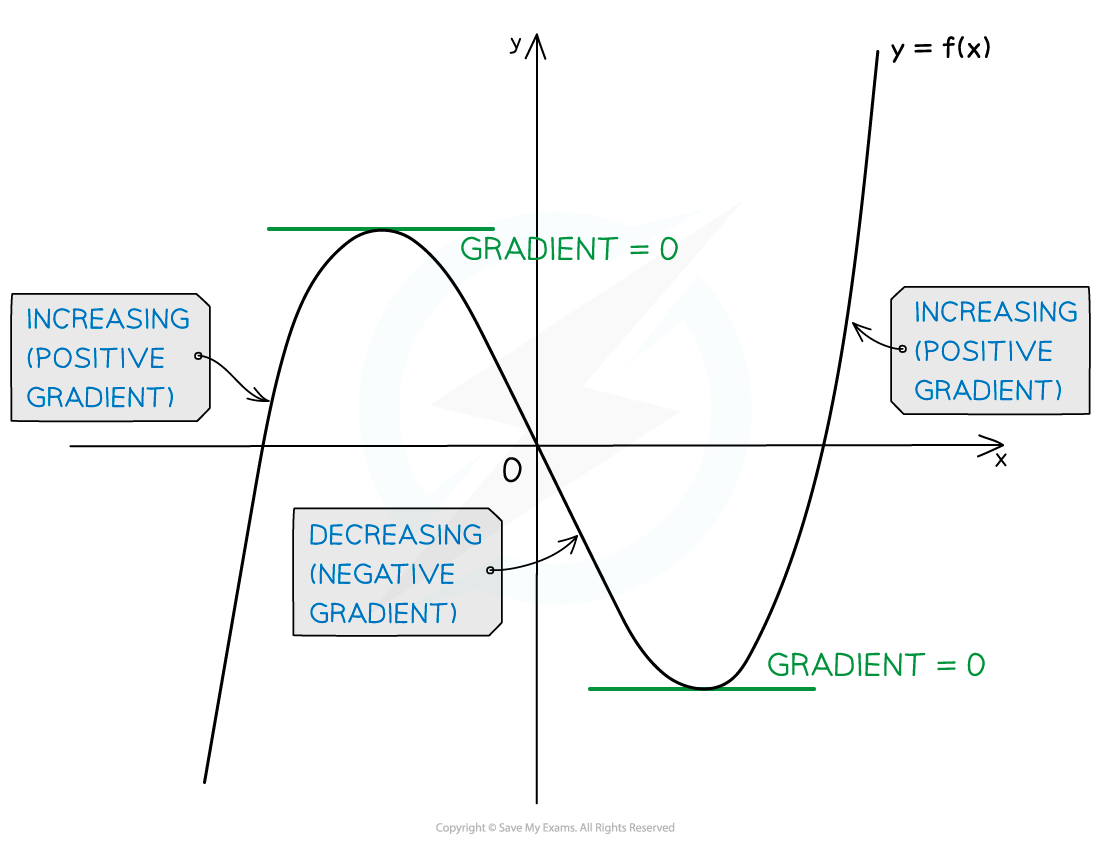
- To identify the intervals on which a function is increasing or decreasing you need to:
- Find the derivative f'(x)
- Solve the inequalities f'(x) ≥ 0 (for increasing intervals) and/or f'(x) ≤ 0 (for decreasing intervals)
Exam Hint
- On an exam, if you need to show a function is increasing or decreasing you can use either strict (<, >) or non-strict (≤, ≥) inequalities
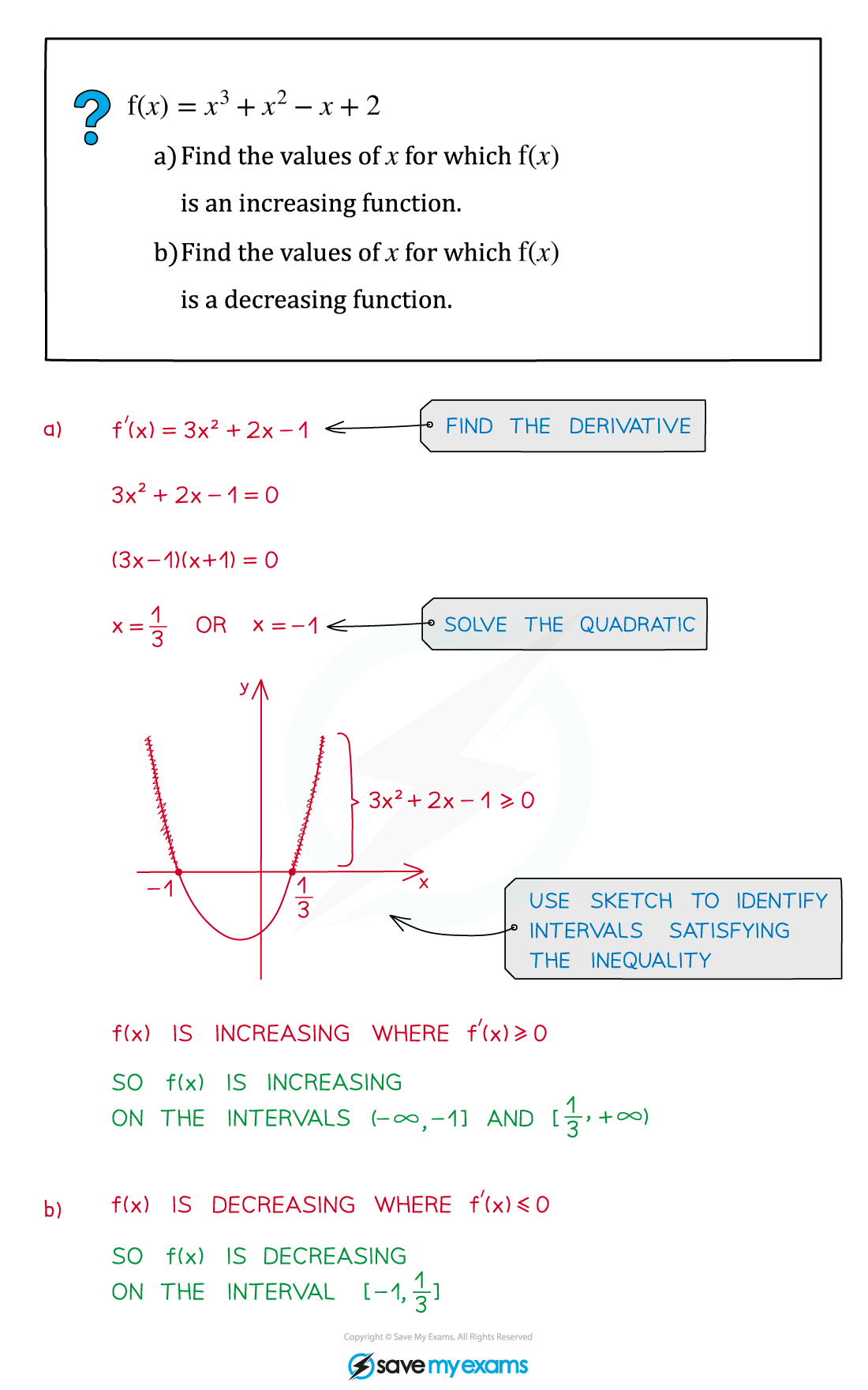
Worked Example
Was this revision note helpful?
Build on this topic