Big trig
Excerpt: This provides an opportunity for students to consider how the sine and cosine functions behave in a "which is bigger?" context. Working on this problem could help to reinforce students' understanding of the behaviour of trigonometric functions and the problem can be attempted in a variety of different ways.
Problem
Which is larger: sin(cosx) or cos(sinx)?
Does it depend on x?
Suggestion
-
What are the minimum and maximum values of sinx and cosx?
-
Where are sinx and cosx positive or negative?
-
Where are sinx and cosx increasing or decreasing?
Things you might consider
Let’s start by thinking about what we know about the behaviour of sinx and cosx.
-
Both sinx and cosx have period 2π so sin(cosx) and cos(sinx) will be periodic. The period of each function can’t be more than 2π so we only need to consider what happens for x in the interval [0,2π].
-
sinx and cosx vary between −1 and 1. What does this tell us about the minimum and maximum values of sin(cosx) and cos(sinx)?
-
For x in [0,2π] and [23π,2π] sinx increases and for x in [2π,23π] it decreases. Where does cosx decrease or increase between 0 and 2π?
-
We know that cosx is an even function and sinx is an odd function, i.e. cos(−x)=cosx and sin(−x)=−sinx.
Special points
We’ll consider some multiples of 2π to get a sense of how the two functions behave. You may find it helpful to start marking some points on a sketch graph as you read.
-
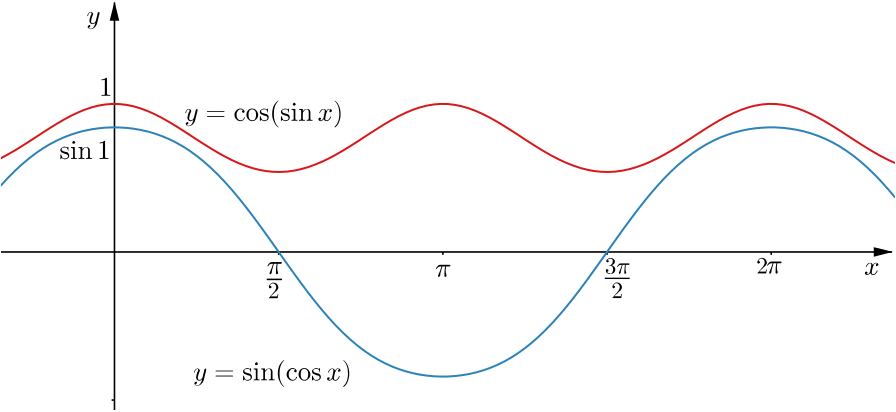
When x=0,π,2π the value of cos(sinx) is 1, which must be the maximum value of the function. This means the period of cos(sinx) could be π.
-
sin(cos2π)=sin(cos0)=sin1. The value sin1 must be positive, but as sinx does not reach 1 until x=2π, sin(cos0)<1. Similarly sin(cosπ)=sin(−1)=−sin1>−1.
-
sin2π=1, so cos(sin2π)=cos1, which is positive, but less than 1. Also, cos(sin23π)=cos1 because of the period of cos(sinx).
-
cosx=0 when x=2π and x=23π so sin(cosx)=0 at these points.
This means that cos(sinx)>sin(cosx) at 0,2π,π,23π and 2π. The values of cos1 and sin1 seem to be important. Without using a calculator or graphing software, how could you decide which of these values is bigger?
Behaviour between special points
Positive and negative
As cosx is negative between 2π and 23π and sinx is negative for x between −1 and 0 the value of the function sin(cosx) must be negative for x between 2π and 23π.
What does the same reasoning tell us about cos(sinx)?
Symmetry
As
cosx
is an even function and
sinx
is odd,
cos(sin(−x))=cos(−sinx)=cos(sinx)
and
sin(cos(−x))=sin(cosx)
, so both functions are even. As well as telling us that the
y
-axis is a line of symmetry of the graphs of
y=sin(cosx)
and
y=cos(sinx)
, this also shows that these graphs are symmetric about the line
x=π.
(For example,
sin(cos(π−x))=sin(cos(x−π)).
) This helps because we are interested in what happens between
0
and
2π.
Increasing and decreasing behaviour
For x between 0 and 2π, sinx increases from 0 to 1 and cosx decreases, so cos(sinx) decreases from 1 to cos1. On [2π,π], sinx decreases from 1 to 0 and cosx decreases from 0 to −1. This means that cos(sinx) increases from cos1 to 1 and therefore has a minimum when x=2π. What happens between π and 2π?
These ideas, can be used to show that cos(sinx) has a period of π and its range is [cos1,1] whereas sin(cosx) has period 2π and its range is [−sin1,sin1].
For all the points considered, cos(sinx)>sin(cosx) and we now know a lot about the graphs y=cos(sinx) and y=sin(cosx). It seems reasonable to conjecture that cos(sinx)>sin(cosx) for all x, but to convince ourselves that this is true, we need to show that the graphs do not cross anywhere.
Do the graphs of y=cos(sinx) and y=sin(cosx) ever cross?
The graphs can’t cross between 2π and 23π because sin(cosx) is negative here, but what about between 0 and 2π or between 23π and 2π?
We want to know whether cos(sinx)=sin(cosx) has any solutions for x in [0,2π]. Now, if cosa=sinb then a=2π−b, so a+b=2π, or in our case sinx+cosx=2π.
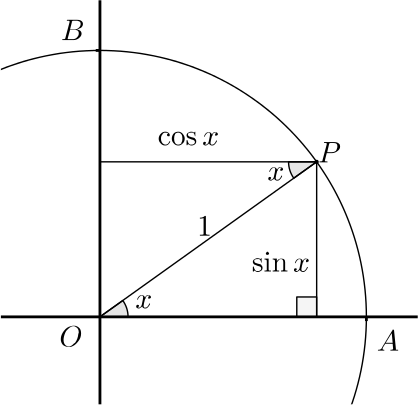
The diagram shows part of a circle of radius 1 and an angle x between 0 and 2π. The length of arc APB is 2π, but sinx is smaller than the length of arc AP and cosx is smaller than the length of arc PB.
Therefore sinx+cosx<2π so cos(sinx)=sin(cosx) does not have any solutions in [0,2π]. The symmetry of the graphs about x=π, means that there aren’t any solutions in [23π,2π] either. Therefore cos(sinx) is larger than sin(cosx) for all real x.
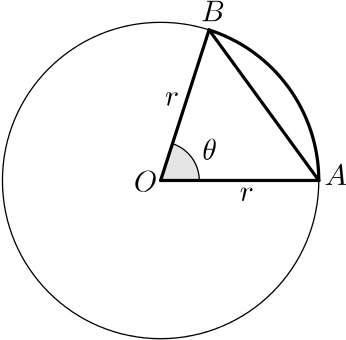
Another approach is to use the inequality sinθ<θ for positive θ. To see how this inequality arises, consider the diagram below. This shows the chord AB of a circle subtending an angle θ at the centre of the circle, where 0<θ<π.
If we compare the areas of the triangle OAB and the minor sector OAB, we get 21r2sinθ<21r2θ and therefore sinθ<θ.
We can combine this inequality with the increasing and decreasing behaviour of sinx and cosx on [0,2π] to show that sin(cosx)<cosxandcos(sinx)>cosx
Therefore cosx is always sandwiched between sin(cosx) and cos(sinx) for x between 0 and 2π. As above, the symmetry of the graphs completes the proof that cos(sinx) is larger than sin(cosx) for all real x.
Graph