Definition of Derivatives (Edexcel IAL Maths)
Spec point —
4.1
Definition of derivatives
What is the derivative of a function?
-
Differentiation is an operation that calculates the rate of change of a function with respect to a variable
- This means how much the function varies when the variable increases by one unit
-
To differentiate a function (f(x)) with respect to the variable x we use the notation
-
The result is called the derivative
What is the link between derivatives and gradients?
-
The rate of change of a function f(x) with respect to x can be thought of as the gradient function of the graph y = f(x)
-
We can write the gradient function (or derivative) as
- or
-
-
The rate of change of a function (or the gradient of its graph) varies for different values of x
-
For a linear function f(x)* *= mx + c the gradient is constant
- We can write this as or
-
For the quadratic function f(x) = x² the gradient varies
- Near the origin the gradient is close to 0
- As x increases the gradient of the graph increases
-
How can I find the derivative of a function at a point?
-
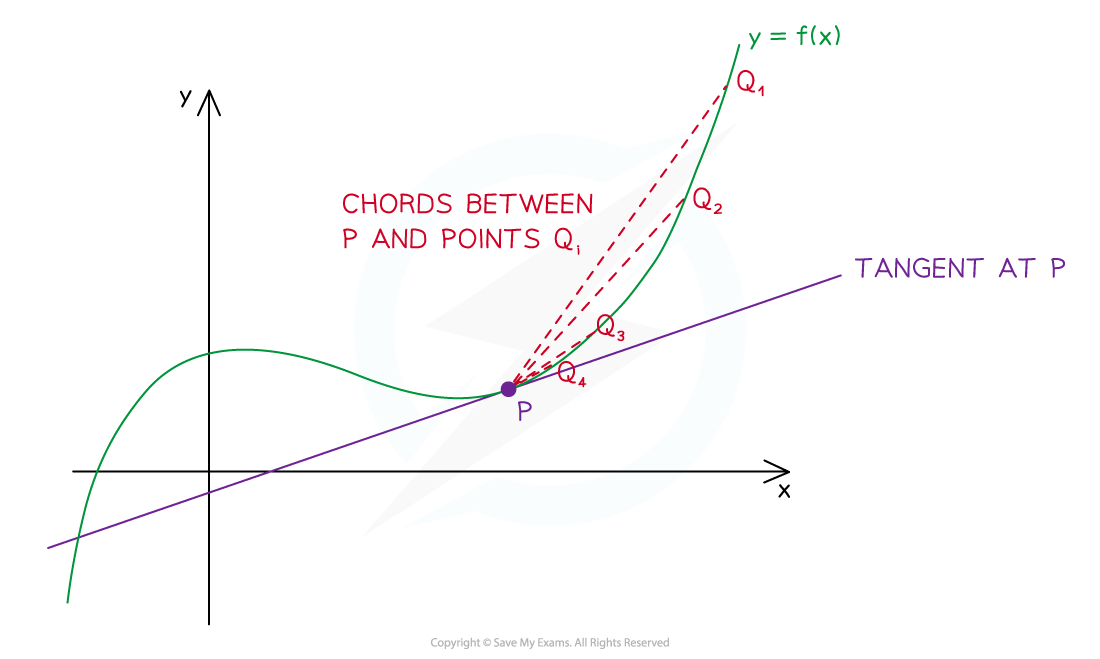
The derivative of a function (or gradient of its graph) at a point is equal to the gradient of the tangent to the graph at that point
-
To estimate the gradient you could draw the tangent and calculate its gradient
-
To find the actual gradient at a point x
-
Pick a second point on the curve close to the first point (call it x + h)
-
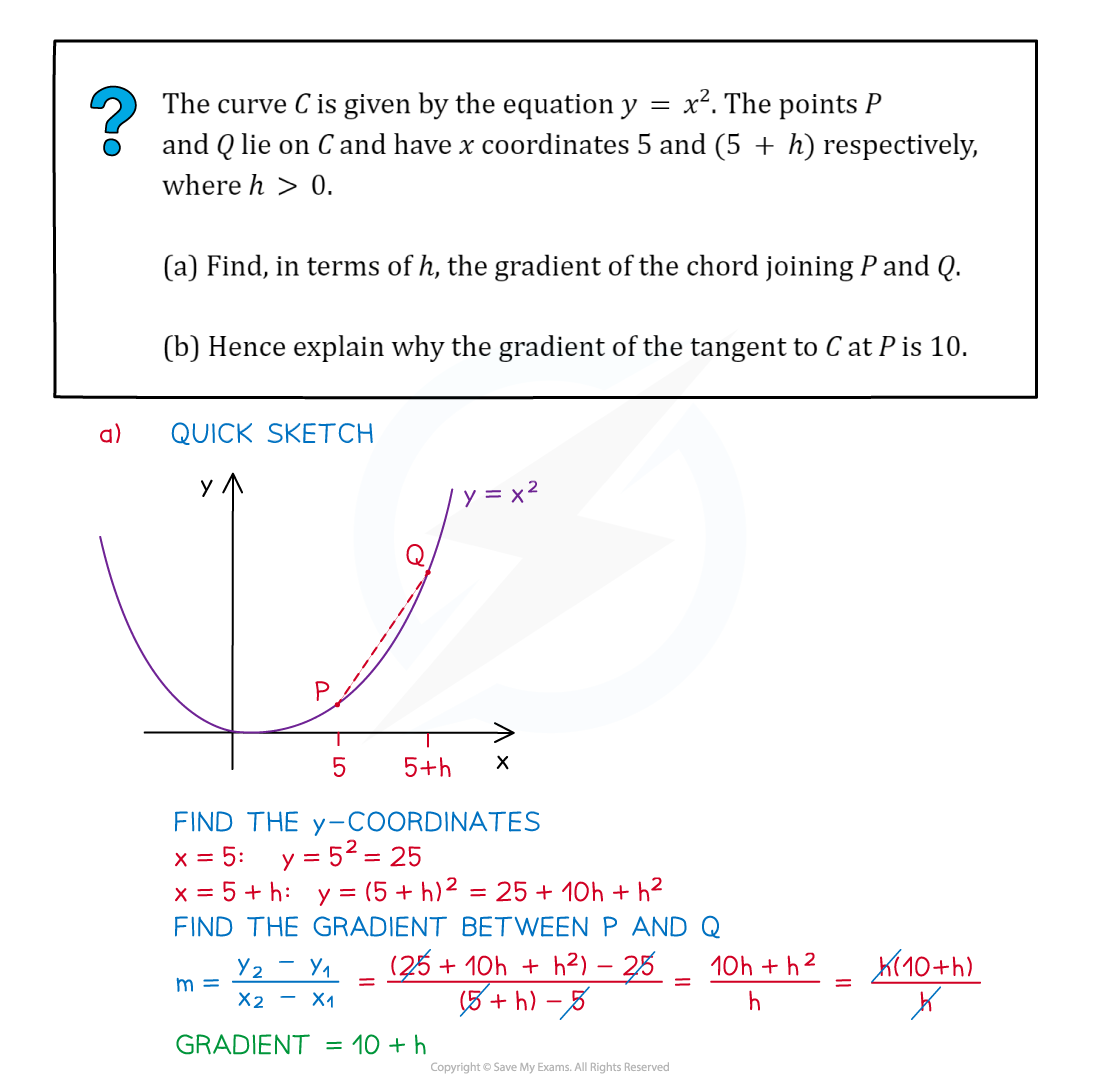
Calculate the gradient of the chord joining the two points
-
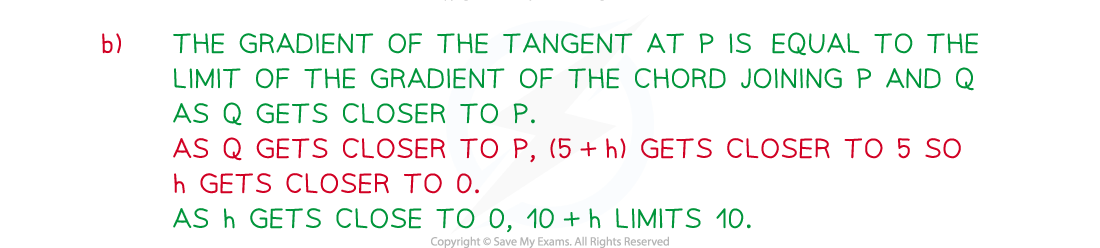
Move the second point closer to the first point (make h get close to zero)
-
Examine what happens to the gradient of the chord
-
The gradient of the tangent will be the limit of the gradients of the chords
- You do not need to remember this formula
-
Worked Example
Exam Hint
- Deriving a derivative from scratch is not examinable
- This revision note is intended to give you an understanding of what derivatives do
Was this revision note helpful?
Build on this topic