F = ma & Vector Notation (Edexcel IAL Maths)
Forces in 2D - Vector Notation
Spec point —
5.1
How are forces and vectors linked?
- Forces are vectors – they have magnitude and direction.
- The magnitude of a force is measured in Newtons and the direction of a force is an angle, usually measured in degrees, anti-clockwise from the horizontal
- There are other ways to talk about direction – in particular Cartesian coordinates(x, y)* are used to describe the position of a point in two-dimensional space (plane), relative to a fixed origin O.
- You may see questions start with a sentence along the lines of “Relative to the frame of reference Oxy …” – this means the two-dimensional space (plane) and distances within it will be based on horizontal (x) and vertical (y) components relative to the origin O.
What is vector notation?
-
Forces in 2D should be given in the form pi +qj where i and j are unit vectors
-
Both column vectors and i, j notation can be used for calculating resultant vectors
- Column vectors can be useful when calculating with vectors as mistakes are less common, but you must remember to change the answer back to i, j notation form
-
A force written as a vector is written with its two components separated so the magnitude and direction of the vector are not directly known
What are the notations for magnitude and direction?
- The magnitude of the force F N would be denoted by |F| N or F N – notice the use of bold and italics in particular
- Direction is an angle, usually measured in degrees anti-clockwise from the horizontal, θ° is usually used
How do I find the magnitude and direction of a force from its components?
-
For a force F = xi + yj N to find
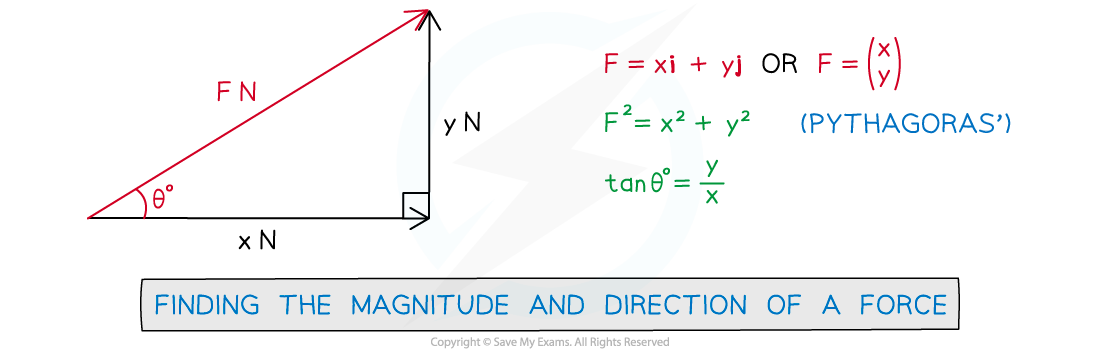
- its magnitude, |F| N or F N, use Pythagoras’ theorem
- its direction (as an angle), use a diagram and trigonometry
-
If either (or both) components are negative then still use a diagram and but
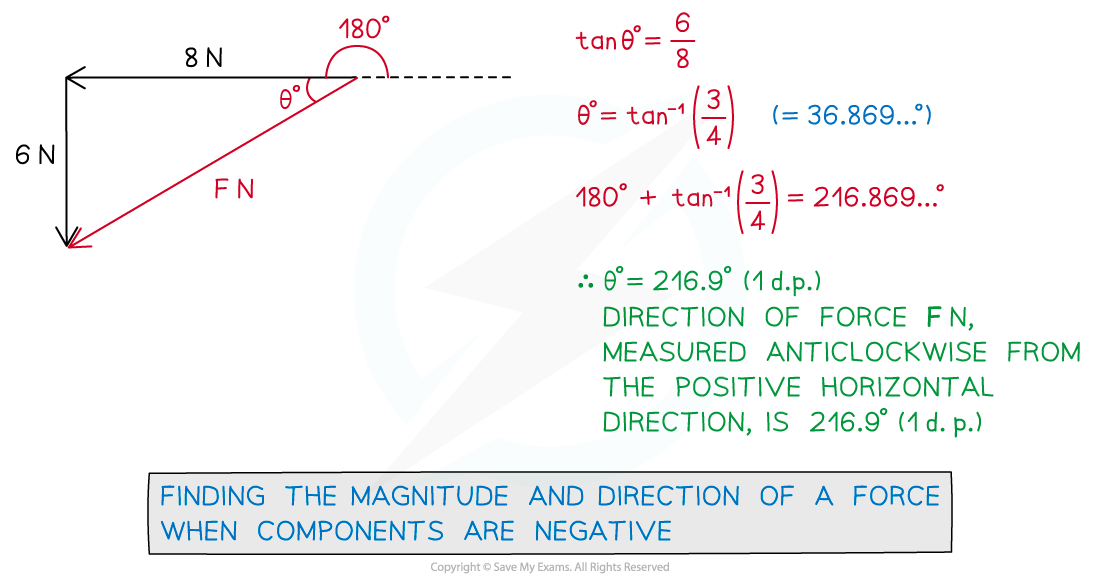
- treat x and y as positive (so |x| and |y| strictly speaking)
- the angle found from may need adjusting depending on where, and which way, the direction is being measured from e.g. Find the direction at which the force F = (-8i - 6j) N, giving your answer as an angle measured in degrees anti-clockwise from the positive horizontal direction
What does equilibrium with vectors mean?
-
In two dimensions a particle is in equilibrium if the resultant force acting on it in both directions is zero
- For vectors in i-j notation, a resultant force of zero would look like (0i + 0j) N
- Both forms may be written as 0 N (called ‘the zero vector’)
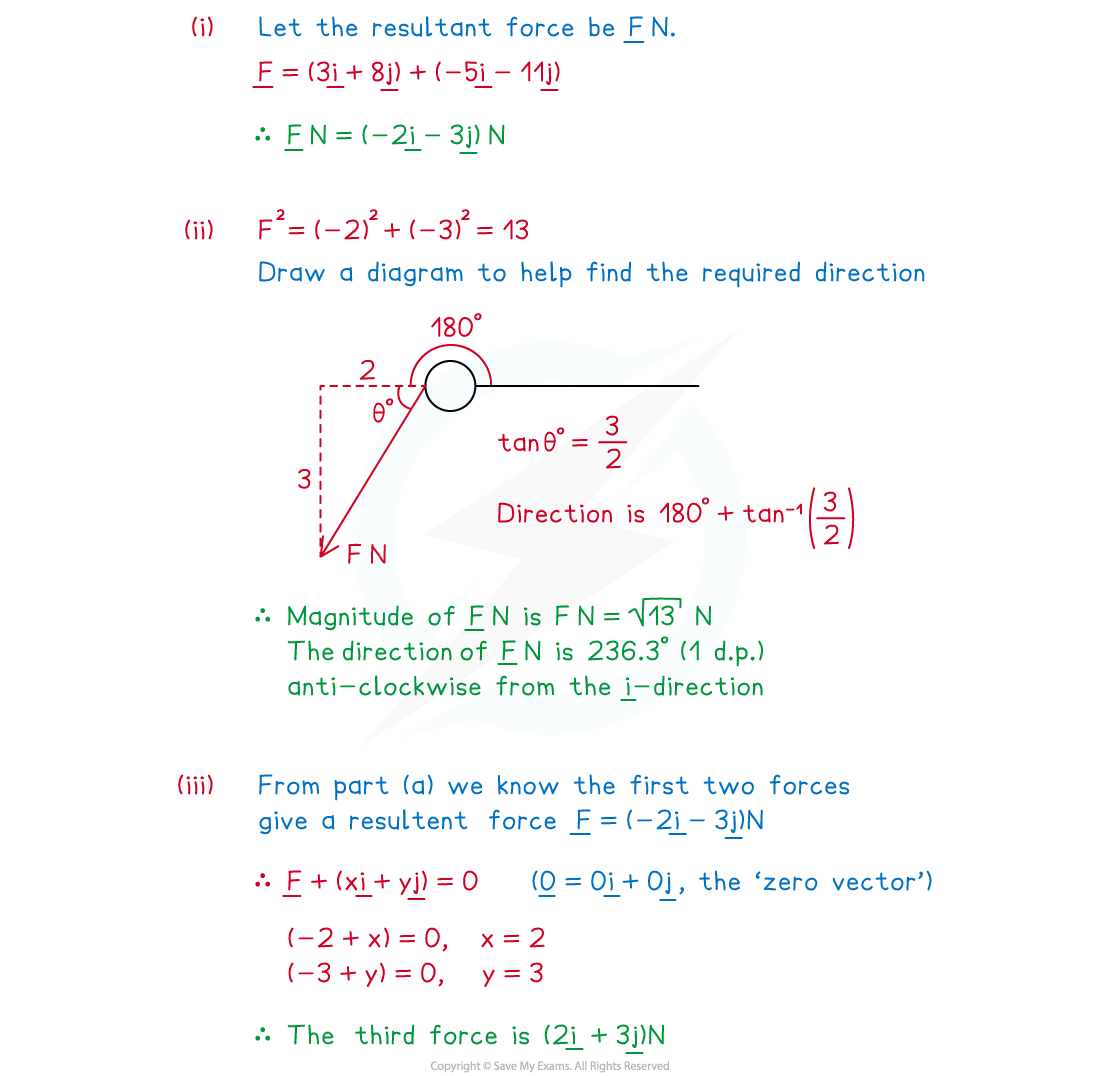
Worked Example Two forces, (3i + 8j) N and (—5i — Ilj) N act on a particle.
(i) Find the resultant force.
(ii) Find the magnitude of the resultant force and its direction as an angle measured anti-clockwise from the i-direction.
(iii) A third force is applied to the particle such that it is brought into equilibrium. Find the third force, giving your answer in the form
Answer:
Exam Hint
- Ideally you should stick to the i-,j- vector notation used in a question but if you prefer to use column vectors within calculations you can use a mixture within the same question. Just be careful your final answer is in the correct format.
- Draw diagrams – including ‘mini’-diagrams of individual forces/vectors – this can help in understanding a problem and being accurate.
Was this revision note helpful?
Build on this topic