Connected Bodies (Lifts) (Edexcel IAL Maths)
Connected Bodies - The Lift Problem
Spec point —
4.2
Connected bodies (lifts)
What is a lift problem?
-
A lift problem involves objects (particles) that are directly in contact with each other – typically a person or crate in a lift
-
If it is not a person in the lift the object is often referred to as a load
-
There may be more than two objects involved – for example two crates stacked on top of each other on a lift floor
-
Vertical motion is involved so use g m s-2, the acceleration due to gravity, where appropriate
- Gravity always acts vertically downwards
- Depending on the positive direction chosen – and which other forces are acting vertically – acceleration (a m s-2) may be positive or negative
-
Remember that acceleration links F= ma (N2L) and the ‘suvat’ equations
How do I solve 'lift problem' questions?
-
Lift problems will only consider motion in the vertical direction
-
As motion is involved Newton’s Laws of Motion apply so use “F = ma” (N2L)
-
The steps for solving lift problems are the same as for solving rope problems
-
As both the lift and load are travelling in the same direction the system can be treated as one particle (as well as separate particles)
- There is no reaction force acting on the lift or load when treating the particle as one - mathematically they cancel each other out
- You can think of the upward force as counteracting the person’s weight and moving the load upwards; N3L applies so there must be an equal force acting in the opposite direction; - you can think of this as the force keeping the person in contact with the lift floor whilst it is moving
-
For constant acceleration the ‘suvat’ equations could be involved
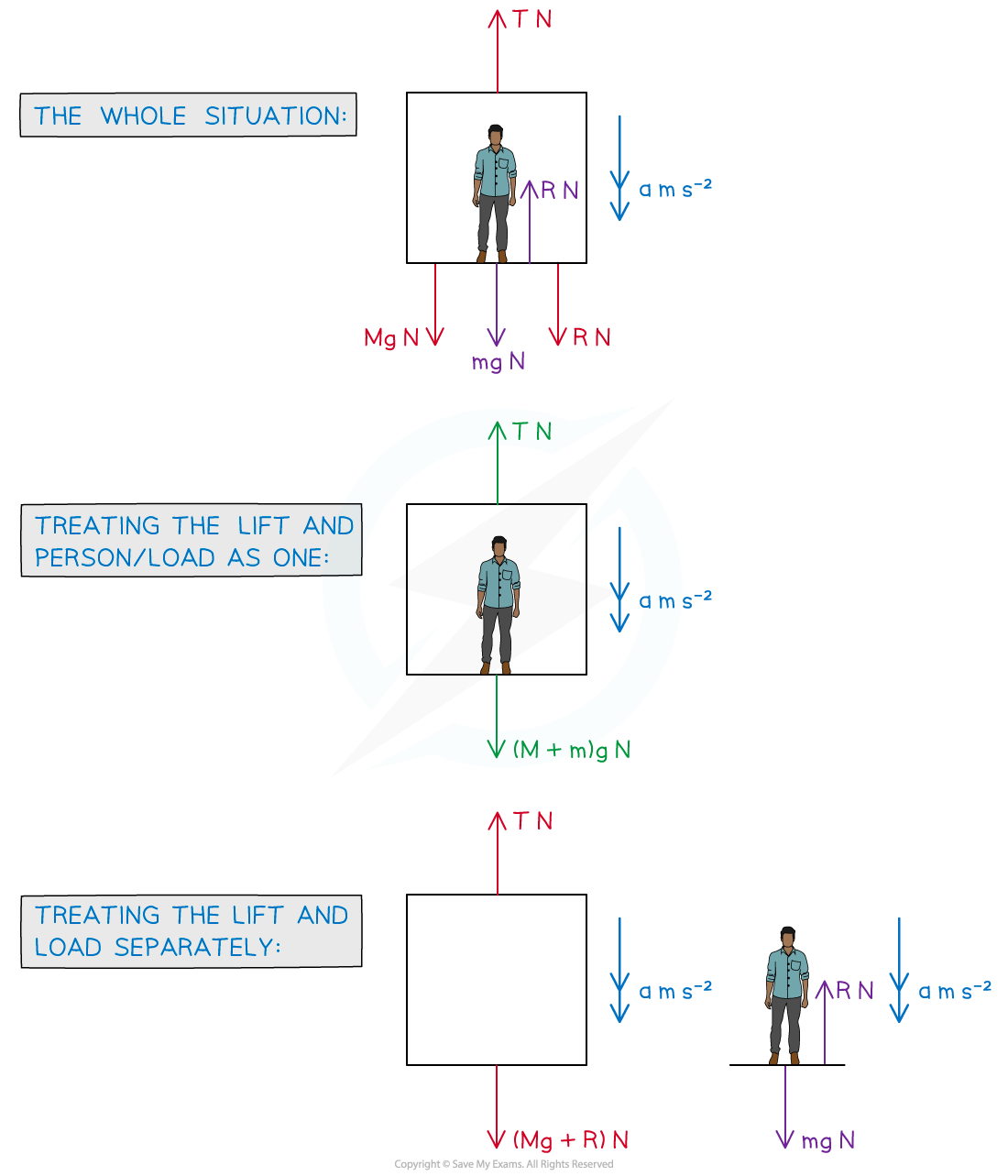
How do I find equations for problems involving lifts?
-
Form the equations as follows:
- Treating the lift and person/load as one
- (↓) (M + m)g - T = (M + m)a
- Treating the lift and person/load separately Lift: (↓) (Mg + R) - T = Ma
- Person/load: (↓) mg - R = ma
-
You do not necessarily need all equations but if in doubt attempt all and it may help you make progress
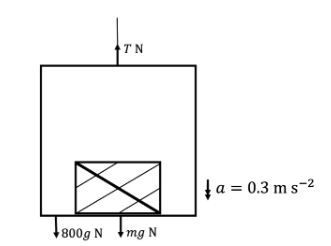
Worked Example A lift of mass 800 kg is moving vertically downwards with acceleration 0.3 m s -2. A load of mass m kg lies on the floor of the lift. The reaction force exerted on the load by the lift is 399 N.
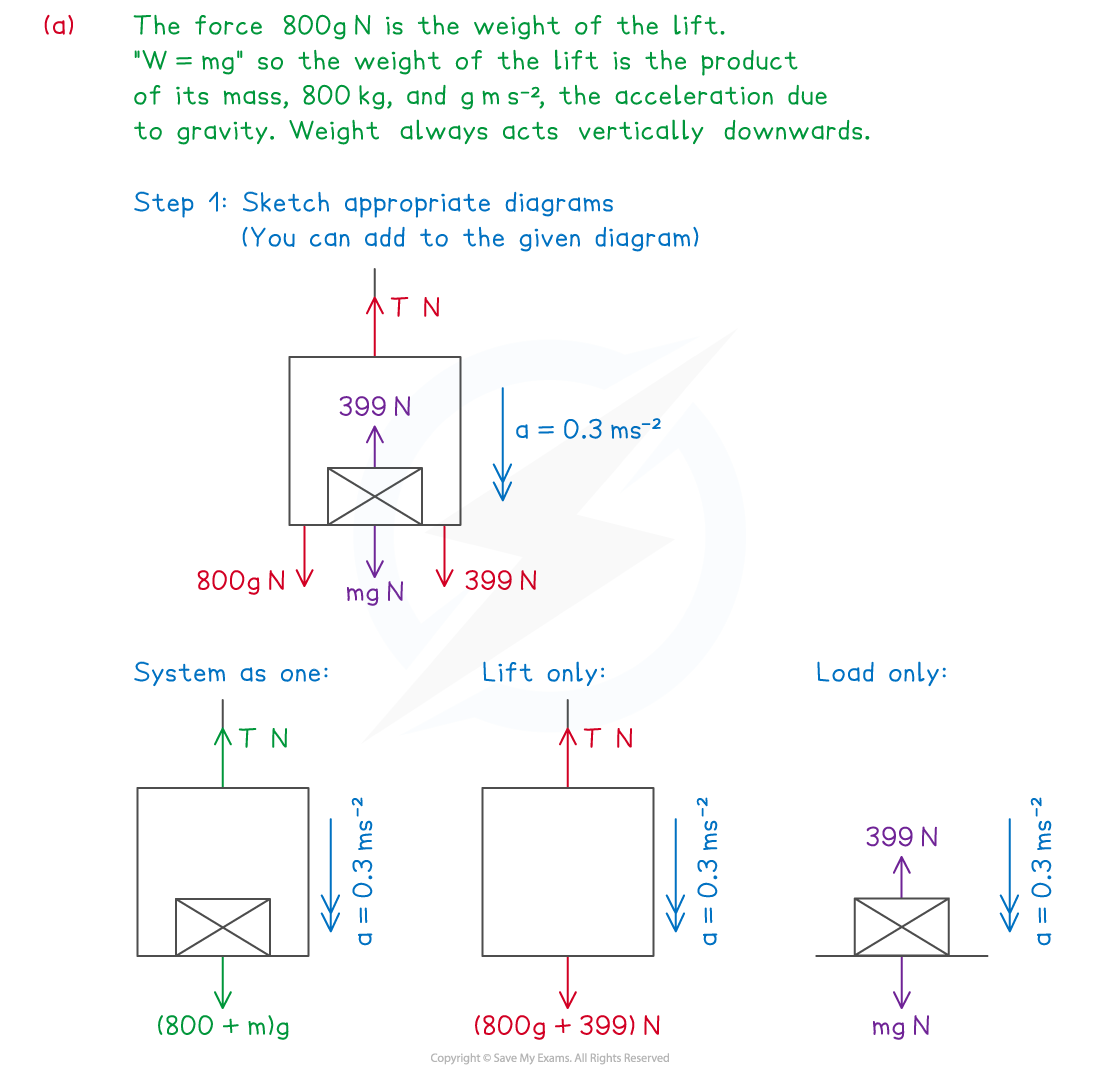
(a) Briefly explain how the force of 800g N arises in this problem.
Answer:
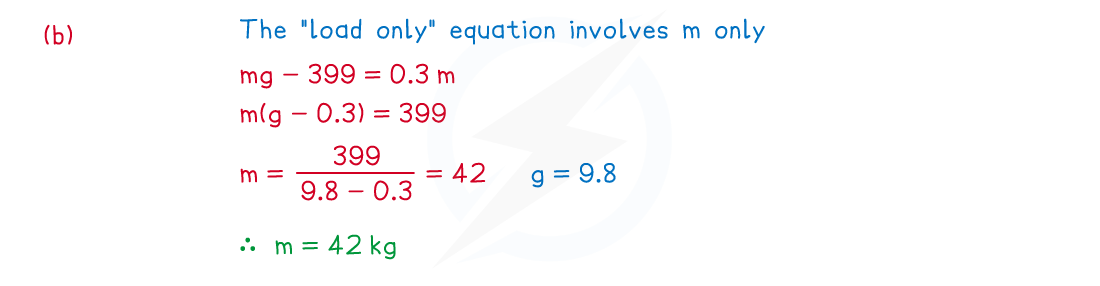
(b) Find the mass of the load, m kg .
Answer:
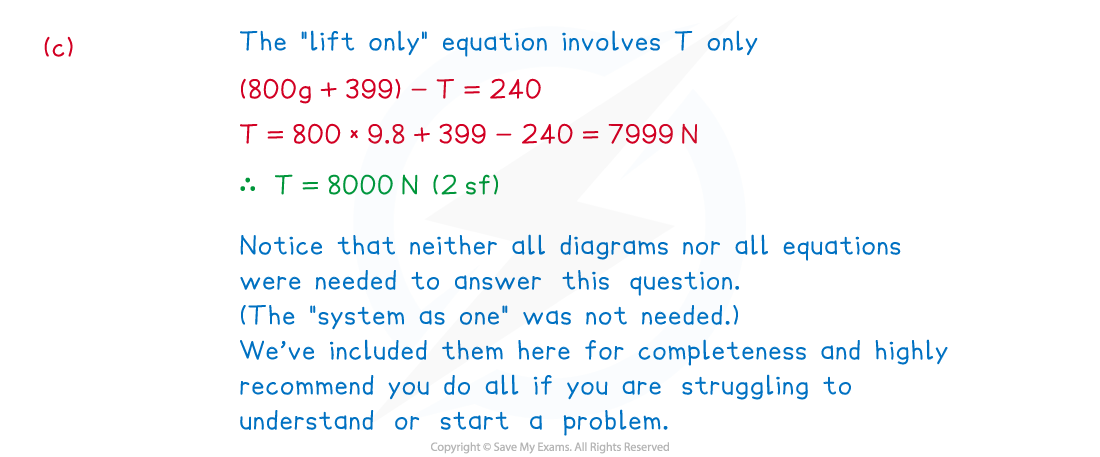
(c) Find the tension,T N, in the cable of the lift.
Answer:

Exam Hint
- Sketch diagrams or add to any diagrams given in a question.
- If in doubt of how to start a problem, draw all diagrams and try writing an equation for each. This may help you make progress as well as picking up some marks.
- Watch out for “hidden lift” problems – we’re not strictly talking elevators here! For example, a load being raised by a crane; the “lift” would be a platform (such as a pallet) and the “lift cable” would be the cable connecting the crane to the load. Another common alternative is a fast rising (or falling) fairground ride.
Was this revision note helpful?