Using Moments with Equilibrium (Edexcel IAL Maths)
Using Moments - Equilibrium
Spec point —
6.1
Using moments with equilibrium
What is the resultant moment for a body in equilibrium?
-
If a rigid body is in equilibrium then:
- The resultant force is 0 N
- The resultant moment about any point is 0 N m
-
The sum of the magnitudes of the clockwise moments equals the sum of the magnitudes of the anti-clockwise moments
How do I use F = ma and moments to solve equilibrium problems?
-
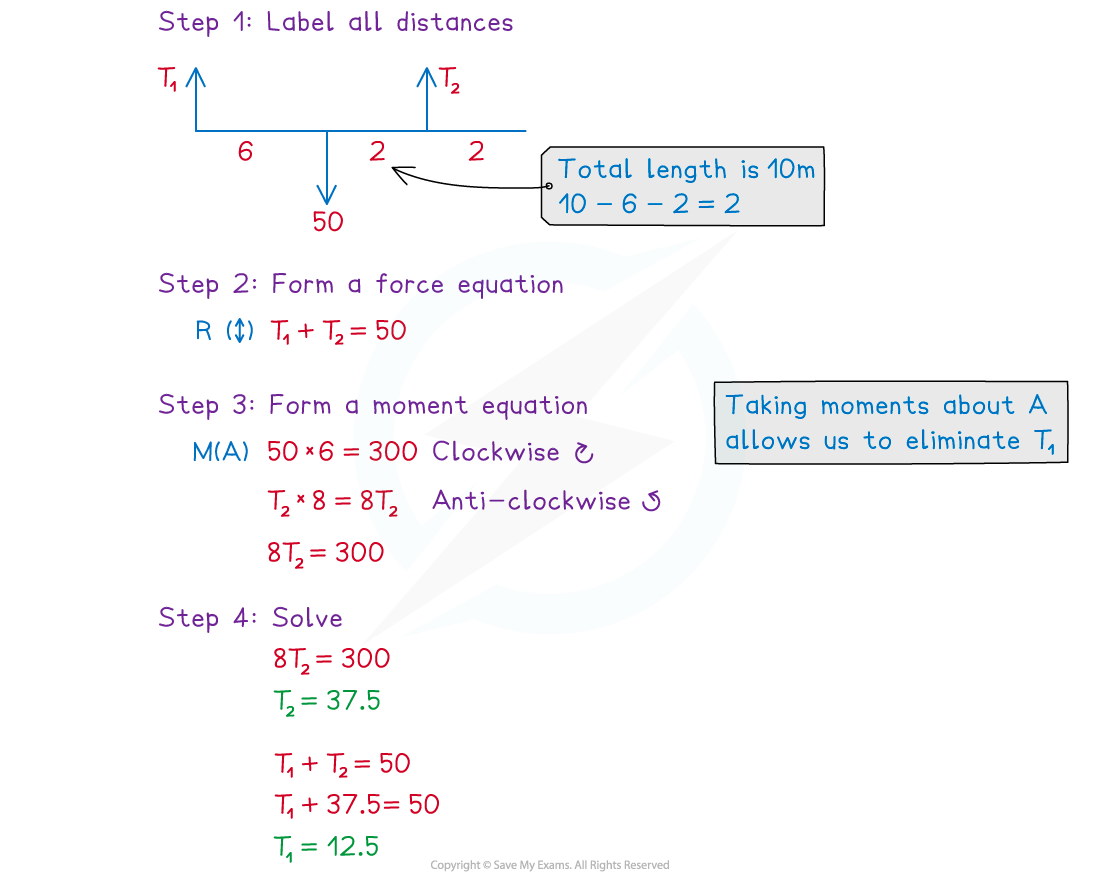
Step 1: Identify all forces and perpendicular distances from the pivot
-
Step 2: Use the fact that the resultant force is 0 N to form an equation
-
Step 3: Use the fact that the resultant moment about any point is 0 N m to form equations
- If there is an unknown force you can choose a pivot that is on the line of action of that force – this will mean that the moment of that force is 0 N m
-
Step 4: Solve the equations
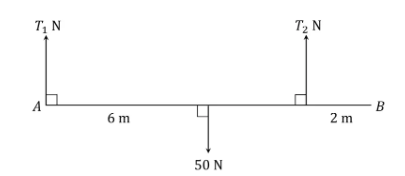
Worked Example A light rod AB of length 10 m is held in equilibrium by three forces: 50 N, T1 N and T2 N.
T1 N acts vertically upwards at A, 50 N acts vertically downwards 6 m away from A and T2 N acts vertically upwards 2 m away from B as shown in the diagram.
Find the values of T1 and T2.
Answer:
Exam Hint
- If you see a force diagram that involves distances then you can be fairly sure that moments will be involved! A clear diagram showing all the distances is key.
- If you pick a pivot and form a moment equation which involves more than one unknown, try choosing another pivot to form simultaneous equations.
- Pick your pivot wisely as unknown and unwanted forces can be eliminated from the equation by choosing the point to be on the line of action of a force.
Was this revision note helpful?
Build on this topic