Working with Vectors (Edexcel IAL Maths)
Spec point —
2.2
Working with Vectors
Vectors represent a movement of a certain magnitude (size) in a given direction. They are used throughout mechanics to describe forces and motion
How are Vectors used in Mechanics?
-
Vector questions are often embedded in a Mechanics context
-
Vectors will most commonly represent forces , accelerations or velocities, they can also represent displacement
-
Newton’s Second Law F = ma is essential When a particle is in equilibrium, the vector sum of the forces on it is equal to zero
- Remember that F and a (force and acceleration) are vectors, while m (mass) is a scalar
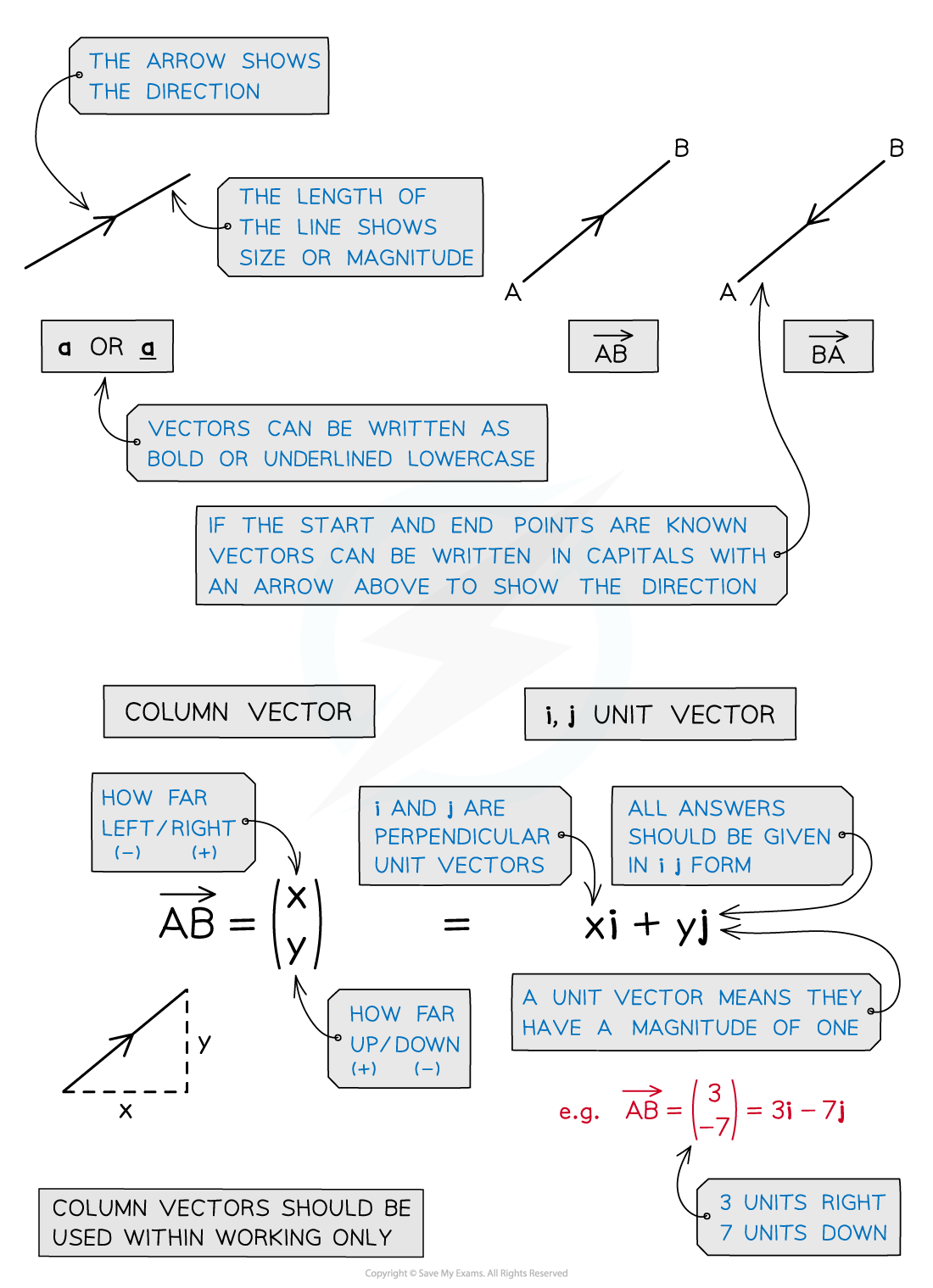
What is vector notation?
-
There are two vector notations used in A level mathematics:
- i and j notation: i and j are unit vectors (they have magnitude 1) in the positive horizontal and positive vertical directions respectively e.g. The vector (-4i + 3j) would mean 4 units in the negative horizontal (x) direction (i.e. left) and 3 units in the positive vertical (y) direction (i.e. up)
- Column vectors: This is one number written above the other enclosed in brackets,
e.g. The (column) vector meaning 3 units in the positive horizontal (x) direction (i.e., right) and 2 units in the negative vertical (y ) direction (i.e., down) can be written as:
-
In Edexcel International A Level Mechanics you must give your final answer using the i and j notation form
- You may use column vectors within your working to make calculations easier
- Remember to convert your final answer back to the correct form
-
As they are vectors, i and j are displayed bold in textbooks and online but in handwriting they would be underlined (i and j)
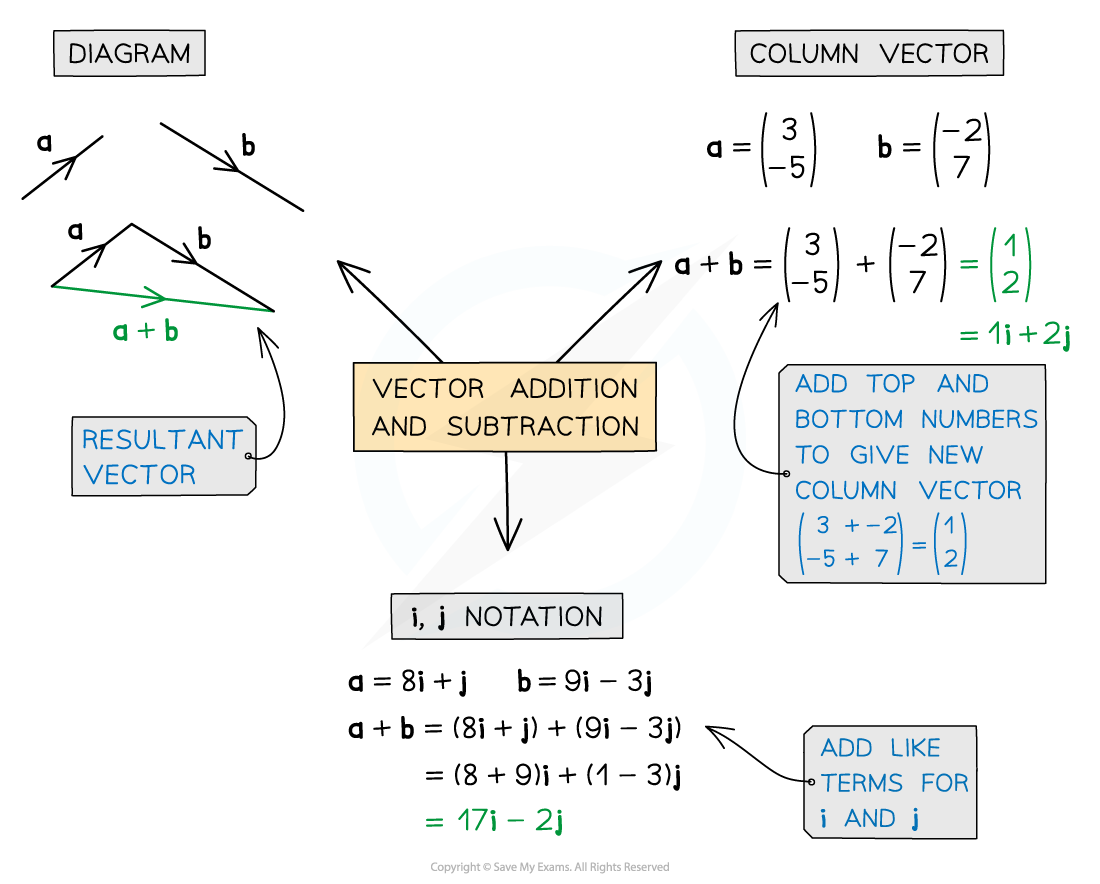
Calculating Resultant Vectors:
-
Adding vectors together gives the resultant vector
-
The vectors can be placed nose to tail for a diagram of the resultant vector
-
Both column vectors and i, j notation can be used for calculating resultant vectors
- Remember to give final answer using i, j notation
-
This is the same when adding force vectors; the resultant force is simply the force vectors added together
-
Forces in equilibrium have a resultant force equal to zero
Calculating Magnitude and Direction:
-
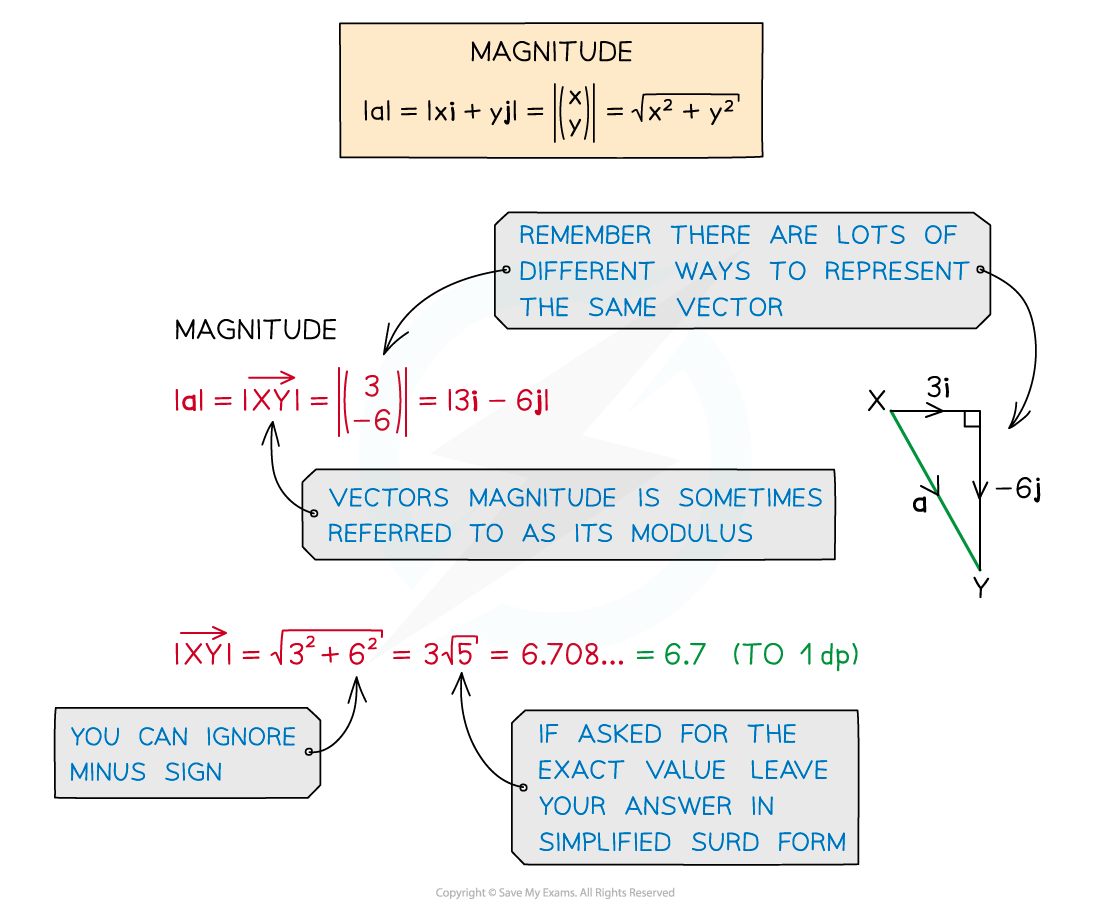
Pythagoras is used to find the magnitude of a vector .
- The magnitude of a displacement vector is the distance
- The magnitude of a velocity vector is the speed
-
Trigonometry is used to find the direction of a vector
- Always draw a diagram, the i and j components will be the opposite and adjacent sides of the right-angled triangle
- The direction is given as the angle the vector makes with the horizontal
-
You may be asked for the direction as a bearing. The unit vector j can be used to represent north and the unit vector i can be used to represent east.
- A unit vector has a magnitude of one
- In the case where k > 0
-
If a particle is moving north then its velocity will have a vector of *kj
-
if a particle A is due south of another particle B then the displacement vector from B to A will have the form -*kj
-
If a particle is moving east then its velocity will have a vector of *ki
-
if a particle A is due west of another particle B then the displacement vector from B to A will have the form -*ki
-
If the position vectors of two particles have the same j component, then the particle with the greater i component will be positioned due east of the other
-
If the position vector of a particle has equal i and j components then it is positioned due north - east of the origin
- if a particle A is north – east of another particle B then the displacement vector from B to A will have equal i and j components
Resolving Vectors:
- A single vector can be broken down into its parts, or components, that will be perpendicular to each other
- Resolving a vector means writing it in component form (as i and j components)
- Given the magnitude and direction of a vector you can work out its components and vice versa
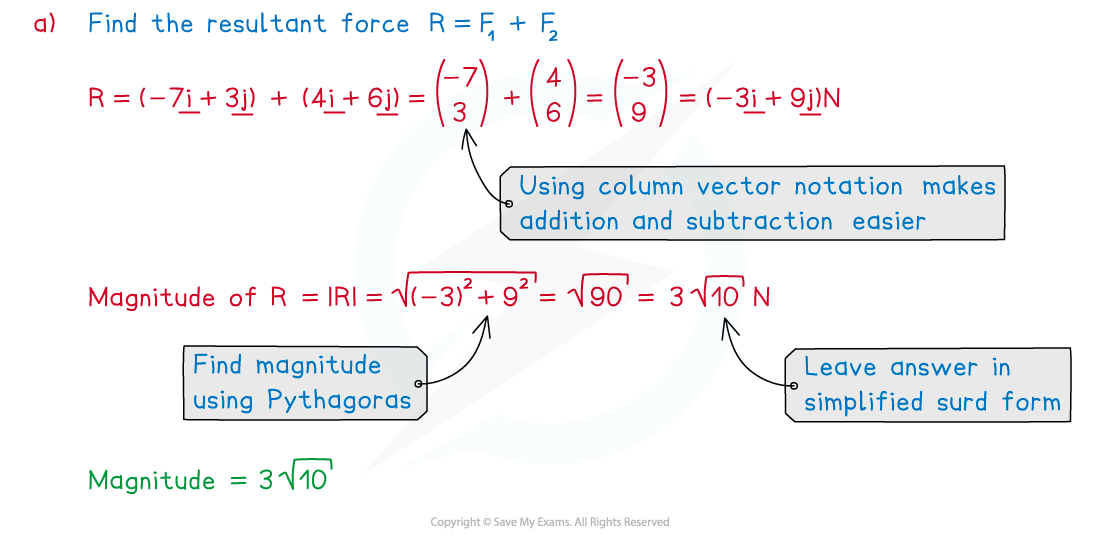
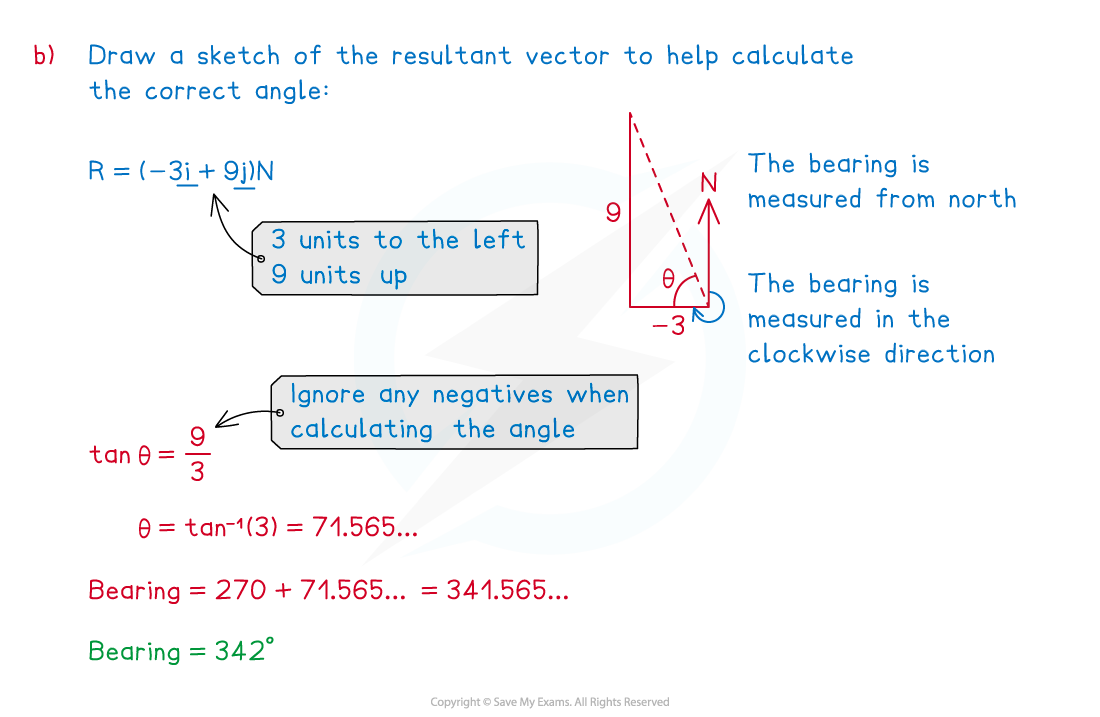
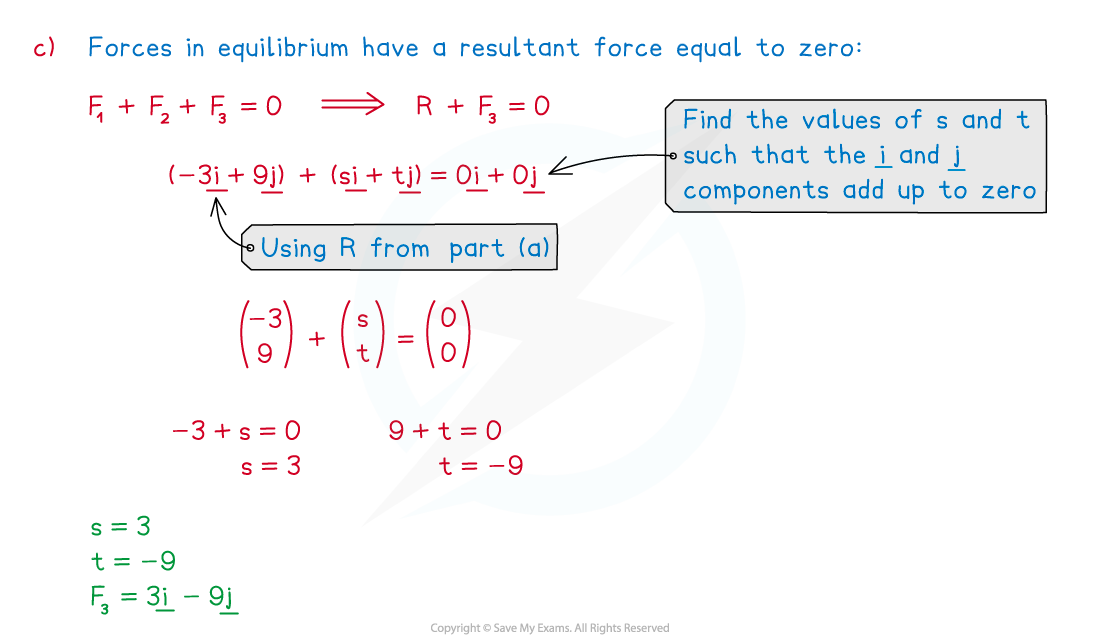
Worked Example Two forces F1, F2 act on a particle P. F1 = -7i + 3j and F2 = 4i + 6j.
a) Find the magnitude of the resultant force R acting on the particle.
Leaving your answer as a simplified surd.
Answer:
b) Find the bearing of the resultant force R.
Give your answer to the nearest degree.
Answer:
A third force F3 = si – tj brings the particle into equilibrium.
c) Find s and t and state the force for F3 in terms of i and j.
Answer:
Exam Hint
- When working with vectors pay attention to accuracy, leaving magnitude in surd form or correct to 3.s.f.
- In your exam you can’t write in bold so should underline your vector notation
Was this revision note helpful?
Build on this topic